I haven't talked much on this blog about moral arguments for the existence of God, at least not explicitly. In a way this is a bit odd, because my first book can be viewed as offering one kind of moral argument--not for the existence of God, but for the legitimacy of having faith in God's existence.
Moral arguments for God's existence, or for religious faith, fall right at the intersection of my main philosophical interests. In this post, I want to consider one such intersection: The need for moral arguments for God to engage with the diverse range of ideas that fall under the heading of what is called "meta-ethics."
Off and on I've posted things on this blog pertaining to what is called "meta-ethics," although I've tended to eschew that term. The field of meta-ethics is perhaps best understood in terms of the questions it asks, which in turn are best understood as question about the answers to lower-level ethical questions. Such lower-level questions are usually categorized as either "applied" or "normative." Applied ethics asks questions like the following: "Is it always wrong for a person to terminate an unwanted pregnancy?" Normative ethics, meanwhile, asks more general-level questions about the nature of morality, such as,"Are there some things that are wrong regardless of the consequences, or is the moral status of an action always a function of its outcomes?"
Meta-ethics steps back, looks at the answers to such lower-level questions, and asks about the nature of these answers. When you say that deliberately terminating a pregnancy is always wrong, are you asserting something of pregnancy-terminations that you take to be true of them, namely that they always have the property of wrongness? If so, what kind of property, exactly, is "wrongness"? And if not, what are you doing when you say these words?
When I say that the end does not always justify the means, am I asserting a fact which is either true or false apart from how I feel? Or am I simply expressing, say, a general-level feeling about actions that prioritize ends over means? Or am I, perhaps, simply voicing my personal commitment never to let consideration of ends trump consideration of means? If I'm asserting a fact, is it morel like a mathematical fact ("2+2=4"), an empirical one ("There are two beers in the fridge"), or a socially constructed one ("Barack Obama is President of the United States")? Or are moral facts unlike any of these?
When I've wandered into meta-ethics on this blog, it has generally been in relation to the question of whether moral claims are "objective" or "subjective." This is a classic way of attempting to get at one of the most crucial meta-ethical questions: Does a moral judgment have a truth value that is independent of the preferences/attitudes/beliefs of the individual making the judgment?
Although I haven't explicitly pursued the connection here, these meta-ethical questions have bearing on issues in the philosophy of religion. More precisely, there's one especially widespread kind of moral argument for God's existence whose soundness depends on some very precise answers to a number of questions in meta-ethics. The species of argument I have in mind has something like the following form:
1. Moral claims have an objective truth value, and some moral claims are true (they're not all false).
2. In order for moral claims to have this sort of objective truth value, theism must be true (or at least metaphysical naturalism must be false).
3. Therefore, theism is true (or metaphysical naturalism is false).
(Clarifying note: What is premise 1 saying? Here's a rough elaboration: A moral claim attributes a property of a certain kind--what we might call a normative property, such as "right" and "good"-- to such things as persons, actions, character traits, and states of affairs. Premise 1 is saying, first, that some of these attributions are correct and others incorrect; and second, that what makes the correct attributions correct is something apart from anyone's (individual or group's) actual approval or disapproval, acceptance or rejection, of that which is being called good or right, etc.)
Typically, the case for the first premise of such an argument rests on an appeal to basic moral intuitions. We are invited to consider a moral claim such as "Torturing children for fun is immoral." We are invited to think about what it would mean for such a claim to be treated as lacking in objective truth. If the implications of such thought experiments are deeply counter-intuitive, it follows that we intuitively accept the first premise. Once this is established, an effort is made to defend the second premise--that is, to show that in order to remain true to our intuitions--in order to underwrite the meta-ethical position we intuitively embrace--we must suppose there is a God. How this is done will vary greatly according to the version of the argument being considered.
A weaker form of this strategy of argument would hold that theism does a better job of making sense of our moral intuitions than does any form of naturalism; hence, theism is the best way (at least given our current understanding of matters) to underwrite those intuitions.
One crucial weakness of any such strategy of argument is this: Even if it works, the reasoning can work in both directions. As one of my friends from graduate school once quipped, "One person's modus ponens is another person's modus tollens." (I won't explain the terms. Google them if you care.) In a nutshell, if you agree that given your intutions premise 1 should be accepted, and you accept 2, you actually have two choices: accept theism or reject your intuitions. And there are some who find theism so implausible (or naturalism so obvious) that they are more than ready to take the second option.
But this is hardly the only way to resist the conclusion of a moral argument along these lines. In fact, there are meta-ethicists who question whether our intutitions really speak as strongly in favor of premise 1 as defenders of this sort of argument suppose. Furthermore, there are meta-ethicists who deny premise 2, having offered quite sophisticated defenses of naturalistic accounts of objective moral truth
Put simply, both premises 1 and 2 make meta-ethical claims that can be and have been challenged in the philosophical literature.
Let's start with the first premise. I have formulated this premise so that it would be true if either of two important meta-ethical positions is correct: (i) moral realism and (ii) objectivist versions of constructivism. Moral realism is, roughly, the view that there are moral facts "out there" whose truth is independent of what any individual or group, even an "ideal" one, does or would think/feel/endorse. Objectivist versions of constructivism hold, roughly, that moral truth is determined by the judgments that would be made by a person or community under certain ideal conditions--for example, under the condition that the individual were being perfectly rationally consistent in the presence of complete knowledge of all relavant facts. In other words, what makes some moral claim true is that the moral claim would be endorsed by the ideally-situated person or group (not by what anyone actually endorses--actual endorsements are correct or incorrect based on their correspondence to this ideal). This view is to be distinguished from subjective and relativistic versions of constructivism. Subjectivism holds that a moral claim is true if it correctly reports the actual contingent thoughts/feelings/attitudes of the individual making the report. Relativism holds that a moral claim is true if it correctly describes that actual agreements reached by a given group, such as a culture or society.
The reason I've formulated premise 1 so that it encompasses both (i) and (ii) is simply this: In my judgment the intuitive case for objectivity in ethics (assuming it is convincing) would be satisfied by either of these theoretic approaches. This is not to say that I think both approaches can be philosophically developed or worked out with equal success. It is one thing to say that our intuitions would be satisfied if there were a moral truth "out there." It is something else to give a plausible account of what such moral truth would be like. It is one thing to say that our intuitions would be satisfied if there were some idealized perspective from which these intuitions would be reliably endorsed. It is something else to attempt to describe such a perspective and show that it would actually underwrite our moral intuitions.
In any event, what the first premise rules out are those meta-ethical views that deny that there are objective moral truths. These are: (a) noncognitivist theories (which hold that moral utterances don't have any truth value at all, since they don't assert anything but, instead, merely express attitudes or plans or some such); (b) subjective or relativistic versions of constructivism (sketched out above); and (c) "error theory" (which holds, in effect, that moral claims do have an objective truth value, but that all moral claims are objectively false in the way that all claims about the properties of non-existent things, like unicorns, are objectively false).
Premise 1 of the argument above effectively rejects each of these theories. But there are, of course, sophisticated meta-ethicists who have rigorously defended these alternative meta-ethical views, even in the face of the intuitive challenge. Simon Blackburn, for example, has been an importand defender of (a). Another, with whom I had dinner a couple of weeks ago, is Allan Gibbard. Gilbert Harman has defended (b). And John Mackie has defended (c). These philosophers have endeavored to account for the intuitions that seem to support an objectivist meta-ethical stance either by explaining the intuitions away or by showing that there remains a way to preserve the intuitions (perhaps in a modified form) within these alternative meta-ethical frameworks.
As to the second premise, there are some sophisticated moral realists who, in recent years, have attempted to stake out a version of moral realism that is thoroughly naturalistic (David Brink and Richard Boyd are good examples). Furthermore, there are a range of sophisticated theories--most of them inspired by Kant--that purport to provide an objective foundation for moral truth that is "constructivist" in the technical sense and which makes no appeal to God in the course of offering that foundation (John Rawls, Alan Gewirth, and Christine Korsgaard offer examplars of such approaches). In general, constructivist accounts of morality, whether objective or subjective or relative, are consistent with naturalism (even thought at least some constructivist theories may also be consistent with theism or other forms of supernaturalism). As such, there are a wide range of theories that would need to be discredited in order for the second premise of the above argument to remain anything more than controversial.
In short, moral arguments for the existence of God that have anything like the above structure need to tackle the entire range of meta-ethical literature. It's not enough that they be able to show how moral objectivity could be defended on theistic assumptions. They also need to show (a) that naturalistic forms of moral realism don't work as well as the favored theistic theory; (b) that objective forms of constructivism don't work as well; (c) that contrary to claims made by some noncognitivists, subjective constructivists, etc., these theories really do fly in the face of our moral intuitions; and (d) if one must choose between one's moral intuitions and a metaphysical naturalism, there is good reason to jettison the latter.
This is quite a project, to say the least. It's unlikely that even with a hefty book one could adequately pursue each elements of it (Robert Merrihew Adams has gamely attempted something along these lines with his Finite and Infinite Goods; but while I regard that books as a great intellectual achievement, it is hardly the final word on the subject--as is evidenced by the rich exchange, following the book's publication, between Adams and the naturalistic moral realist Richard Boyd).
So, even if I were inclined to defend this sort of moral argument for God's existence, I wouldn't be inclined to do so in a blog post. And the fact is, I'm not sure what to think about this moral argument. I'd love to find a version of it that convinces me when I put on my critical philosopher's hat, but I haven't yet.
There are, however, other kinds of moral arguments. Some I find myself more drawn to than others.
In fact, one way to read Is God a Delusion? would be to treat it as an extended defense of a moral argument, not for God's existence as such, but for the decision to have faith in the existence of God. Here's how I'd formally reconstruct the argument along these lines that is nascent in the book:
1. Some things are objectively morally good.
2. If naturalism were true, then reality at a fundamental level would be indifferent to what is objectively morally good (the basic constituents of and principles governing reality would, given naturalism, neither embody such goodness themselves nor reliably promote its expression or preserve/perpetuate that which expresses it).
3. There is a worldview, opposed to naturalism, according to which reality at a fundamental level would not be indifferent to what is objectively morally good but, on the contrary, would embody such goodness, promote its expression, and preserve/perpetuate that which expresses it. A worldview of this sort is what unites theists who regard God as a proper object of devotion, trust, and worship (as opposed to fear and fawning subservience), and so can be described as the worldview of theistic religion (as opposed to theistic superstition, following Plutarch's distinction).
4. Both naturalism and the worldview of theistic religion are compatible with reason and our overall body of experience, even though both exceed what reason and evidence can establish.
5. Given the definition of theistic religion offered in (3), it would be objectively morally good if the worldview of theistic religion were true.
6. Living as if the worldview of theistic religion were true is a morally benign choice--that is, doing this would not produce outcomes or behaviors that are objectively morally bad, but would produce outcomes or behaviors that are objectively morally good.
7. Faith in one important sense of the word involves the decision to live as if a worldview is true based on the hope that it is true, and this decision is reasonable and moral if (a) the worldview is compatible with reason and experience even if not uniquely supported by it; (b) it would be objectively morally good were the worldview true (hence making the worldview a suitable object of hope); and (c) living as if it were true is morally benign.
8. Hence, faith in the worldview of theistic religion is reasonable and moral.
Framed in this way, it's obvious that my overarching line of argument in Is God a Delusion? depends on a meta-ethical premise, one which I never explicitly defend. But notice that this premise--roughly, that there are objective moral goods--would be true were any form of moral realism or objective constructivism correct. In other words, this argument does not depend on discrediting naturalistic forms of moral realism and every version of objective constructivism. It does, however, suppose that noncognitivism, error theory, and subjective and relativist forms of constructivism are mistaken.
In short, a unifying argument in Is God a Delusion? presupposes a meta-ethical position, but a far broader one than the more narrow moral argument requires.
There are other moral arguments for God's existence, and I suspect that each such argument probably depends for its soundness on some kind of meta-ethical position being correct. If so, then criticisms and defenses of moral arguments for God, to be complete, will inevitably have to consider work being done in meta-ethics.
Friday, October 12, 2012


Wednesday, October 10, 2012
Why Big Bird Matters
Perhaps the most memorable moment of the first presidential debate occurred when Mitt Romney announced that he'd fire Big Bird. Social media (and to a lesser extent political cartoonists) went nuts with it. My favorite facebook meme is this one:
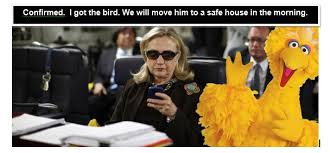
Many other good memes are found here.
But other than being a source of amusement, is Romney's targeting of the big yellow symbol of kindness and children's educational programming of any real significance? Romney dismisses all of it as a distraction from the issues that really matter: “These are tough times with real serious issues, so you have to scratch your head when the president spends the last week talking about saving Big Bird.” Is Romney right to treat this as a trivial issue? Or does Big Bird matter?
Of course, Big Bird is a symbol of something. What's at issue is whether the things that Big Bird stands for should be put on the chopping block, and what it means for a presidential candidate to promise to do just that.
During the debate, the attack on our yellow friend came as Romney was being pressed to explain how he'd balance the budget in the face of his enormous across-the-board tax cuts and military spending increases. The problem, as Obama pointed out, was this: Romney's stated strategy for covering the tax cuts and spending increases has been to eliminate exemptions and deductions; but this strategy would only close the gap if middle class deductions and exemptions were axed to the point of effectively raising their taxes by thousands of dollars. So how else could Romney close this gap?
Romney mentioned two things: Repealing Obamacare and cutting the federal subsidy to public broadcasting. That is, he'd eliminate the program that ensures that my friends' daughter with juvenile diabetes can actually get medical coverage, and he'd fire Big Bird.
Since Obamacare is actually a cost-saving policy, Romney's first suggestion makes no sense at all. Only the latter suggestion would actually amount to a budget cut. But it’s an eyebrow-raising suggestion for the simple reason that the federal subsidy for public broadcasting is a miniscule part of the federal budget.
According to the Christian Science Monitor, "The CPB’s two-year, $445 million government grant makes up less than 1/100th of a percent of a Federal Budget worth upwards of $3.5 trillion." It’s like a family faced with mounting credit card debt declaring, “That’s it! No more visits from the tooth fairy!” Pocketing the quarters that might have gone under the pillow will surely be a deep disappointment to the child, but it won't do a lick of good to solve the family's financial troubles. Here's one political cartoonist's way of making the same point:

(Source: David Horsey, LA Times)
But the problem goes deeper. It’s not just that federal support for public broadcasting amounts to pocket change. It’s that this support is a meaningful expression of public values. What are you saying when you announce to the nation that you’re firing Big Bird? What you’re saying is this: educational programming is not a national priority.
Let’s be clear about something. The children’s programming on PBS offers something that for-profit television simply isn’t interested in offering: genuine early learning opportunities. Some have called it "America's biggest classroom."
My kids watched Sesame Street, Super WHY, Between the Lions, the Electric Company, and other shows—and guess what? Watching these shows helped in their early education. Furthermore, these shows were a safe haven of sorts. Sometimes I'd be home alone in the morning and had to take my shower. 15 minutes in front of the TV could be a way to keep them safe and out of trouble--or it could be a source of trouble. I never knew what my kids would end up watching if they tuned into a show on commercial TV. Commercials would urge them to buy toys they didn't need, sparking a clamoring and whining for something I knew would sit there in the closet after the first day. Or they'd suddenly want sugary cereals that are terrible for human health. Sometimes they'd see images I'm not at all sure I want my children seeing.
On PBS Kids, they learned how to read.
PBS is part of our national commitment to education. It’s a cost-effective way to disseminate educational programming to the American population, programming that commercial and cable television has little interest in developing and disseminating for a simple reason: While these shows aspire to be both educational and entertaining, it’s only the “entertaining” element that’s profitable. Why strive to educate while you entertain, if the educational dimension doesn’t add to profitability?
In the debate, Romney tried to sell the idea that private enterprise always does it better than “big” government. But he’s simply wrong about this. Yes, private enterprise does many things better. But private enterprise is profit-driven. It cares about making money, not about promoting social values. If you want to focus on the latter even when it’s not profitable to do so, you can’t trust in the free market.
Had it not been for government support for public broadcasting, the educational children’s programs we see today would never have existed. And our society would have been poorer for it. This is not wasted money. It’s a very small amount of money by federal standards, and in terms of what you get in exchange for such a miniscule outlay of resources, it’s money well-spent.
Of course, some of this educational programming, while it got its start thanks to federal support, can and does now largely support itself. Sesame Street is like this, largely because of its now-iconic characters. Big Bird has been around long enough to resonate with symbolic meaning, with the innocence of childhood and the joys of discovery and the value of early education. Big Bird will survive what Romney does. The deeper problem is what happens when you commit to the idea that the government will no longer provide even token support for such symbolically weighty programming (and much-needed support for other programs that are bound up with those same symbols).
On this more profound symbolic level, government support for public broadcasting communicates and reinforces our collective commitment to educating and informing the public, both children and adults, about issues and ideas that matter—issues and ideas that it's good for people to know about even if devoting resources to this isn’t as profitable as renewing Honey Boo Boo for another season.
The philosopher Aristotle noted long ago that we become virtuous by doing virtuous acts. To become courageous, you behave courageously until it sinks into your character. To become caring and compassionate, you behave in these ways until they become a part of who you are.
This process of habituation works not only on the individual level, but on the collective level. You change the culture of a corporation by consistently engaging in practices that express the desired cultural values, especially practices that are visible and that resonate with symbolic weight.
You shape the character of government in similar ways. If you want a government that cares about the American people, you don’t achieve that by eliminating some of the most symbolically resonant government expressions of care. If you want a society that prioritized the healthy education of our children, you don't engage in financially-insignificant but symbolically-weighty cuts to children's educational programming.
You don't fire Big Bird.
Many other good memes are found here.
But other than being a source of amusement, is Romney's targeting of the big yellow symbol of kindness and children's educational programming of any real significance? Romney dismisses all of it as a distraction from the issues that really matter: “These are tough times with real serious issues, so you have to scratch your head when the president spends the last week talking about saving Big Bird.” Is Romney right to treat this as a trivial issue? Or does Big Bird matter?
Of course, Big Bird is a symbol of something. What's at issue is whether the things that Big Bird stands for should be put on the chopping block, and what it means for a presidential candidate to promise to do just that.
During the debate, the attack on our yellow friend came as Romney was being pressed to explain how he'd balance the budget in the face of his enormous across-the-board tax cuts and military spending increases. The problem, as Obama pointed out, was this: Romney's stated strategy for covering the tax cuts and spending increases has been to eliminate exemptions and deductions; but this strategy would only close the gap if middle class deductions and exemptions were axed to the point of effectively raising their taxes by thousands of dollars. So how else could Romney close this gap?
Romney mentioned two things: Repealing Obamacare and cutting the federal subsidy to public broadcasting. That is, he'd eliminate the program that ensures that my friends' daughter with juvenile diabetes can actually get medical coverage, and he'd fire Big Bird.
Since Obamacare is actually a cost-saving policy, Romney's first suggestion makes no sense at all. Only the latter suggestion would actually amount to a budget cut. But it’s an eyebrow-raising suggestion for the simple reason that the federal subsidy for public broadcasting is a miniscule part of the federal budget.
According to the Christian Science Monitor, "The CPB’s two-year, $445 million government grant makes up less than 1/100th of a percent of a Federal Budget worth upwards of $3.5 trillion." It’s like a family faced with mounting credit card debt declaring, “That’s it! No more visits from the tooth fairy!” Pocketing the quarters that might have gone under the pillow will surely be a deep disappointment to the child, but it won't do a lick of good to solve the family's financial troubles. Here's one political cartoonist's way of making the same point:
(Source: David Horsey, LA Times)
But the problem goes deeper. It’s not just that federal support for public broadcasting amounts to pocket change. It’s that this support is a meaningful expression of public values. What are you saying when you announce to the nation that you’re firing Big Bird? What you’re saying is this: educational programming is not a national priority.
Let’s be clear about something. The children’s programming on PBS offers something that for-profit television simply isn’t interested in offering: genuine early learning opportunities. Some have called it "America's biggest classroom."
My kids watched Sesame Street, Super WHY, Between the Lions, the Electric Company, and other shows—and guess what? Watching these shows helped in their early education. Furthermore, these shows were a safe haven of sorts. Sometimes I'd be home alone in the morning and had to take my shower. 15 minutes in front of the TV could be a way to keep them safe and out of trouble--or it could be a source of trouble. I never knew what my kids would end up watching if they tuned into a show on commercial TV. Commercials would urge them to buy toys they didn't need, sparking a clamoring and whining for something I knew would sit there in the closet after the first day. Or they'd suddenly want sugary cereals that are terrible for human health. Sometimes they'd see images I'm not at all sure I want my children seeing.
On PBS Kids, they learned how to read.
PBS is part of our national commitment to education. It’s a cost-effective way to disseminate educational programming to the American population, programming that commercial and cable television has little interest in developing and disseminating for a simple reason: While these shows aspire to be both educational and entertaining, it’s only the “entertaining” element that’s profitable. Why strive to educate while you entertain, if the educational dimension doesn’t add to profitability?
In the debate, Romney tried to sell the idea that private enterprise always does it better than “big” government. But he’s simply wrong about this. Yes, private enterprise does many things better. But private enterprise is profit-driven. It cares about making money, not about promoting social values. If you want to focus on the latter even when it’s not profitable to do so, you can’t trust in the free market.
Had it not been for government support for public broadcasting, the educational children’s programs we see today would never have existed. And our society would have been poorer for it. This is not wasted money. It’s a very small amount of money by federal standards, and in terms of what you get in exchange for such a miniscule outlay of resources, it’s money well-spent.
Of course, some of this educational programming, while it got its start thanks to federal support, can and does now largely support itself. Sesame Street is like this, largely because of its now-iconic characters. Big Bird has been around long enough to resonate with symbolic meaning, with the innocence of childhood and the joys of discovery and the value of early education. Big Bird will survive what Romney does. The deeper problem is what happens when you commit to the idea that the government will no longer provide even token support for such symbolically weighty programming (and much-needed support for other programs that are bound up with those same symbols).
On this more profound symbolic level, government support for public broadcasting communicates and reinforces our collective commitment to educating and informing the public, both children and adults, about issues and ideas that matter—issues and ideas that it's good for people to know about even if devoting resources to this isn’t as profitable as renewing Honey Boo Boo for another season.
The philosopher Aristotle noted long ago that we become virtuous by doing virtuous acts. To become courageous, you behave courageously until it sinks into your character. To become caring and compassionate, you behave in these ways until they become a part of who you are.
This process of habituation works not only on the individual level, but on the collective level. You change the culture of a corporation by consistently engaging in practices that express the desired cultural values, especially practices that are visible and that resonate with symbolic weight.
You shape the character of government in similar ways. If you want a government that cares about the American people, you don’t achieve that by eliminating some of the most symbolically resonant government expressions of care. If you want a society that prioritized the healthy education of our children, you don't engage in financially-insignificant but symbolically-weighty cuts to children's educational programming.
You don't fire Big Bird.
Sunday, October 7, 2012
Hegel's Rabble
One of the most interesting talks I attended at the Central State Philosophical Association Conference was entitled "What Is to Be Done about the Rabble?", presented by Joshua Anderson. The paper focused on a piece of Hegel's political philosophy, specifically, his idea that the operation of modern civil society gives rise to a problematic underclass of people whom Hegel dubbed "the rabble" (from what I can tell, not intended to have the derisive sense that "rabble" connotes today). While I don't remember all the details of the talk and the ensuing discussion, I want to share here what I took from the conversation and from my subsequent refresher reading of the relevant passages from Hegel's Philosophy of Right--because I think it has important implications for our contemporary conversations about poverty and welfare.
For Hegel, the beneficiaries of civil society are organized into "Corporations"--by which Hegel means organizations of people who carry out some recognized branch of the work that a civil society needs done (this would include corporations in the modern sense but would also extend to other kinds of social organizations, such as universities, police and fire departments, hospitals, governmental agencies, etc.). Full membership in civil society is conferred when you become a member of a Corporation. When you do, you have a role, a recognized place in society for which you are compensated with the means to meet your needs.
Corporations in this sense are a crucial part of organizing human beings into a civil society. As Hegel puts it, the Corporation operates as "a second family for its members, while civil society can only be an indeterminate sort of family because it comprises everyone and so is farther removed from individuals and their special exigencies." Put another way, the Corporation serves as a kind of mediating social unit, between the family and the society as a whole. You become a citizen of society through corporate membership. As a member of a Corporation you have a specified role to play in an organization that itself has a specified role in society as a whole. You are recognized and remunerated by the Corporation, and the Corporation is in turn recognized by the civil society at large and given the right to exchange the goods or services it provides in exchange for capital.
This arrangement brings several concrete benefits to the Corporation member. First, and most obviously, as a Corporation member you acquire the resources to care for yourself and your dependents. Without this, you are impoverished.
Second, you acquire recognition from your community. You are seen as a contributing member--you have a "recognitive status"--and so enjoy a sense of belonging. Without such a role, you are alienated.
Third, you acquire the opportunity to do meaningful work and so experience yourself as being a contributor to society. In Hegel's words, "the Corporation member needs no external marks beyond his own membership as evidence of his skill and his regular income and subsistence, i.e., as evidence that he is somebody." As social animals, we "find ourselves" through the impact we have on the social world. Our sense of self, our dignity, is bound up with being able to recognize that impact in our community. Hence, without such a role, we are cast into a position of shame.
Hegel argues that as civil society increases its population and its wealth, there are inherent limits to how many positions relative to the population are available within Corporations. Hegel is a bit unclear about why. He seems to think that Corporations are engines not only of production, but of differential distribution of the benefits of production. Conditions arise "which greatly facilitate the concentration of disproportionate wealth in a few hands," but the flip side is a growing mass of people who are left out. These persons are not only impoverished, but alienated and defined by shame. From the standpoint of society they are outsiders; from their own standpoint they lack the kind of identity that can confer positive self-worth.
These are "the rabble." They are denied two crucial things: First, they are excluded from the benefits of the social contract. Second, they are deprived of the opportunity to contribute to society in ways that are socially recognized and respected. In more technical lingo, they are denied the opportunity to legitimately "externalize themselves" in their social environment.
This second kind of deprivation should not be underappreciated. One of Hegel's important contributions to social philosophy--picked up on famously by Marx--is the insight that those who work have a unique advantage over those who are idle, even if the idleness is that of wealth and privilege. Those who work make an imprint on the world. That imprint is an assurance of their own significance and identity. It's as if they can see themselves through the effect they have on their environment, and so come to know that they matter. It is for this reason that, on Hegel's view, slaves are better off, at least in one crucial way, than the rabble.
Hegel doesn't see a way to avoid the creation of a "rabble" in a civil society, nor does he see a solution that will do any substantive good. He considers the possibility of the wealthier classes supporting the rabble through a kind of social welfare, which he dismisses on the grounds that receiving subsistence without working for it "would violate the principle of civil society and the feeling of individual independence and self-respect in its individual members." The first part of this dismissal is a familiar refrain today (those who receive benefits without contributing are "freeloaders" or "moochers"). The second part is more interesting: Neither charitable giving nor state-sponsored welfare confer a meaningful place in society, a recognized role and the opportunity to engage in the sort of work that confers a sense of self and dignity.
So what about giving the rabble jobs? Hegel says this won't solve the problem either, because the problem is a function of overproduction relative to "the number of consumers who are themselves also producers." You give more people more jobs, and you overproduce even more. This solution, Hegel claims, only intensifies the fundamental problem that gives rise to the impoverished class. In short, Hegel seems to be a proto-Keynesian convinced that universal employment inevitably guarantees overproduction relative to demand. To achieve a balance between supply and demand requires that a proportion of the populace remain unable to find work.
But Hegel is vague about this, and I'm not enough of an economist to say with confidence whether he is right, or how this proto-Keynesian view relates back to his idea that the creation of a rabble is the necessary flip-side of growing concentrations of wealth. My best guess is that the existence of a pool of potential workers that exceeds the available work not only is required for the sake of preventing overproduction and so preserving profit, but is also required in order for employers to be able to keep more for themselves of what the worker's labor is worth. If workers can be easily replaced by dipping into the hungry rabble, who will happily take any employment on any terms for the sake of fending off starvation, then workers are at a bargaining disadvantage. They'll be compelled to sell their labor for less than it is worth, while corporate owners keep the difference and so get rich.
The closest Hegel comes to proposing a solution to the problem of the rabble is to suggest that the rabble serve as a motive for foreign trade and, ultimately, colonial expansion. Through the latter, society "supplies to part of its population a return to life on the family basis in a new land and so also supplies itself with a new demand and field for its industry." In other words, you export your rabble, who ideally return to a simpler agrarian existence of local self-sufficiency ("life on the family basis," as opposed to life in a civil society unified around industrial production). They are gone from your soil but still consume your goods, meaning that consumption of what you produce exceeds your local population. And this makes possible more universal employment while still facilitating the accumulation of wealth among the privileged classes.
A handy solution for Hegel. But the history of colonialization is frought with injustice as soon as you pay attention to the fact that colonial settlers were actually moving into lands already occupied by peoples not participating in the industrial social contract and its mode of social organization. Furthermore, the history of colonialization seems to me to be the history of a globalization of the industrial social model, leading ultimately to a global "rabble": whole nations of destitute and disenfranchised human beings. Eventually you run out of new frontiers, and the problem of the rabble resurfaces on an international scale.
And so we confront the question posed by Joshua Anderson in the title of his conference paper: "What is to be done about the rabble?" Is such an underclass really as inevitable as Hegel thought? Are there any meaningful solutions that address both of the chief problems from which the rabble suffer--namely poverty and lack of recognitive status?
The coversation at the conference was too rich and interesting to adequately summarize. In simplest terms, Anderson's suggestion in his talk was that the rabble themselves, by existing outside the social contract, had a freedom to act that offers hope for the emergence of a solution from within the rabble. His commentator, Roxy Green, noted that the life circumstances of the rabble will likely put limits on their capacity to understand social dynamics enough to use their freedom productively.
These points, taken together, call attention in my mind to something Hegel doesn't dwell on but which is important to consider--namely, the way in which the rabble pose a threat, and the way in which society tends to manage that threat. Insofar as the rabble don't benefit from the social contract, it is fairly clear why they threaten the social order: We can't expect them to follow the rules when they aren't beneficiaries of the system the rules are meant to keep in place. In short, the first kind of deprivation from which the rabble suffer erases a crucial constraint against lashing out destructively.
And the second kind of deprivation can positively motivate violence. As social animals, it is very important to us that we matter in relation to our social environment. If there are no legitimate roles through which we can achieve this, then what happens to us? We either begin to think of ourselves as something less than human, as having a status equivalent to the squirrels that dart across one's path but aren't part of the human community; or we assert our humanity in dangerously anti-social ways. Denied a positive impact on the social environment, some opt for a negative one.
But while the rabble are threatening for these reasons, the threat they pose is mitigated by their lack of power and their limited knowledge. When they do lash out against the civil society in ways that violate the laws, their blows are usually quite limited in their capacity to damage the system or its most affluent beneficiaries; and, generally, they are quickly apprehended and far more likely to be convicted than those who enjoy the benefits of the social order would be. This is a baseline solution that members of civil society in general, regardless of political persuasion, seems to endorse: Count on the police and criminal justice system to take care of the threat posed by the rabble--directly by removing those who break the law from society; indirectly through the deterrent effect of these examples. Given the general powerlessness of the rabble overall, this may go a long way towards solving the threat posed by the disenfranchised underclass--and that may be all the "solution" that many care about.
But sometimes the threat posed by the rabble--either through sporadic violence or more concerted action (not necessarily violent) to claim some share of what they are denied--faces the prospect of becoming more serious. And so civil society supplements law enforcement with other strategies. The rabble's limited perspective and knowledge means that savvy beneficiaries of the social contract can find strategies to misdirect and mislead them into behaving in ways that serve or at least don't threaten the status quo. Perhaps they are led to turn on one another, to be so hostile or fractured among themselves that there is little risk of organizing effectively. If there's a poor, unskilled working class, it might be possible to pit them against the rabble.
Or perhaps the underclass is fed the promise of some otherworldly solution to their plight, the message that their state in this life is irrelevant and they should live wholly for the life to come.
Or perhaps they hunker down in hopelessness and self-blame--beating themselves up, literally or metaphorically, because they have come to accept a narrative according to which they are responsible for their own alienated state and would be just fine if only they had the will to pull themselves up by their bootstraps. Perhaps they are fed stories of rags-to-riches archetypes who embody the notion that anyone can succeed in civil society, even if they start out among the rabble. Such stories imply that there are no rabble in the true sense, since anyone in this state could escape it if only they applied themselves.
Another way to manage the rabble is to follow Hegel's first suggestion: provide them with a subsistence living through handouts--perhaps as an official social policy. Do this, and they now become beneficiaries of the social contract, even though they remain alienated and denied a meaning-bestowing role. As beneficiaries of the system, they are brought within the scope of its laws. They owe their obedience. Furthermore, fear of losing what little they have can keep them from lashing out. The problem, of course, is that now they are deprived of dignity. And general allegiance to the principle of civil society--that each member gains his or her share of social goods by contributing proportionately--may combine with the very rags-to-riches stories mentioned above to produce outraged resistance from the poorest of those who do contribute, since their share of social goods may be little more than what the rabble a receiving without working for it.
What these solutions have in common is that they all operate within the framework of the system that creates the rabble in the first place. The most famous Hegel-influenced philosopher on socio-political matters, Marx, can be seen as looking for a solution by adopting an alternative system brought about by a revolution of, not the rabble, but the proletariat (the exploited workers who benefit minimally from the industrial social contract).
But is the creation of a rabble really as inevitable as Hegel thinks, given the roughly capitalist social contract that Hegel envisions? Can a free market industrial society exist without giving rise to a disenfranchised underclass, either at home or abroad? If it is not inevitable, who benefits from the patterns that give rise to this underclass, and what sort of resistance will efforts to change things generate among those beneficiaries?
My own intuition is that the creation of a rabble is not inevitable, even in a free market system, so long as that system is regulated and supplemented in the right ways--such as, for example, with minimum wage laws that undercut the incentive to play the working poor against the rabble for the sake of exploiting labor, and tax policies that erase the advantages of concentrating wealth through exploitation of the vulnerable. If the incentive to hire in the private sector is limited by worries of overproduction relative to demand, the government can step in as an entity not beholden to such profit concerns and hire the unemployed to do tasks that serve the public good: investments in infrastructure, etc.
But I'm not economist, so my grasp of these issue is limited. What do others think?
Wednesday, October 3, 2012
Were I President Obama...
So the first presidential debate of the campaign is history. Here are my first-blush impressions.
As I see it, Romney "won." He came out more polished, and he was able to more effectively deliver a unified message. If anyone benefited from the debate (and I'm not at all sure anyone did) it would have been Romney.
His message, in sum, was roughly this: "Free enterprise does it better than big government, at least so long as there is regulation and so long as there are crucial government investments and an effective social safety net; and my plans achieve the latter despite what my opponent says, and they do it while trusting free enterprise instead of big government."
I say that this message was effectively delivered. That's not to say I accept it. I'm not at all convinced that Romney's proposals offer the regulations that are needed, make the investments that are most important for the future (green energy may be the single most important investment we can make for the future of humanity, and Romney chastised Obama for that prioritization), or provide the most just and compassionate response to the plight of the poor.
But those questions aside, I am unconvinced by the first piece of Romney's message. I simply don't think the blanket endorsement of free enterprise is accurate. Of course free enterprise is important, and in many things is the best way to produce and distribute goods. But when it comes to paying for health care (which isn't the same as providing it), I think there are good reasons to believe that a single-payer system that is not-for-profit has crucial advantages over a multipayer insurance industry composed of profit-seeking businesses.
Not that either candidate is proposing anything other than the latter with respect to health care in general--but Romney is proposing that we move to the latter with respect to Medicare, while Obama wants to preserve Medicare in its current form--as a single-payer, not-for-profit government program. Obama tried to make this point and highlight its significance--and I think some people heard it. But the message was at least partly occluded by Romney's repetition of the charge that Obama is cutting Medicare by $700 billion.
Obama did try to point out that the cuts were not to Medicare benefits but were cost savings made possible by other provisions of Obamacare (for example, universal coverage will save hospitals the money lost to providing emergency care for the uninsured, meaning they won't have to recover the costs by charging higher rates elsewhere, such as to those covered by Medicare). But in my view he didn't push this point forcefully enough. Had I been Obama, I would have turned to Romney and pointed out that he was just repeating a tired old misrepresentation of the facts that had been thoroughly debunked by the fact checkers when Ryan repeated it at the convention. And then I would have used that moment as an opportunity to tout the merits of Obamacare: the Affordable Care Act makes possible the sort of cost saving measures that increase the long-term financial viability of the Medicare program.
And speaking of what I would have said were I President Obama, one biggie pertains to Romney's proposed tax plan. This is what I think Obama should have said: "If you lower the tax rate across the board but pay for it mainly by eliminating tax exemptions and deductions, you haven't lowered taxes overall. You've decreased taxes for those who were not benefiting from those eliminated exemptions and deductions, and you've raised taxes on those who were benefiting from them. So the question is which deductions and exemptions Romney wants to eliminate, and who the current beneficiaries of those exemptions and deductions are. If it's disproportionately the middle class, then you've effectively raised taxes on the middle class. And according to such-and-such study, it is disproportionately the middle class."
I say that were I in Obama's shoes, that's what I would have said. The truth is that were I in Obama's shoes, I would have stared in frozen horror at the lights and the cameras and hemmed and hawed incoherently. And probably nervously chewed off a hang nail.
Thursday, September 27, 2012
An Adolescent Screams
Yesterday morning in a hallway of the Junior High School here in Stillwater, OK, a 13-year-old boy took out a handgun, turned it on himself and, in the presence of his stunned peers, ended his life.
The city is still reeling from the shock. Speculations about why he did it are rampant. Bullying was quickly blamed, but there is scant evidence of this. The truth is we don’t know why he did it, and we may never fully understand.
What we do know is that on this particular morning, of all the things this boy might have done, he chose to end his life in a very public and shockingly dramatic way.
He didn’t just choose to end his life. He chose to scream.
What I mean is this: When this boy killed himself in full view of his classmates, he was communicating something to his peers in a way that could not possibly be ignored. Like a scream, the act was ambiguous in its meaning. A scream can mean horror or despair, fear or outrage. What it lacks in clarity it makes up for in inescapability.
Screams are loud. So is killing yourself in a public hallway with a gun. Other forms of self-destruction are quieter. Consuming a lethal overdose of drugs communicates something, too; but the message and the delivery are different. The feelings and motives that would drive someone to do the former might not inspire them to do the latter.
And this boy was motivated, for reasons we may never fully comprehend, to do the former: to scream more loudly and inescapably than human vocal cords can scream. He wanted to express the depths of his negative feelings in a way that, however inarticulate, would seize hold of those around him and require them to pay attention, to take the scream as seriously as anything they’d ever heard.
And he had the means to do it. He had a loaded gun.
I don’t know where he found it, and I have no desire to place blame. In this country there are almost as many guns as there are people (9 guns for every 10 persons, the highest proportion of any country in the world), and that creates enormous opportunity to get your hands on a gun if you’re determined…even when there are no legitimate avenues (in Oklahoma, it's illegal for minors to purchase or possess handguns).
We don’t know what would have happened if he hadn’t had access to a gun yesterday. Maybe he would have found some other way to scream, and maybe this other choice would have been just as lethal. Or maybe he would have closed inward, quietly longing for a way to express the depths of his feeling, and maybe someone would have noticed the darkness and reached out. Or maybe an opportunist would have preyed on that darkness in one of countless ways.
We can’t know what might have been. But actions are a stew of means and motives. So are human tragedies. Change the motives and tragedy may be averted. But the same is true of changing the available means.
There’s more than one way to do that. Not every kind of scream is as loud, as inescapable as a gunshot. But those quieter options are often more articulate, better suited to conveying meaning, to ensuring that the person crying out is not merely heard but understood. We need to find ways to increase access to those options and do our best to ensure that our young people appreciate their power. The more they trust in the transformative potential of written words, performance art, social activism—and the more they trust that there are those who will hear and understand—the less likely they are to turn to the modes of expression that are both more brutal and more irrevocable.
And yes--although this is the more politically charged piece of the puzzle--we also need to think about how we can make those darker options less accessible. Anyone who has been through adolescence knows it to be an impulsive and dramatic age. And although there are important differences of degree, everyone at some point in that stage of life has felt the urge to scream. When that urge hits, it would be better if there weren’t a gun at hand.
I won’t pretend there are easy answers. The issue of controlling access to guns faces, in this country, a culture in which guns are linked to traditions and hobbies and family heritage, not to mention convictions about personal liberty and self-defense. Regulating legitimate access to guns through careful screening and licensing of prospective gun owners might be crucial to keeping guns out of the hands of those who really ought not to be armed and dangerous—but such regulations will have limited effect unless the pathways to illegitimate access are relatively few. And with the guns already out there in such great numbers, achieving the latter may be difficult. We might propose trying to reduce the number of guns in circulation, but that would be no small challenge. I’d hate to be the police officers assigned the task of confiscating the weapons of those who believe the right to bear arms is synonymous with freedom from tyranny.
There are no easy answers. But that doesn’t mean we shouldn’t wrestle with the questions. And we shouldn't focus on one set of questions to the exclusion of the others. We need to wrestle with the question of motives in an attempt to better understand what drives adolescents to such extremes. We need to grope for better policies to prevent or mitigate the forces that inflame and dehumanize—such things as verbal and physical abuse by peers ("bullying"), such things as systemic social exclusion and deep loneliness. None of these things may be what lay behind yesterday's tragedy in Stillwater. But every such tragedy should move us to think on forces that drive people to the brink, and to renew our commitment to diminish their power in the world.
But every effort of this kind will be imperfect. There will always be adolescent screams. And so we need to think about our collective commitment to fashioning constructive outlets, offering a diversity of avenues for self-expression—even for the expression of those feelings that frighten us, for those extremities of outrage and anguish we would like to pretend our young people never feel.
And we need to wrestle with how more effectively to protect adolescents from themselves, how to minimize their access to the most destructive ways of screaming.
In relation to these questions, I believe there are many things that Stillwater, as a community, is already doing well. This is not about blame or recrimination, but about trying to come to terms with tragedy in part by learning what we can from it and changing where it makes sense to change. And to wrestle seriously with any of these questions, we have to set aside partisan polarization and pat slogans in favor of substantive conversations in which diverse perspectives are heard and weighted thoughtfully, critically, and respectfully. To engage in such conversations is a way of honoring the victims of tragedy. But we do not honor them unless we really listen and honestly share, unless we strive to find solidarity amidst differences in the shared goal of making our community a safer and healthier place for all.
How do we do this?
Today, this day, it is Stillwater’s turn to ask that question. Today, this day, it is Stillwater’s turn to decide not only how we will grieve, but how we will come together to draw lessons from this tragedy, to honor its victims by trying, however imperfectly, to make its like less likely to happen again.
Monday, September 17, 2012
Once More for Posterity: The Politician's Beatitudes
In honor of the final ramp up to election day, I repost these Politician's Beatitudes:
Blessed are those who act to preserve the privileges of the rich, for they shall receive substantial campaign contributions.
Blessed are those who swallow back tears at strategic moments only to quickly compose themselves again, for they shall be regarded as having a sensitive side but still be seen as strong, thereby being judged more trustworthy by the electorate (unless they’re women, in which case they risk being seen as dangerously emotional).
Blessed are the aggressive, since negative campaigning has proven time and again to work even though the electorate complains about it.
Blessed are those who hunger and thirst for prestige and influence while pretending to care primarily about serving the public, for they will gain levels of political influence that those motivated more by a spirit of public service than ambition can only dream of.
Blessed are the merciless, because they’ll ruin the political credibility of their opponent before their opponent does the same to them.
Blessed are those who can look earnestly into the camera and sound really sincere as they say things like “God bless the United States of America,” for they will win the heartland.
Blessed are the warmongers, at least if they can properly time their war-related popularity surge to an election cycle.
Blessed are those who can spin their political opponent’s attack ads as persecution for righteousness’s sake, for they can engage in an underhanded attack on their political opponent while appearing as if they are standing against negative campaigning—thereby both enjoying the benefits of a negative campaign and enjoying the benefits of pandering to the public’s theoretic opposition to negative campaigns.
Blessed are those who, in moments of moral integrity, defy this cynical list of political beatitudes and act from a sense of authentic justice, compassion, or moral purpose—for although they might not get reelected, they may actually find true fullfilment in the lives they lead after leaving public office.
Central States Philosophical Association 2012 Conference Program
For those of you who have been dying to know what I've been doing for the last five months when I haven't been blogging, this conference program represents the fruits of (much of) that activity.
Central States Philosophical Association 2012 Conference
September 21-22, University of Missouri, Columbia
Memorial Union, South Wing
(Parking available at University Avenue Parking Garage; fee/permit required on 21st only)
Note: Sessions end five minutes before the hour to allow for a short break between sessions.
Friday Morning, Sept. 21—Epistemology (Memorial Union S107)
9:00 Kyle Ray (Oklahoma State), “False Affirmation and Testimony”
Commentator: John Camacho (UMSL)
Chair: Bob Fischer (Texas State)
10:00 Richard Fry (Georgetown), “The Epistemological and Psychological Status of Proofs in Hume”
Commentator: Mary Gwin (Oklahoma State)
Chair: John Matheson (North Florida)
11:00 Bob Fischer (Texas State), “TRUE is False and Why it Matters”
Commentator: Joshua DiPaolo (Massachusetts-Amherst)
Chair: Eric Reitan (Oklahoma State)
12:00 Michael Shaffer (St Cloud State), “Doxastic Voluntarism, Epistemic Deontology and Belief-contravening Commitments”
Commentator: Christopher Gadsden (Missouri)
Chair: Brendan Murday (Ithaca)
Friday Morning, Sept 21—Ethics (Memorial Union S207)
9:00 Eric Wiland (Missouri-St. Louis), “Williams on Thick Ethical Concepts and Reasons for Action”
Commentator: Robert Johnson (Missouri)
Chair: Thomas Reynolds (Missouri)
10:00 Adam Thompson (Nebraska-Lincoln), “Optimism and Resentment”
Commentator: MaryEllen VanDerHeyden (Washington University)
Chair: John Camacho (UMSL)
11:00 Jeff Behrends (Wisconsin-Madison), “Parfit’s All or None Argument and the Development of Normative Hybridism”
Commentator: Joel Dittmer (MU of Sci & Tech)
Chair: Thomas Reynolds (Missouri)
12:00 Bekka Williams (Wisconsin-Madison), “What Does Subjective ‘Ought’ Imply?”
Commentator: Joshua Smart (Missouri)
Chair: Bryan Stegner (Washington University)
Friday Morning, Sept. 21—Free Will & Philosophy of Mind (Memorial Union S110)
9:00 Philip Swenson (UC-Riverside), “What Can We Learn from Deterministic Frankfurt-Style Cases?”
Commentator: David Palmer (Tennessee-Knoxville)
Chair: Kevin McCain (Alabama-Birmingham)
10:00 Open (Session Cancelled)
11:00 Dennis Trinkle (Wisconsin-Madison), “Delusions and Downstream Effects”
Commentator: Krista Wiley (UMSL)
Chair: Bradley Rettler (Notre Dame)
12:00 Matthew Cook (Oklahoma), “Extended Perception”
Commentator: Lynn Chien-Hui Chiu (Missouri)
Chair: Bryan Weaver
LUNCH: 1-2 PM
Friday Afternoon, Sept 21—The Philosophy of Allan Gibbard (MU S107)
2:00 Tyler Paytas (Washington U), “How Should We Feel about Nursing Homes and Camel Thefts?”
Commentator: Phil Zema (Missouri)
Chair: : Thomas Reynolds (Missouri)
3:00 Louis Gularte (Northern Illinois), “On the Possibility of Compatibility Between Moral Objectivity and Plan-based Expressivism”
Commentator: Jeff Behrends, Wisconsin-Madison)
Chair: Joshua DiPaoulo
4:00 Bruce Russell (Wayne State), “Parfit and Gibbard on Intuitions”
Commentator: Allan Gibbard (Michigan)
Chair: Eric Reitan
Friday Afternoon, Sept 21—Values & Ethics (MU S207)
2:00 Andrew Ward (Minnesota), “A Pragmatic Rapproachment of Facts and Values”
Commentator: Don Morse (Webster)
Chair: Christopher Gadsden (Missouri)
3:00 Antony Aumann (Northern Michigan), “The Relationship Between Aesthetic Value and Cognitive Value”
Commentator: Allison Merrick (Arkansas-Little Rock)
Chair: Dennis Trinkle (Wisconsin-Madison)
4:00 Donald Wilson (Kansas State), “Herman on Beneficence”
Commentator: Everett Fulmer (St. Louis)
Chair: Kyle Ray (Oklahoma State)
Friday Afternoon, Sept. 21—Metaphysics (MU S110)
2:00 Maxwell Suffis (Northern Illinois), “Why We Shouldn’t Think of Souls as Meriological Simples: A Negative Assessment of the Paradox of Increase”
Commentator: Kevin Sharpe (St. Could State)
Chair: Bradley Rettler (Notre Dame)
3:00 Bradley Rettler (Notre Dame), “How to Think About Grounding”
Commentator: Andrew Melnyk (Missouri)
Chair: Richard Fry (Georgetown)
Friday, 5-6 PM: Keynote by Allan Gibbard: “Meaning and Normativity.” Introduction by Paul Weirich (MU S107)
Banquet: 7 PM, Reynolds Alumni Center
Saturday Morning, Sept. 22—Political Philosophy (MU S207)
9:00 Joshua Anderson (St. Louis), “What is to be Done About the Rabble?”
Commentator: Roxy Green (Arkansas-Little Rock)
Chair: Bekka Williams (Wisconsin-Madison)
10:00 Christopher McCammon (Drake), “How to be an Instrumentalist about Political Legitimacy”
Commentator: Peter Vallentyne (Missouri)
Chair: Regina Schouten (Wisconsin Madison)
11:00 Regina Schouten (Wisconsin-Madison), “Citizenship, Reciprocity, and the Gendered Division of Labor.”
Commentator: Stephanie Hull (Missouri)
Chair: Joshua DiPaoulo (Massachusetts-Amherst)
12:00 Dustin Nelson (Tennessee), “(Mis)Understanding Rawls’ Wide View of Public Political Culture”
Commentator: Sheng Zhang (Missouri)
Chair: Tyler Paytas (Washington University-St. Louis)
Saturday Morning, Sept. 22—Decision Theory and Epistemology (MU S203)
9:00 Ashton Sperry (Missouri), “On Defining Strategy”
Commentator: Seth Kurtenbach (Missouri)
Chair: Andrew Spear (Grand Valley State)
10:00 Tanya Kostochka (Northern Illinois), “Intention and Resolution in a Two-Stage Newcomb’s Problem”
Commentator: Ashton Sperry (Missouri)
Chair: Andrew Spear (Grand Valley State)
11:00 James Beebe (SUNY Buffalo), “Gettierized Knobe Effects”
Commentator: Kevin McCain (Alabama-Birmingham)
Chair: Mary Gwin (Oklahoma State)
12:00 Brendan Murday (Ithaca College), “Dissolving the Problem of the Criterion”
Commentator: Andrew Spear (Grand Valley State)
Chair: Mary Gwin (Oklahoma State)
Saturday Morning, Sept. 22—Metaphysics (MU S206)
9:00 Kenneth Boyce (Notre Dame), “On Believing in Neutrons but not Numbers”
Commentator: Eric Hiddleston (Wayne State)
Chair: Andrew Melnyk (Missouri)
10:00 Justin Remhof (Illinois-Urbana Champaign), “Object Constructivism and Unconstructed Objects”
Commentator: Kenneth Boyce (Notre Dame)
Chair: Jonah Goldwater (Missouri)
11:00 Eric Hiddleston (Wayne State), “Semantic Ineliminabilty, Fictionalism, and Ontology”
Commentator: John Collins (East Carolina)
Chair: Richard Fry (Georgetown)
LUNCH: 1-2
Saturday Afternoon, Sept. 22—Moral Problems (MU S207)
2:00 Philip Mouch (Minnesota State-Moorhead), “Self-Defense and the Castle Doctrine”
Commentator: Crystal Allen (Principia College)
Chair: Phillip Zema (Missouri)
3:00 Crystal Allen (Principia College), “Justifying War and the Boundaries of Territorial Defense”
Commentator: Isaac Wagner (Missouri)
Chair: Philip Swenson (UC-Riverside)
4:00 Owen Shaefer (Oxford), “Moral Disagreement and Moral Enhancement”
Commentator: Wenwen Fan (Missouri)
Chair: Ron Glass (Wisconsin-LaCross)
Saturday Afternoon, Sept. 22—Epistemology (MU S203)
2:00 Jonathan Matheson (North Florida), “Is there a Well-Founded Solution to the Generality Problem?”
Commentator: Casey Swank (St. Cloud State)
Chair: Mary Gwin (Oklahoma State)
3:00 Ted Poston (South Alabama), “Coherence, A Priority, and Logic”
Commentator: David Henderson (Nebraska-Lincoln)
Chair: Jonathan Matheson (North Florida)
4:00 Kevin McCain (Alabama-Birmingham), “In Defense of the Explanationist Response to Skepticism”
Commentator: Ali Hasan (Iowa)
Chair: Ted Poston (South Alabama)
Saturday Afternoon, Sept. 22—Philosophy of Religion (MU S206)
2:00 Andrew Moon (Kansas State), “Religious Disagreement, Epistemic Circularity, and the Cognitive Science of Religion”
Commentator: David Alexander (Iowa State)
Chair: Dennis Trinkle (Wisconsin-Madison)
3:00 Billy Ramey (Missouri), “Why We Cannot Go On to Infinity: A Hybrid Cosmological Argument”
Commentator: Eric Reitan (Oklahoma State)
Chair: Antony Aumann (Northern Michigan)
4:00 Open (Session cancelled)
Saturday Sept. 22, 5 PM: Business Meeting (chaired by Eric Reitan) followed by Presidential Address by Paul Weirich: “Simplifying Choices” (MU S203)
Saturday, Sept 22, 6-7 PM: Closing Reception (MU S206)
Friday, September 14, 2012
A Simple Principle
I think it may help, in the effort to avoid a lot of confusion, misrepresentation, and polarizing conflict, if we just keep one simple principle in mind:
Moral responsibility can be shared.
The other day an attack on the U.S Embassy in Benghazi, Libya, killed the US Ambassador J Christopher Stevens and three others, including security officer and former Navy SEALs Glen Doherty, and Foreign Service Information Management Officer Sean Smith.
The perpetrators of the attack remain unknown, and tracking them down may prove difficult--but everyone agrees, of course, that they bear the primary and most immediate responsibility for the tragic deaths. But if you're inclined to look more broadly, beyond the attacks themselves to events that helped generate an outraged protest that either spiraled our of control or (as seems now to be the more likely story) was opportunistically fueled and used as part of a broader plot--if you're inclined to ask how all of us might have helped avert this tragedy, you face the risk of being dubbed an apologist for the perpetrators.
It happens a lot. Someone points to broader social forces that helped motivate violence, and it's as if they've said that the perpetrators of violence were nothing more than blameless robots programmed by these social forces. You note how others were needlessly provocative or inflammatory, and it's as if you've said that the perpetrators were puppets wholly controlled by those who provoked them. But this way of thinking assumes that responsibility has to fall in just one place. It doesn't.
To put things bluntly: Some of the biggest #@*!-ups happen because lots of people behave like idiots. To point out the idiocy of one of the contributors does not amount to absolving the idiocy of the others. Nor does it imply that those most immediately responsible for the gravest harms of a tragedy aren't worthy of special condemnation and punishment in a way that the others who contributed are not.
More importantly, to acknowledge your own role--or your own community's role--in creating a problem is just plain human decency. So is apologizing for it. You shouldn't resist doing the decent thing because you're afraid that somehow it lets others off the hook or implies that others more intimately involved in the problem aren't to blame. But we are afraid to do this, far too often, because we are caught up at least implicitly by this misguided idea that moral responsibility can't be shared. Sometimes pundits and politicians play off this misguided propensity to score political points.
But when we think about it explicitly, of course we all know better.
If I sleep with your wife and you attempt to murder me in a fit of rage, I am not responsible for the attempt on my life. But I am responsible for what I did. I am responsible for having the affair. I am responsible for the provocation. If I concede that I provoked you, I am not implying that there's nothing wrong with the sort of character that sends someone over the edge in the face of infidelity. While people should be angry when their spouses break their vows and others are complicit in that, no one should become murderously angry. If you're like that, then you've got a serious character flaw. If you acted on the urgings of that character flaw, you've done something seriously wrong.
And so the fact that I was able to provoke you to murderous intent speaks poorly of your character. But that I provoked you in this particular way speaks poorly of mine.
But now suppose I knew this about you in advance. And suppose I knew not only that you're easily provoked to murderous rage by infidelity, but that your wife (my would-be lover) would also be at risk should you be triggered. Suppose I went ahead and slept with your wife knowing that her life was also thereby put at risk. But suppose I didn't care. I took no steps to protect her. I didn't help her get to a domestic violence shelter or anything like that before indulging myself in ways I knew could trigger you to kill her. I just ignite the spark in pursuit of my pleasure and walk away.
If you then murder your wife, do I bear any responsibility? I'm not talking about legal responsibility here. I mean moral responsibility.
Of course I do. Admitting this doesn't reduce the gravity of what you did, the depths of your moral failings, the reality of the danger that letting you roam free in the world poses to us all, especially those you come to possessively "love" as if they were things that belong to you. It's possible for all these serious moral failings and wrongs to fall squarely on your shoulders, even if there are a bunch of serious moral failings and wrongs that fall squarely on mine. Even if both your moral failings and mine helped push circumstances forward to the tragic outcome.
But when it comes to the failings I have the best hope of correcting, I need to look inward. While that doesn't mean we should ignore the wrongs of others or not seek to apprehend those who pose the most imminent threat to human safety, it does mean that when we or our communities play a role in a complex chain of events that culminates in tragedy, we should ask ourselves what changes we can make closer to home, so that we aren't implicated in future tragedies. And when we do so, it doesn't follow that the gravity of what others have done is mitigated or erased.
Because moral responsibility can be shared.
Recently, a juvenile, amateurish filmmaker made a horrible movie. It wasn't just bad art--although from what I can tell it was really, really lousy on that score. But it was also deliberately offensive and slanderous--and its target was Muslims, a large and diverse group of people. In the film, not only is Mohammed depicted (something that by itself is known to be deeply offensive to Muslims), but he is depicted as being a murderer and adulterer who approved of pedophilic sex abuse.
A hate-filled religious ideologue, the Koran-burning Terry Jones, then went ahead and championed this amateurish, offensive, slanderous move, helping to bring what was otherwise a dead-in-the-water film (it showed once, apparently to a mostly empty theater) to the attention of the large and diverse religious community being slandered. The filmmaker and its champion did this knowing full well that some of those in the targeted religious group have a history of ideology-fueled violence.
To say that these people--the filmmaker and the crazy Islamophobic preacher--bear some moral responsibility for what happened next does not mitigate the gravity of extremist violence. Because moral responsibility isn't this limited resource with only so much to go around.
And if one looks more broadly at our American culture; if one asks whether the incendiary hatred of Muslims on display in this film is a distillation or amplification of broader social attitudes that we should be working on changing, one does not thereby mitigate the gravity of what the film-makers and those who championed them did. Because moral responsibility can be shared.
Here is a fact: Sometimes I know how others are likely to respond to my actions because I know something about their character. Sometimes crazy extremist behavior is a predictable outcome of certain broad social patterns and ideas. This is not to say that people who behave as predicted bear no responsibility for their actions. People can and do take responsibility for themselves and their choices, rising above their conditioning...at least if they're encouraged, challenged, and supported in the right way.
But, more often than not, people don't defy predictions. They don't take responsibility, but instead simply act out their conditioning. And sometimes that conditioning leads them to respond to certain triggers with violent umbrage.
Knowing that they're there, what do we do? We shouldn't be held hostage by them, of course. We shouldn't do something wrong, say or do things we don't believe, just to appease them. I don't think, for example, that we ought to abandon our national commitment to freedom of speech and freedom of expression and begin suppressing inflammatory filmmakers and crazy preachers, just because there are extremists out there who will begin targeting decent, caring human beings just for sharing a national identity with a hateful bigot or two.
But it's one thing to say we shouldn't be held hostage to the poor character or ideological conditioning of others. It's something else to say we shouldn't pay attention to how our own character flaws, our own unreflective ideologies, help to fuel violent feedback loops with the harmful conditioning of others.
Far too often, pointless tragedies happen because too many people, in diverse ways, mistake the humiliation and dehumanization of others for something worth doing. Too many allow themselves to be guided by these deeply divisive ideologies that spring from ancient tribal instincts and are vindicated by appeal to a tribal god (and then, predictably enough, insist that this tribal god is the God of all people, the creator Who sustains in being every Hindu, every Muslim, every Christian, every Jew, the God whose sustaining love supposedly encompasses the whole creation).
How can such tribalism swamp our better natures? It rears its head most powerfully when it is embraced by people on both sides of an ideological divide, when there are those who identify themselves against one another, who target one another, who universalize and absolutize their dehumanizing depictions of one another.
If you have a few tribal voices within a community of tolerant, compassionate human beings, and if, in the community anathematized by those tribal voices, you have nothing but tolerant, compassionate human beings who reach out in fellowship...well, the tribal voices won't be a good thing even then, but they lose much of their power. They face a kind of persistent challenge that can motivate many of them to take responsibility for their own ideological conditioning, reflect on it, discuss it, and eventually transform it.
Sometimes, however, there are broad unspoken social sentiments that, while not themselves overtly hostile and vitriolic, provide the stew out of which a few extreme voices emerge to spew overt hate. Two such communities, perched on opposite sides of an ideological divide, can progressively feed off the extreme messages coming from the vocal minority on the other side. The voices react to each other, enrage each other, and in targeting each other end up reinforcing their respective dehumanizing views of the other side. And as innocents on both sides become the targets of the extreme acts of the few, more members of each community start to listen to those hate-filled tribal voices, the voices that universalize and absolutize the dehumanizing depictions of one another. More and more of us stop taking responsibility for our own complicity, instead blaming the other side and vindicating our own attacks--physical attacks or rhetorical, with movies or with guns--by unreflective invocation of an ideology of hate.
Casting all the blame at the doorstep of a few individuals or at the doorstep of the other community, refusing to recognize that responsibility can be shared, that it should be shared, that we all must take responsibility for ourselves and each other...these are habits that only play into the tragic feedback loop through which tribalism comes to swamp our better natures.
Moral responsibility can be shared. And it must be shared, especially in the face of tragedies. Or we're all in trouble.
Tuesday, September 11, 2012
From the Archives: The Gods of September 11
The following is a repost of an essay I posted here on the 10th anniversary of the September 11 terrorist attacks.
Over the last week or so I’ve heard more than one person say that September 11 has served our generation as a vivid reminder of the reality of evil, of the gravity of the problem of sin—in Christian terms, of what it means to exist in alienation from our creator.
I don't disagree. There is no question in my mind that what we witnessed on that day was evil—not that the agents of the attacks were essentially evil (as so many claimed), or that their religion was evil (as too many still insist), or that religion as such was evil (as Sam Harris boldly declared in The End of Faith). But what was done, the indifference to life, the deliberate pursuit of atrocity followed by its celebration…if there is anything that deserves the label “sin,” surely this qualifies.
But when Americans point to September 11 and say, “Here is sin,” their fingers are pointing away from themselves.
Let me say this again, more inclusively: When any one of us who has not personally presided over the extermination of human life points at the September 11 attacks and says, “Here is sin,” we are pointing away from ourselves.
And when sin becomes about pointing fingers, rather than about self-transformation and transcendence, the invocation of "sin" becomes part of the problem of sin.
To be transformative, "sin" must be an inner recognition, not an outer judgment. It must be seen, not as a positive reality that has claimed the wicked Other, but as something in ourselves—not something that calls for a response of self-loathing, but an absence that cries out to be filled. As such, sin is like hunger: a symptom of our need to reach beyond ourselves for sustenance. When we are hungry, we do not hate ourselves. When we are hungry we look for food.
And what will feed us? “God,” comes the answer. But what does that mean? For Fred Phelps it means a steady diet of hate. Is that God? Is that what fills the absence, what completes us?
As we confront the horror of September 11, we feel, urgently, the need to be filled. What do we turn to? When confronted with atrocity, where do we look for God?
Some look for vengeance, convinced that it will satisfy. Is their God the one who casts sinners into a fiery hell? Will vengeance fill the emptiness we call sin?
Some link arms and sing patriotic songs, and wave their flags and insist on unity, but it becomes more than just solidarity. They seek to be filled by national pride, by standing up with the tribe that has been struck, by standing together against the enemy, by retooling the very same us/them ideology that allows whole communities to be legitimately targeted in the chosen people’s holy war against its enemies. Is our God a tribal God?
Some scramble for security, taking every possible step to make certain it never happens again—as if, in Stanley Hauerwas’s provocative terms, they can thereby manage to get out of this life alive. Is that the answer? Will sin be defeated if principle gives way to fear, if in the name of security we are prepared to extract information under torture, or let the hungry starve so that our bank accounts are comfortably padded?
Some are like that alpha boy on the playground when he finds himself hurt. Others feel his pain and reach out. But compassion strikes him as pity, and pity is for the weak. And so he sets out to prove that he doesn’t need anyone. The community of mutuality, of interdependence, of shared vulnerability and strength, this community that is suddenly trembling on the tongue of that strange girl leaning down to ask if he’s alright—it terrifies him, and he bats it way.
Is self-reliance our God?
Some, when confronting tragedy, look for ways to fit it into all their old patterns of thinking, rather than allow the enormity of the moment to inspire silence. Some use what happened opportunistically, to pursue the same agendas they’ve always had, rather than let the cracks in their world inspire the humility to ask what their agendas ought to be.
Some seek to use the tragedy—and all the confused fears and longings it inspires—to manipulate their way into power or privilege. They represent themselves as having the answers, if only others will follow where they lead. If they become the thing that feeds the emptiness in others, perhaps their own will disappear. But emptiness cannot feed emptiness.
Some look at the September 11 terrorist attacks and say, “Where is God? Where is God in this horror?” They mean it as rhetorical, but the question doesn’t strike me as rhetorical at all. We all have our answers. But which one will fill us?
"Christ has bidden us," said Simone Weil in a letter to her friend and confidante Father Perrin, "to attain to the perfection of our heavenly Father by imitating his indiscriminate bestowal of light....Every existing thing is equally upheld in its existence by God's creative love. The friends of God should love him to the point of merging their love into his with regard to all things here below." And when we love as God loves, when we cast out this web of indiscriminate love, we become "the bird with golden wings" who pierces the shell of the world.
Perhaps sin, in the end, is about all the futile answers we choose, all the absurd alternatives to love.
Friday, September 7, 2012
The Costs of Talking Down to Your Audience
On Wednesday night, Bill Clinton spoke for more than 45 minutes to the Democratic National Convention--and his speech was, by political standards, astonishingly free from major distortions or misrepresentations of the facts. FactCheck.org described it in this way:
What I want to consider is why Clinton's speech is so (relatively) clean with respect to the facts. I think part of the reason is that Clinton is willing to take the time (too much time, some say) to lay out his criticisms and arguments with precision--something he's willing to do, in part, because he is less inclined to talk down to his audiences than politician have historically tended to be.
Take one of the problems with Biden's speech. Here's how FactCheck.org describes it:
But, of course, taking the time and making the more complex argument is honest--and Clinton took that more complex argument to the same conclusion that Binen wanted to jump to with one sentence: Romney is prepared to benefit the richest Americans at the cost of those who are less well off.
I'm not saying that Bill Clinton is a paragon of honesty here ("I did not have sexual relations with that woman!"), or that Biden is an unusually dishonest politician. What I'm saying is that the attempt to simplify things, to put them into soundbites, to make the message punchy and "clear" so that the "main point" doesn't get lost amidst the complications--this effort has costs. The chief cost is that you have to say something that is false. The reason why Clinton's speech was so clean isn't because Clinton is habitually honest in a way that other politicans are not. The reason is that Clinton is habitually resistant to talking down to his audiences. Instead, he tries (and succeeds, more often than not) to find a way to express the issues accessibly.
In my work--teaching--what Biden did in the example above could be described using the term "pedagogical license." The idea here is this. The full details of the theory are too complex for most of your students to follow and digest, at least in the time you have, whereas a simplified version is going to be inacurrate but more accessible. And so you offer the version that is incorrect, because the incorrect version will be grasped and lead the students to believe something in the vicinity of the truth. If you explained the true theory, you worry that the students would just be lost.
Now sometimes teachers have to do this--but when good teachers do it, they preface what they are offering with a disclaimer, something like the following: "Here's a way to think of it that's not quite correct, but which is helpful in getting the gist of the theory. Once you understand the basic idea, we can work on refining your understanding so that it's more accurate."
Usually I try to avoid pedagogical lincense in lecture. I offer as accurate an account as I can, and I try to make it as accessible as I can using examples, putting things in more than one way, etc. Sometimes a student will then say, "So what you're saying is blah"--and "blah" happens to be an oversimplified version that gets the gist of the theory but isn't really accurate. At that point I'll say that this is helpful in getting us in the ballpark, but the theory is a bit more complicated. Then I try to explain why.
Sometimes, however, I know from experience that given the student level and the time allowed, what I need to do is start with the more accessible but inaccurate explanation, offer due warnings about inaccuracy, and then work on refining the understanding as time allows.
But imagine a politician who prefaces his remarks with, "What I'm about to say about my political opponent isn't exactly correct, but I think it is in the ballpark of the truth. And the real truth has, I think, the same implications for what we should think of his policies. But the real truth is too hard for me to explain to you, so I won't try."
Such a politician wouldn't get very far. So, instead, they just offer the incorrect statement as if it were the correct one.
I'm not saying that all or most inaccuracies in political speech-making are like this. There are plenty of bald-faced lies, attempts to mislead and misdirect. But there are also attempts to lead people in what the politician sincerely believes is the right direction by doing something analogous to pedagogical license--but without offering the qualifying preface that a good teacher would offer.
But the cost is not just dishonesty in the particular case. The cost is a culture that becomes more tolerant of dishonesty. If the inaccuracy in one case is okay because the inaccurate view is in the ballpark of the harder-to-grasp correct view and has the same political implications, then what about an inaccurate view that isn't nearly as close to the true position but which the politician thinks has the same political implications? Where do you draw the line between the political analogue of pedagogical license and deliberate deception for political gain? If it's okay to say something that isn't quite factual because it will give voters the right impression, is it okay to say something that is strictly factual but aims to leave voters with the wrong impression?
What I think Bill Clinton's example shows is that if you present the material in the right way, you don't need to dumb it down. If you are sufficiently dynamic and engaging, your audience will give you the time to explain things carefully and precisely.
And whatever else one might say about Clinton, on this matter I think more politicians should strive to emulate him. Underestimating one's audience isn't good for those audiences, and it isn't good for a culture of truth.
Former President Bill Clinton’s stem-winding nomination speech was a fact-checker’s nightmare: lots of effort required to run down his many statistics and factual claims, producing little for us to write about.The speeches last night, by Biden and Obama, weren't quite as clean (although arguably far cleaner than many recent political speeches).
Republicans will find plenty of Clinton’s scorching opinions objectionable. But with few exceptions, we found his stats checked out.
What I want to consider is why Clinton's speech is so (relatively) clean with respect to the facts. I think part of the reason is that Clinton is willing to take the time (too much time, some say) to lay out his criticisms and arguments with precision--something he's willing to do, in part, because he is less inclined to talk down to his audiences than politician have historically tended to be.
Take one of the problems with Biden's speech. Here's how FactCheck.org describes it:
Biden joined the chorus of off-key convention speakers who have attacked Romney for wanting to raise taxes on the middle class, even though Romney says he won’t do that.
Biden: Folks, Governor Romney believes it’s OK to raise taxes on middle classes by $2,000 in order to pay for … another trillion-dollar tax cut for the very wealthy.
That’s exactly the opposite of what Romney actually says. In his speech accepting the presidential nomination at the Republican National Convention, he said:
Romney, Aug. 30: I will not raise taxes on the middle class.
Biden refers to an analysis by the Tax Policy Center of a plan that, as Romney also promises, cuts income tax rates across the board by 20 percent and pays for it by eliminating and reducing tax deductions and credits. TPC found that such a plan would “increase the tax burdens on middle- and/or lower-income taxpayers.” Under one scenario, it said that “taxpayers with children who make less than $200,000 would pay, on average, $2,000 more in taxes.”
But that’s not evidence that Romney wants to increase taxes on the middle class. It only proves Romney “can’t accomplish all his stated objectives,” according to the Tax Policy Center’s director, Donald Marron.I pick out this element of Biden's speech because I explicitly remember Clinton walking his audience through the very problem in Romney's tax plan identified by the Tax Policy Center. Clinton took the time to spell out the various scenarios which might result from Romney's plan--and then he argued that each scenario was undesirable from the standpoint of the core values he associated with the Democrats. This took some time to do, and he risked some of his listeners getting lost in the more complex structure of the argument. Far quicker and easier to say "Romney believes it's OK to raise taxes on the middle classes by $2,000."
But, of course, taking the time and making the more complex argument is honest--and Clinton took that more complex argument to the same conclusion that Binen wanted to jump to with one sentence: Romney is prepared to benefit the richest Americans at the cost of those who are less well off.
I'm not saying that Bill Clinton is a paragon of honesty here ("I did not have sexual relations with that woman!"), or that Biden is an unusually dishonest politician. What I'm saying is that the attempt to simplify things, to put them into soundbites, to make the message punchy and "clear" so that the "main point" doesn't get lost amidst the complications--this effort has costs. The chief cost is that you have to say something that is false. The reason why Clinton's speech was so clean isn't because Clinton is habitually honest in a way that other politicans are not. The reason is that Clinton is habitually resistant to talking down to his audiences. Instead, he tries (and succeeds, more often than not) to find a way to express the issues accessibly.
In my work--teaching--what Biden did in the example above could be described using the term "pedagogical license." The idea here is this. The full details of the theory are too complex for most of your students to follow and digest, at least in the time you have, whereas a simplified version is going to be inacurrate but more accessible. And so you offer the version that is incorrect, because the incorrect version will be grasped and lead the students to believe something in the vicinity of the truth. If you explained the true theory, you worry that the students would just be lost.
Now sometimes teachers have to do this--but when good teachers do it, they preface what they are offering with a disclaimer, something like the following: "Here's a way to think of it that's not quite correct, but which is helpful in getting the gist of the theory. Once you understand the basic idea, we can work on refining your understanding so that it's more accurate."
Usually I try to avoid pedagogical lincense in lecture. I offer as accurate an account as I can, and I try to make it as accessible as I can using examples, putting things in more than one way, etc. Sometimes a student will then say, "So what you're saying is blah"--and "blah" happens to be an oversimplified version that gets the gist of the theory but isn't really accurate. At that point I'll say that this is helpful in getting us in the ballpark, but the theory is a bit more complicated. Then I try to explain why.
Sometimes, however, I know from experience that given the student level and the time allowed, what I need to do is start with the more accessible but inaccurate explanation, offer due warnings about inaccuracy, and then work on refining the understanding as time allows.
But imagine a politician who prefaces his remarks with, "What I'm about to say about my political opponent isn't exactly correct, but I think it is in the ballpark of the truth. And the real truth has, I think, the same implications for what we should think of his policies. But the real truth is too hard for me to explain to you, so I won't try."
Such a politician wouldn't get very far. So, instead, they just offer the incorrect statement as if it were the correct one.
I'm not saying that all or most inaccuracies in political speech-making are like this. There are plenty of bald-faced lies, attempts to mislead and misdirect. But there are also attempts to lead people in what the politician sincerely believes is the right direction by doing something analogous to pedagogical license--but without offering the qualifying preface that a good teacher would offer.
But the cost is not just dishonesty in the particular case. The cost is a culture that becomes more tolerant of dishonesty. If the inaccuracy in one case is okay because the inaccurate view is in the ballpark of the harder-to-grasp correct view and has the same political implications, then what about an inaccurate view that isn't nearly as close to the true position but which the politician thinks has the same political implications? Where do you draw the line between the political analogue of pedagogical license and deliberate deception for political gain? If it's okay to say something that isn't quite factual because it will give voters the right impression, is it okay to say something that is strictly factual but aims to leave voters with the wrong impression?
What I think Bill Clinton's example shows is that if you present the material in the right way, you don't need to dumb it down. If you are sufficiently dynamic and engaging, your audience will give you the time to explain things carefully and precisely.
And whatever else one might say about Clinton, on this matter I think more politicians should strive to emulate him. Underestimating one's audience isn't good for those audiences, and it isn't good for a culture of truth.
Subscribe to:
Posts (Atom)