Showing posts with label police. Show all posts

Saturday, June 6, 2020

One Statue, One Symbolic Gesture: The Case of the Texas Ranger Statue at Love Field

The other day, airport officials at Dallas Love Field removed a 12' brass sculpture that has greeted travelers for decades.

The sculpture is of a law enforcement officer, a Texas Ranger. The sculpture's caption reads, "One Riot, One Ranger"--a reference to the apocryphal story that when a single Texas Ranger appeared in response to a riot there was someone who asked if he was really alone and the ranger replied, "You only have one riot, don't you?"

The model for the sculpture was a Texas Ranger by the name of Jay Banks. The impetus for the removal of the statue comes from a recently published excerpt, in D Magazine, from a forthcoming book, Cult of Glory, by Doug Swanson (a Pulitzer Prize finalist and, for a year, a John S. Knight Fellow in Journalism at Stanford University). But while that publication called attention to some uncomfortable truths about Jay Banks, current national events almost certainly played a big role in the swiftness of the decision to remove the statue. What Swanson's excerpt reveals is that Banks commanded Rangers who carried out a deeply troubling assignment: they blocked the integration of a public high school and a junior college in Mansfield, Texas.

The move to take down the statue is predictably controversial, peppered with cries of political correctness run amok. One person I know on social media bemoaned the fact that, because Banks did one thing people don't like, we are tearing down a tribute to someone who spent a career serving and protecting the public.

But just as one Texas Ranger can, purportedly, quell a riot, so too can one act by a law officer have far-reaching and career-defining implications.

A favorite quote of mine, from A.J. Muste, is this: "If you can't love Hitler, you can't love anybody." Muste is here make a very challenging but also a quasi-logical claim about the nature of Christian love, the distinct kind of love that does not wait on worth but extends unconditionally to all. His point was that if I can't love Hitler, then my love has conditions; and if my love has conditions, it isn't this unconditional Christian kind of love. And that means that this ONE instance tells us something about all of my acts of love: none of them are Christian love in the full sense.

Likewise, one police action by an individual officer can, at least in certain cases, reveal to us something career-defining, something about who that officer is and what values and commitments shape the nature of his police work. It can tell us, among other things, whom he sees himself as serving in his vocation--and whom he does not serve.

And that, in turn, can tell us a lot about what his name and likeness mean, symbolically, when lifted up--or taken down--by a community. A career-defining moment may not only tell who this officer is, but the values of the community that chooses to honor that officer. If a community hoists up a statue to that officer, what is the community saying about itself, about its members, about its values? If they leave it up when they learn something troubling, what does that say? And if the same community takes the statue down, what does that say?

The decisions about erecting monuments, keeping them up, and taking them down are decisions about what a community wants to say about itself to its citizens and to wider world. One statue can thus mean a lot, and what we do with that statue can both express and shape the values of a community. It can help determine whether Black Lives Matter, really matter on an equal footing with White lives, to a community and its criminal justice system.

With this in mind, let's look at the story about Jay Banks that Swanson shares in the published excerpt from his forthcoming book.

I want to review the story that Swanson tells in my own words, since I want to highlight certain features of it that are important for drawing moral conclusions. In 1956, in keeping with the Brown v Board of Education Supreme Court Decision, the NAACP tried to integrate the high school in Mansfield, Texas. White citizens responded with outrage, threats of violence, and an effigy of a lynched black man strung up at the entrance to the school. The governor responded by sending in the Rangers--not to quell the angry white supremacist crowds and help the black children go to school, but to help the angry white supremacists keep integration from happening.

Let me say that another way: these Rangers were not sent to enforce the law of the land but to help the white citizens of Mansfield to continue segregationist policies in violation of the highest laws of the land.

Jay Banks was the Ranger in command. And he did as ordered. It was his mission to enforce unconstitutional segregationist policies, and he carried it out.

We could imagine a brave officer of the law refusing such a mission on the grounds that his job was to enforce the law, not help citizens violate it. We could imagine some Texas Ranger taking a principled stand for justice in that moment in history, bucking the white supremacist values that were so widespread and instead speaking a prophetic moral message of racial equality. It would make a great story. But Jay Banks was not the hero in such a story. He made no such courageous stand.

Nor did he did make any attempt to disperse the violence-threatening mob of white citizens who were gathered to defy US law and enforce white supremacist principles.

Nor did he make any attempt to take down the sinister effigy of a lynched Black man--a symbol used to terrorize the Black population of Mansfield just as lynchings and the threat of lynchings have been used for generations to terrorize Black people. He let that stay up.

Here's a picture of Jay Banks, leaning against a tree in front of the school, the dangling effigy in place:
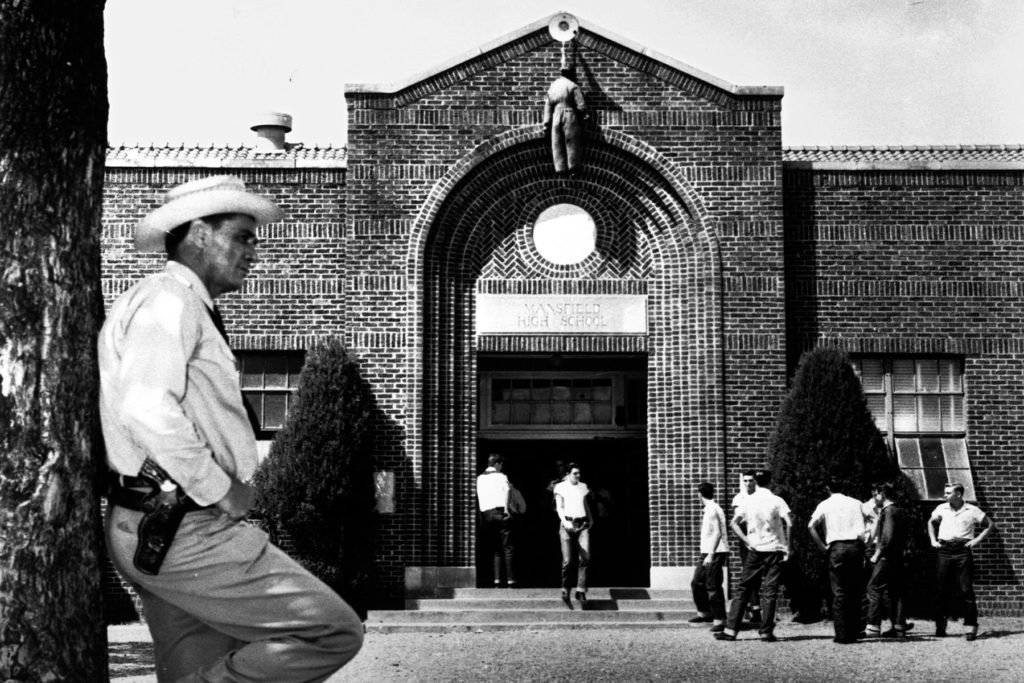
Ranger EJ Banks in front of Mansfield Highschool


When asked about it later, he explained his actions as follows: “They were just ‘salt of the earth’ citizens. They were concerned because they were convinced that someone was trying to interfere with their way of life.”

Banks and the Rangers dispatched to Mansfield were successful. As Swanson notes about the high school integration effort, "Blacks were so intimidated that none attempted to enroll at Mansfield." When two young Black people, aged 17 and 18, attempted to enroll at the local junior college, they were met by an angry mob--one that a Life Magazine photographer described as among the meanest he'd ever seen.

The Rangers, including Banks, stood with the mob. They made no attempt to disperse the mob but, instead, threatened to arrest the two young Black people, who then retreated. Afterwards, the White Citizens Council treated Banks to a chicken dinner.

So what does all of this tell us? What I know specifically about Banks' career overall is limited to what I just shared. But I assume that he did many good things in the course of a career in law enforcement. I assume he apprehended violent criminals and helped to prevent acts of violence. I assume he protected innocent people from harm and gave a helping hand to people in trouble. Maybe he helped a lost child find her parents. Maybe he stood his ground in the face of dire threats to his life in order to keep other people alive. Maybe he saw people broken down on the side of the highway and stopped to help.

But when I use the word "people," I wonder who these people are. Because here's the thing: in Mansfield, Texas, a mob comprised of one segment of the population threatened violence against another. They hoisted up one of the most terrible, terrifying symbolic images one can imagine: a lynched body, a symbol of hanging someone until dead. A Black body, of course, not a White one. The symbol probably did not instill terror in Whites. But it surely did to the Black citizens of Mansfield. It said to them, loudly and forcefully, "We will murder you if you exercise your newly-acknowledged legal right to attend this school."

Jay Banks called the people who delivered this message "the salt of the earth." He defended them on the grounds that "someone" was trying to "interfere with their way of life."

And he acted to protect their way of life from the "someone" who threatened it.

He saw that as his job. He did not protest it or resist it. He saw it as his job: to serve and protect the White community and its way of life from the threat posed by Blacks, by the prospect of Black equality, and by those outsiders (whatever their color) who worked for equality and justice.

I keep returning to this portrayal of violence-threatening mobs as "the salt of the earth," because it communicates a vision of what law enforcement is about, a vision that's bound up with white supremacy. Mobs that gather and threaten violence in order to thwart people from doing what the highest law in the land says they have a legal right to do? THAT is the very definition of lawlessness. A commitment to law enforcement that was impartial with respect to race would balk at defending such a mob.

In order to do what Jay Banks did in Mansfield, he had to have an understanding of his role, of his purpose, that was not impartial with respect to race. He had to believe that it was his mission to protect and serve White people--and a big part of what he was supposed to protect them against was the threat posed by Blacks. Not just Black violence, but Black presumption--the presumption of equality and dignity and respect that trying to enroll in a junior college represents.

This means that Jay Banks did not merely see his role as being about protecting and serving White citizens but about protecting and serving their White privilege. He stood with the White citizens of Mansfield to face down that threat to their privilege posed by integration.

Now let me pause here and say something important: I'm not claiming here that Jay Banks was some kind of moral monster who helped to fire up the racist sentiments in Mansfield. Far from it. In seeing things the way that he did, and in seeing his role as a law enforcement officer as he did, he was probably pretty normal.

It was probably how he was raised to see things. It had to be, for him to look at mobs threatening Black children with lynching and call then the salt of the earth. The people who did this were his people, people like him who were raised to think as he did about race in America. And he saw his job as a Texas Ranger not to be the egalitarian administration of justice or the unbiased enforcement of the law but the protection of these White citizens and their privilege, even against threats that came from the law itself--from the highest law of the land, the Constitution of the United States of America and the rulings of the Supreme Court.

The way that an officer of the law carries out an assignment like this tells us how that officer of the law sees his role and his purpose in society. And what we see on display here is a racialized vision of law enforcement. It is about protecting and serving White citizens and their privilege. It is about protecting them from the threats posed by Black citizens (although I doubt he'd call them citizens), whether that threat came in the form of theft or promised violence, or whether it came from the attempt to assert equality and dignity.

The fact that this way of seeing things was commonplace at the time may well serve to soften the force of our moral repudiation. Today, people know better and have no excuse for thinking in a such a way--but maybe in Jay Banks' day, they didn't know better. Or perhaps they were just beginning to encounter the insights that could help them to know better. In terms of assessing the moral blameworthiness of people in the past, it can lead us into trouble if we simply apply our contemporary standards and values without qualification. While I believe injustice is injustice no matter what the era, understandable cultural blindness can partly excuse people for failing to be just, even if such blindness can never make injustice anything other than wrong.

But in taking down a statue of someone from the past, the issue at hand is not how we should morally assess the overall moral praiseworthiness or blameworthiness of the person represented in the statue. The question is what values we want to symbolically affirm today with the public symbols we choose to display.

The fact is that precisely because Jay Banks was a man of his time rather than a man ahead of his time, he represents something far bigger than himself: he represents a vision of law enforcement that has for generations led to the marginalization and violation of Black Americans. It is precisely this vision of law enforcement whose legacy we have to cast off if we want to move into a future in which fewer George Floyds are murdered by police officers. It is precisely this vision of law enforcement that has no place in any system of law enforcement today. Not that it did back then, either, but we have the clarity of vision today to stand against that vision and to lift up in its place one that is truly egalitarian and just.

To do that, we need to clearly repudiate racist visions of law enforcement. This is what the historic moment we are in calls for: unambiguous repudiation of the vision of law enforcement that sees the mission of police to be the protection of White Americans and White privilege against the threats posed by people of color and their demands for equal dignity and respect.

In other words, this moment in history calls us to unambiguously repudiate the vision of law enforcement that Jay Banks represents--the one so clearly on display during his defining moments in Mansfield, Texas. He was perhaps no more guilty than anyone else in his day for affirming and acting on such a racist vision. Still, he was an uncritical agent of that racist vision and its evils. And that means he represents this vision. And there is no way to unambiguously repudiate that vision while, at the same time, leaving intact a symbol in a public space that lifts up someone whose career represents it.

At the same time, a public act of taking down such a symbol is a public message with its own symbolic meaning: "We are turning away from this racist conceptions of policing; we are choosing not to honor it."

Of course, there are difficulties here because public symbols are complex. This is especially true of the public symbols that are tied to the legacy of human lives, such as statues and the names of famous people attached to building or streets or town squares. No human being symbolizes just one thing. And neither does Jay Banks. And there are surely things in Jay Banks' life that we want to lift up today.

If we look at the lives of those officers of the law who, in earlier generations, saw their mission through racist lenses and went out to serve and protect White citizens while keep Black ones down--if we are honest and fair as we examine their stories, we will find them standing for things we want to honor: their courage in facing danger for the sake of the helpless, for example. But surely we can find people in our history who exemplify these virtues without the limitations that racism imposes on their expression. It's probably true that, at some point, Jay Banks went out of his way to help a child. But my guess is it was a white child, and that he wouldn't have shown the same compassion for a black child. But surely there are law officers in the state of Texas who have shown compassion without racist constraints. So let's honor those officer.

If we want to honor the virtues of law enforcement without also honoring the racist history of policing in America, let's find those prophetic officers who stood for racial equality when it wasn't popular to do so, the ones who were asked to enforce inequality and said no. Let's find the officers who took a stand for racial justice. Let's find Black officers who had the courage to take up a calling in law enforcement despite a hostile environment, who blazed a trail paved with moral courage and helped to challenge racist assumptions.

Let's find those officers who represent the values we want our law enforcement agencies today to embody. Let's commission statues of them.

Maybe the people of Dallas want to lift up what is best in the history of the Texas Rangers. So let's find someone who can symbolize that--someone who saw the mission of the Rangers as demanding opposition to racist oppression rather than someone who happily went along with a Governor's order to enforce racial oppression. Surely in the storied ranks of the Texas Rangers it is possible find such a person, right?

So find that person, make a statue, and erect it where Jay Banks' statue used to stand. One statue, one symbolic gesture that affirms our community's opposition to racist law enforcement and the respect we hold for those officers of the law who truly embody a commitment to equality under the law, to even-handed administration of legal justice, to fairness and dignity, to the idea of serving and protecting everyone in the community regardless of such markers as race or ethnicity, creed or sexuality.

Our symbols matter. Even one symbolic change can, like a Texas Ranger wading into a riot alone, make a big difference in who feels included in the community, who feels marginalized, who sees law enforcement as an ally in the quest to live a good life, and who sees law enforcement as a threat.

In this historic moment, let us make the kinds of symbolic changes that reflect the values of equality and justice and human dignity that can help us move towards a more inclusive and harmonious nation.

Wednesday, May 27, 2020

I Can't Breathe

"I can't breathe."

There are people out there these days who are protesting rules that require wearing masks during this pandemic. They think the law is pressing itself into their lives, restricting their freedom. Some complain that it's hard to breathe in those things.

The force of law, restricting their breath.

"I can't breathe."

Eric Garner was put in a choke hold after being detained by police for selling loose cigarettes. We know how it ended: Eric Garner died and the police officer walked free.

The force of the law, restricting his breath.

A year later, in Tulsa, Eric Harris was fleeing the police. He died when a volunteer reserve deputy shot him after he'd already been tackled. It was apparently a mistake: the volunteer meant to pull out his taser but instead pulled out his gun. As Harris was dying, he gasped out, "I'm losing my breath." The deputy responded, "F**k your breath." Perhaps they were the last words he heard before he died.

The force of the law, restricting his breath.

The other day a police officer knelt on the throat of George Floyd, who was suspected of forgery and resisted when the officers tried to arrest him. He gasped for breath, gasped out the words, "I can't breathe." Onlookers became involved, afraid for Floyd's life, asking the officer to relent. The police officer did not relent. Floyd was picked up by an ambulance but he died.

The force of the law, restricting his breath.

Stopping it. Ending it.

An utterly predictable ending in this most recent case. I saw the size of the officer who had his knee on George Floyd's throat. I know that if someone that size had their knee on my throat for thirty seconds or less, I'd almost certainly die. George Floyd looked bigger and stronger than me, so I'd give it a little longer. Still, this was a murderous form of restraint. A deadly form of restraint. Certainly not the only thing the officer could have possibly done under the circumstances with an unarmed man being arrested for a nonviolent crime.

Three black men who couldn't breathe. Three black men who lost their lives. And they are only a few among many.

Most police officers have not ended someone's life by cutting off their air supply, certainly not by kneeling on the suspect's throat. We need to point that out. But it isn't enough to point this out. We also need to ask how many, under identical circumstances, would do the same.

I hope the answer is not many. I think the police officers I know would be critical of what this officer did. We need to point that out. But pointing that out is not enough. Because we also need to ask how many police officers will circle the wagons and defend those in their ranks who cut off someone's breath.

I hope the answer is that far fewer will do so this time than has happened in the past. And if this is right, we need to point that out. But again, pointing that out is not enough. We need to ask other questions, broader questions:

How many in our society will look at what happened and say, "He shouldn't have resisted when the cops came to arrest him. It's his own fault." As if the death penalty is the right punishment--imposed without judge or jury, there on the scene, on the street, caught between a tire and the weight of a man's body concentrated through the knee and applied to the throat. As if that is what resisting arrest deserves.

How many will say, "The man was big and dangerous, and when he resisted they had to subdue him. They had no choice." As if, in a confrontation between an unarmed man outnumbered by armed police trained in various methods of restraint, there was no other possible choice but to kneel on his throat and keep kneeling on it even after he started gasping, even after it was clear that he was struggling to breathe, to live, to live one more moment if not another day. "No alternative. Gotta do it. Big black guy. Dangerous. Gotta put him down like a mad dog." How many say such things? And of those who don't say it, how many think it?

How many in our society, even if they do not think such things, are hesitant to speak against blatant inhumanity, homicidal inhumanity, for fear of alienating those in their circle of friends and family who do think such things?

This is not just about a single person committing a single homicidal act. That police officer who killed George Floyd is clearly responsible for his actions, but the rest of us are responsible for how we respond to those actions. The rest of us are responsible for shaping and reshaping our shared culture and society.

Do we shape it in ways that minimize the gravity of such crimes? Do we shape it in ways that help to form the hot thin soup out of which such crimes evolve?

Do we shape it in ways that result in Black lives being treated as less precious than white lives? Do we shape it in ways that, while virtuously condemning overt in-your-face racism, perpetuate a quiet refusal to consider how implicit biases and unconscious prejudices create a more dangerous world for our Black neighbors?

If so, then our voices are there, helping to shape the words of the officer who said "F**k your breath" to a dying man.

Or are we, instead, gagging along with Eric Garner, Eric Harris, and George Floyd? Are we encouraging the empathy that is required to see the humanity, the image of God, the face of God, in strangers who are dying on the street? Do we feel the everyday racism that our Black neighbors endure as a weight on our own shoulders, even if we aren't ourselves Black and even if we cannot fully inhabit or understand it? Do we endeavor to do so with enough persistence and compassion to at least try to envision what it is like to be Black in America and to see white police officers ending the lives of unarmed Black men only to be acquitted time and time again, and to see white vigilantes gunning down Black joggers and not be charged until there is a public outcry?

If so, then how can we not find ourselves vicariously gasping and crying out, "I can't breathe"?

Since I started by talking about face masks, let me return to that now--because I think there some lessons there.

Except in rare cases, a cloth face mask does very little to restrict breathing. People can wear it for hours and suffer no ill effects except for mild discomfort, fogged eyeglasses, and some chafing. These masks help keep asymptomatic carriers of COVID-19 from unwittingly spreading it to others, by trapping the respiratory droplets that spread the disease before they can splash outward into the grocery store or the pharmacy. Any law or policy requiring you to wear such a mask is not intended for your safety. It is intended for the safety of those around you. But the policy only works if everyone does their part.

There are two lessons to draw from this. The first is this. Except in rare cases where medical conditions make mask-wearing harmful, those who complain that they can't breathe when they wear a mask are operating from a position of privilege. They are operating from a space of unfettered breathing, from a social space in which they are used to filling their lungs and breathing out across their world without a care. The restriction is nothing compared to the knee at George Floyd's throat. So if you think the mask is the law demanding too much, then so is the knee. If the mask calls for protests and rallies and hours of your time fighting in the name of human breath free of legal tyranny, than all the more so should the knee demand the same. Perhaps something even more dramatic, more sustained, than quietly taking a knee during the National Anthem at a football game.

And here is the second lesson: the mask requirement is about collective responsibility. It is a small thing, but if all of us collectively do it the outcome could be dramatic: people alive who would otherwise be dead; small businesses able to stay afloat which would die if another surge in the pandemic created the need for more sheltering in place. All of us do this little thing, and the burden of the pandemic will be eased from the shoulders of the minority who fall into the highest risk categories. We all do our little part, a tiny inconvenience, and people live who otherwise would have died--like my mother who is in her 80s, or my mother-in-law who is in her 70s and has diabetes.

This is about collective action: everyone seeing themselves as part of the solution rather than treating it as someone else's problem. That is what the masks represent. And that is what is required to change our society enough that our Black neighbors can breathe easier.

The problem of racism is in part a problem of overt racist people acting out their hate in the world. If and when police officers are identified as such overt racists, they should be fired. And when their acts rise to the level of crimes, they should be punished.

But the problem of racism is also a problem of hidden systemic forces and widespread patterns of thinking and acting that are most unconscious and, individually, probably not very harmful. Let's call this the problem of systemic and implicit racism. With respect to this problem, it is a mistake to single out the police as some special locus of systemic and implicit racism. That's just a trick some people play--people who aren't police officers, often white liberals--to avoid responsibility. The problem of systemic and implicit racism is everywhere, including in the system of higher education of which I am a part.

What we need is collective action and collective responsibility. What we need is a willingness to take action from our place of privilege, despite the chafing and the fogging of our glasses, so that someone lives who otherwise would have died.

In the case of systemic and implicit racism, the steps are less obvious and more complicated than simply putting on a mask before stepping into Walmart. It will be harder work. And just as there are those who refuse to wear a mask, there are those who refuse to do this harder work. But hopefully enough of us hear the anguished cry, "I can't breathe," deep in our bones. Deep enough so it aches. Deep enough so it stirs us to act.

The cynic will say, "I'm not holding my breath." But I am not a cynic. I am a person of faith, and I believe that every breath is a gift. As long we can breathe, we have the power to carry into our world the very breath of God. Let us use it well.

Monday, April 13, 2015

"F**k Your Breath": Mistakes in Law Enforcement

The other day, another police shooting of a black man made headlines--this one in Tulsa, so it hit close to home.

It was all captured on video: An officer tackled a fleeing suspect, Eric Harris. While he was ordering Harris to roll onto his stomach, a reserve deputy--a volunteer with full law-enforcement authority--decided to subdue Harris with his Taser. Except that he wasn't holding his Taser. He was holding his handgun.

You can barely hear the "sorry" on the video. It's swamped by Harris's cries: "Oh my God, he shot me! He shot me!"

But if you listen closely you will hear that soft "sorry," and it has an oh-shit quality to it. So I'm confident the Taser story is true. The guy didn't mean to fire his gun. It was a mistake.

A fatal one. Harris died later at the hospital.

Another feature of the story isn't included in the video (at least the one I saw and that's linked to above). At the end of that video, Harris can be heard saying, "I'm losing my breath." And then the video ends. But according to reports, a deputy responded to that fading plea with crude disdain: "F**k your breath."

It's impossible not to think about Eric Garner, a black man who died last summer from a police officer's choke hold, whose last words were, "I can't breathe." Was the deputy thinking about Garner? Was his dismissal of Harris's life breath an expression of a deeper and broader disdain?

I don't know. But I can't help but think about lying on the pavement, bleeding, dying, crying out in pain and horror, and hearing my life and human dignity swept away with "F**k your breath." Perhaps they were the last words Harris ever heard, the final punctuation of his life story.

The man who said those words committed no crime. There will be no charges filed. One man shot Harris by mistake, and may face charges. Another sent him into death with a final message: You don't matter.

Both acts trouble me, but the latter strikes me as more inhuman, even if its consequences were less dire.

I don't like to define people by their worst moments. The officer who said to a dying Harris, "F**k your breath," should not be defined by those words. What he said may have been horrible and inhuman. That doesn't mean he was.

I like to think that right now he is mortified. I like to think that he lies awake thinking, "How could I have said that? What must it have been like, to hear those last words just before he died?" Maybe the officer was caught up in the adrenal rush of the moment: the chase, the unexpected gunshot, the furious thought that this would never have happened if the suspect hadn't run.

Maybe it just slipped out. A different kind of mistake.

I've known numerous police officers over the years, all of them good people with a sense of civic responsibility. They recognize the weight of the public trust they've been invested with, and they're committed not to abusing that trust. I can't imagine any of them saying "F**k your breath" to an apprehended suspect dying from an accidental gunshot wound. And I like to think that none of them would ever mistake the firearm in their hand for a Taser, and so fatally shoot a suspect who--whatever his mistakes--didn't deserve to die.

But mistakes happen. Especially when strong negative emotions overtake us, we say and do things we wouldn't do in wiser moments. It was a mistake for Eric Harris to flee the police. So why did he do it? Maybe he was terrified. Maybe he thought, "I might become the next Eric Garner, the next black man killed by the cops." And so he fled. It's not uncommon for fear-driven behavior to actually bring to life the things we fear.

Police work is dangerous, and the moments when police shootings happen are some of the most high-stress, high-adrenalin moments in a police officer's work life. And such moments are the ones when mistakes are more likely to happen. The right kind of training can reduce their likelihood. Did the reserve deputy who mistook his sidearm for a Taser get the same kind of training that a regular officer receives?

I don't know, but the mistake I want to focus on is the other one: the anger-fueled obscenity, the dismissal of a life. I'm going to assume it was a mistake--that is, something said in the heat of the moment and later regretted, as opposed to the calculated, self-righteous dehumanization of a dying man.

My question has to do with the kind of training that reduces mistakes of that kind. In the heat of the moment, with emotions high and blood pounding in our ears, how much more likely are we to dehumanize those we see as our opponents and our enemies? And what kind of training can ensure that even in those moments, we remember the humanity of those who run from us or talk back at us or lash out at us in anger and frustration?

In some cases, the failure to really see the humanity of a suspect might lead to a crushing remark that discounts a human life in its final moments. In other cases, that failure could mean the difference between shooting a suspect and holding fire. Police should fire when lives are at stake--their own, another officer's, a civilian's. But one of the lives at stake in every police shooting is the one who is shot. That life needs to be given its due weight, too. How do we ensure it isn't discounted? How do we ensure that lives aren't cut short or damaged because, in the adrenalin-fueled moment, those lives aren't valued as they should be?

Much of the discussion about this has focused on race--as well it should. There is rampant evidence of subconscious racism operating beneath the surface of our thoughts, influencing our choices without our knowledge. This isn't a police problem. It's been documented in college professors, preschool teachers, Northerners and Southerners, rich and poor, black and white. (Yes, unconscious bias--against blacks--even influences the thinking of blacks through the phenomenon sometimes called internalized racism.)

While there is also overt racism at work in many corners of our society--as the federal investigation into the Ferguson PD makes plain--the bigger issue by far is the covert kind of racial bias that influences the choices of good people without their conscious knowledge. Such racial bias--especially if we aren't aware that it's at work in us--can increase our likelihood of making mistakes of the kind I'm talking about. Mistakes in which we think less of people than they deserve.

Such mistakes are a problem wherever they happen. But they become a bigger problem in high-stress moments. And they become a potentially fatal problem when guns are involved. This means that we will be more likely to see the problem play out in dramatic fashion among law enforcement, precisely because they are in high stress jobs that sometimes require decisions about using lethal force.

This does not mean that police are somehow especially racist. It isn't "their" problem and it isn't "theirs" to fix. Its our problem. It's ours to fix. The social forces that generate implicit bias don't originate in police departments. They come from everywhere. And if we are afraid of the effects that such biases will have on police officers who need to make life and death decisions and may be influenced by unconscious biases, then all of us need to tackle the sweeping social forces that perpetuate these biases.  (We also need to root out overt racism, and not just in police departments.)

But in the meantime, we need to offer resources to police officers who do not want to be influenced by such biases, who are committed to being fair defenders of the public good. The power they're invested with means that if anything, they need to be better than the rest of us when it comes to such things. And the police I know feel the weight of that and want to live up to that weighty trust. What tools and techniques can we offer that will help?

As important as the issue of implicit racial bias may be, it isn't the only source of the mistakes I'm talking about here. Can we imagine the recent events in Tulsa playing out with a white suspect? Of course. The kinds of scenarios that awaken fight-or-flight responses also fuel adversarial, zero-sum thinking: It's him or me. It's us or them. And as soon as another human being becomes one of "them," their humanity begins to be discounted.

This tendency appears to be rooted deeply in our human instincts. And police officers are asked to throw themselves into the very situations that trip these instincts. It's their duty as police officers to step into danger, to confront law-breakers in a way that's inevitably adversarial. Caught up in the emotional intensity of that conflict, the suffering of the adversary might trigger a flush of righteous animosity, spilling out in words like "F**k your breath."

It's only human. But it's a mistake. A tragic moment of staggering inhumanity. The police officers I know want to be the best they can be, even in those moments that have a tendency to evoke our ugliest selves. What kind of training will help?

It should be clear that I'm talking about something very different from the sort of training that will help a reserve deputy keep his head enough to realize that he's holding a handgun rather than a Taser. What I have in mind is something rooted in our capacity to see and respond to humanity in the face of conflicts and emotional forces that have a natural tendency to drive out such responsiveness.

But there are layers of problems here. Police officers have dangerous jobs, and their survival--their ability to make it home to their families--may depend on responses that are rooted in the same fight-or-flight instincts that fuel our propensity to dehumanize. What kind of training can offer the right sort of balance between preserving those essential survival instincts while nurturing our human capacity to see the humanity even in those we are in conflict with?

That's the balancing act we are asking our police officers to perform. And they're being asked to do it in a society where racial biases and other forms of prejudice are being written into our subconscious responses to our environments from an early age.

It should be clear that I don't have pat or ready answers. My aim here, rather, is to ask questions that acknowledge the deep problems and the tragedies we face without drawing good-guy/bad-guy lines, without oversimplifying, without pointing the finger at the other guy.

The Tulsa case is human. It is human because humans make mistakes, and sometimes those mistakes are tragically wrong. It is also inhuman. Sometimes our mistakes lead us to fall short of our human potential, and to see our fellow human beings as less than human. When it comes to wrestling with such oh-so-human inhumanity, we need to be in it together, to ask what we can do to help each other be better than we thought we could be.

And that means we need to stop saying "F**k your breath," even to those who say it to others.

Friday, December 19, 2014

Racism: We're All Victims

When I was a small child in the late 1960's, my family visited friends in a mostly black neighborhood in California--and my mother decided to warn me about playing out in the front yard while we were there. My memories of this are very sketchy. I think she said something about black people being mad at white people right now. Whatever she said, it caused me to have nightmares. I remember those vividly. In my dreams that night, coal-black men burst through the door of our hotel room and snatched me away.

Then we returned to the lily-white suburban neighborhood where I grew up, and the nightmares didn't follow me. I wasn't aware, for a long time, of any lingering effects. After all, there were only two black boys in my school district, and they were friendly and familiar.

But a dozen years later, I was at a Lutheran summer camp. It was the first day, and activities hadn't started yet. After dumping my things on a bunk in the boy's dormitory, I walked around the campground for half an hour. Then I decided to read under a tree, and so headed back to the dorm to get my book.

Three black teenagers were there, chatting and laughing. I froze in fear. I almost turned in the doorway. But I stopped myself. I forced myself to walk into the room, say hi, and get my book. They didn't beat me up. Instead, they said hi back. And I, still flushed with adrenalin, went and found a tree to read under.

In light of recent news out of Ferguson and New York, I've been thinking quite a bit about my childhood nightmare, and about my encounter with my gut-level racial fears in that summer camp dorm room. They are evidence of something--namely, that I've been harmed by growing up in a racist society. My best self has been harmed.

One of the things that profoundly shaped Martin Luther King, Jr.'s approach to fighting segregation was his conviction that the struggle was not between white people and black people, but between human beings and the racist system.This is one crucial reason why he insisted on an approach that eschewed violence and expressed love for the white oppressor: We're all in this together. All of us should work together to overcome racism, because all of us are its victims.

Let's be clear: King didn't mean that blacks are just as racist towards whites as the other way around, and that we're therefore all on the same footing. When a social system--defined by deeply rooted cultural practices and patterns of thinking and feeling--causes one group to enjoy privileges at the expense of another, there is no equal footing. And when members of the marginalized group lash out against the privileged group, it has a very different meaning than when members of the privileged group invoke their privilege to put the oppressed in their place.

Racism is not just about harboring animosity towards members of a racial group. It's about the oppressive use of social power. And unlike the frustrated lash-back of its victims, such oppressive use of social power can look very subtle, almost benign, to those who aren't its victims. When the oppressed behave badly, it looks like rioting. When the privileged behave badly, it looks like business-as-usual.

King called on all of us to stop behaving badly--but that call demands different things from the privileged than it does from the oppressed. It is one thing to resist the urge, in the wake of years of frustration and resentment, to lash out with flailing fists. That can be hard, especially in moments of acute outrage at specific injustices. But that challenge--to resist behaving badly in the face of an acute injustice--is very different from the challenge of resisting the urge to do what is socially acceptable, what is invisible, what you don't even know you are doing when you do it.

Racism drives the oppressed to moments of acute frustration, where it becomes hard to be your best self. But racism confronts the privileged with easy injustice, and it sometimes takes moments of acute emotion to begin learning to resist temptation. Racism harms me, a white male, not only because it make me unjustifiably afraid of my fellow Lutheran campers. It harms me because it makes it so easy, so painfully easy, to fall short of my moral aspirations.

And this is what King meant when he said that the racist system harms us all. White supremacists have been inhumanized by racist ideologies even as their black victims have been dehumanized. Well-meaning white people have had their best intentions undermined by subconscious prejudices that they don't even know are there, and black people have felt the accumulated weight of the micro-aggressions that result.

Research shows that even people who loathe racism are affected by unconscious prejudices. And no one is immune. Those in my profession are as guilty as anyone, as a recent study of college professors reveals. The evidence also shows that black children feel the effects of this unconscious racism very early on--starting as early as pre-school. Black children who behave the same way as white ones are perceived by white authority figures as a problem in a way that their white peers are not. It starts in preschool and just keeps happening. For some personality types, this may lead to a kind of cowering effort to avoid notice. In some, it may inspire a concerted effort to be better-behaved than everyone else, so that one can come off looking to unconsciously racist eyes as almost respectable.

But for some personality types, it can lead to growing frustration, growing anger, a growing sense of injustice. And if those personalities don't also possess uncommon resources for expressing their sense of injustice with eloquence and creative nonviolence--if they don't have the uncommon resources of a Martin Luther King, Jr.--they may strike back in more antisocial ways, creating a kind of feedback loop. Authorities treat you as a problem, so you react in ways that lead authorities to treat you as a bigger problem, and so on--culminating, perhaps, in a black teenager lashing out in explosive rage at a white police officer who orders him off the street, and a white police officer seeing a problem so terrifying that shooting seems the only way to get home to his family alive.

I've thought quite a lot about the tragic encounter between Officer Darren Wilson and teenager Michael Brown, and I'm uncomfortable with knee-jerk reactions in either direction. It was a black police officer who said, at a panel discussion I attended in early September, that the evidence available to him pointed to a justified police shooting. But if we accept that judgment, and also the judgment of the Grand Jury, it doesn't mean that racism isn't deeply implicated in what happened in Ferguson. Rather, it points to the deep truth that the racist system in this country has victims who are both black and white.

If Darren Wilson was justified in pulling the trigger, then it's because a system of anti-black racism worked itself out in the history of Ferguson, MO, and in the lives of the people involved, in ways that put that police officer into a desperate corner. Black boys grew up unfairly singled out as problems rather than people. A system evolved such that a city of mostly black citizens was policed by mostly-white officers who lived elsewhere, who were both physically and racially segregated from the community they served and so were unlikely to feel deeply connected to the community and its members.

The police have been targeted for a special kind of scrutiny by recent events, and given their important role in our society, and the power with which they are invested, I suppose such scrutiny makes sense. But the problem of racism is a social problem, not a police problem. I know a number of police officers and respect them all. They are good people devoted to serving the public good. As in all professions, there are bad apples. And as in all professions--including my own--the broad social influence of systemic racism will have its effects.

One of those effects is unconscious racial bias. The thing about such bias is that, unlike deliberate prejudice, we are not morally blameworthy for it. The enemy is the racist system; the fact that we acquire unconscious racial biases is a sign of the way that we all are victims. When blacks internalize such bias, it leads to self-destructive patterns, an internalized racism that leads them to underestimate their own potential. When whites do, it cuts them off from the full fruits of fellowship with their black neighbors, and leads them to unconsciously carry out patterns of behavior that defy their own values.

The moral questions comes into play when we wrestle with what to do with our racial bias.

When I came face-to-face with my own racial bias at that Lutheran summer camp, it awakened me to something I hadn't been aware of before. I might have pretended that race had nothing to do with my reaction--that I was just following a gut instinct that the teens standing there in the dorm were bad news. But I saw my own racial bias in that case, and over the years I have become convinced that there are many forms it takes which I don't see.

So what do I do with that? Here's one thing I do with it. You know that instinct you have, sometimes, not to get in an elevator when you see who's inside, or to cross to the far side of the street when you see who's coming towards you? I have that instinct. And here's the thing: I am probably more likely to feel it when the person in the elevator or coming towards me is black. But for that very reason, I am more likely to act on it if the person is white. Because if the person is black, chances are it's the legacy of the racist system at work within me--and that's something I ought to ignore. But if the person is white, I may be intuitively responding to something that I should pay attention to.

In other words, I am more suspicious of my instincts when it comes to my reactions to black strangers than to white ones, because I know how insidious covert racial bias can be. In relation to intuitive responses to white strangers, I hesitate less because there is less reason to mistrust my instincts. In relation to black strangers, I hesitate more. Now this still means I treat whites and blacks differently--perhaps differently in ways that might be noticed, that might still work in ways that are harmful. But it is the best I know how to do under the circumstances.

There's reason to suppose that white police officers in general have internalized the same lesson. A recent Washington State University study shows that, despite the evidence of unconscious racial bias in police officers (mirroring the unconscious racial bias in the general population), in circumstances that mimic real-life decision-making, white police officers hesitate more and make fewer errors when shooting black suspects. This is true even though the same study shows that the participants were more likely to perceive black suspects as threatening.

One way to understand this finding is that the police trust their gut more when the suspect is white, and so don't hesitate as long (and so make more errors). When the suspect is black, they have developed a meta-level instinct not to take their first-order fear-response as trustworthy. And so they hesitate longer, and make better decisions.

If this is right, then when it comes to the split-second decision-making of whether to fire their weapon or not, most police officers are doing the best they know how to do under the circumstances. Of course this is just one study, but it is a hopeful one. While there is little reason to suppose that the police are any more immune to unconscious bias than the rest of us, there is reason to think that, in general, police have some awareness of racism's potential to bias judgment and have--perhaps unconsciously--developed meta-level instincts to counteract those effects.

But racism is a many-tentacled monster, and doing the best you know how to do in split-second decision-making isn't enough to overcome a long legacy of oppression and injustice. Racism will sometimes rear its monstrous head in the form of overtly racist officers. Some police departments may foster a culture that discourages self-reflective awareness of racial bias and its effects, so that that the meta-level instincts to counteract such bias never take root.

But the bigger problem is that the police cannot be expected to become immune to racism in isolation. They cannot be expected to cope effectively with a society that treats black boys as suspect from earliest childhood, and reinforces that message so deeply through the years that it becomes a struggle not to internalize it. They cannot be expected to take responsibility for the whole range of social forces that turn the police into a group of outsiders entering a community they don't belong to and being received as an occupying force rather than as officers of the peace.

The police, like the rest of us, are victims of a racist system. As King insisted half a century ago, that system is the enemy. It's not the police, and it's certainly not the protesters in Ferguson and New York around the country who are rising up to say that black lives matter.

Racism has made victims of us all, but we don't have to stay victims. The trick is to remember who the enemy is, so that we don't turn against each other, human against human, and thereby allow the many-tentacled monster of racism to continue to do its terrible work unresisted.

Friday, August 29, 2014

Some Thoughts on Ferguson

I've been wondering for awhile what I can add to the public discussion that has been generated by the recent events in Ferguson, MO: the police shooting of unarmed black teen Michael Brown, and the subsequent community protests. What light can I shed, a white man sitting comfortably here in Stillwater, OK?

And then I remembered something my daughter said earlier this summer. We were driving, and we passed a police vehicle. From her car seat in the back, my daughter waved to the police officer. I know this not because I saw her do it (I was watching the road), but because she promptly announced, "I waved to the police officer. I like to wave to the police. They're nice."

They're nice.

That is my daughter's experience of the police, and I'm not surprised. We have a relative, Uncle Rob, who's a police officer. I'm sure she thinks of him as a warm, intelligent, and charming gentleman--because he is all those things. For a few years, a police officer lived across the street from us. He and his family were good neighbors. We had them to our house for dinner. His wife helped my daughter acquire Charlotte, her American Girl doll. My daughter knew that if she ever needed to run to a neighbor for help, she should go to them.

The point is this: Police officers are members of my daughter's community. They're neighbors, like the teachers who live down the street, and the nurse around the corner, and the professor. They're family members. They have a job, and their job is to keep people safe and make sure everyone follows the law. It's an important job. It's good that some members of the community are doing it.

That's who the police are to my little girl. They're nice.

The job of a police officer is best served, I think, to the extent that they are what my daughter takes them to be: Members of the community that they serve, neighbors and friends and family members who identify with the people they meet on the street, who see their job as serving and protecting their own community.

Similarly, the job of a police officer is compromised to the extent that the line between officers and the community in which they work is a dividing line between us and them, between community members and strangers who enter it with power and authority. There is a fundamental difference between an occupying force--even one that sees its mission as keeping the peace--and the police. To the extent that this distinction evaporates, something has gone tragically wrong.

The police have a hard job, and as I learned a few years back from police officers at conference on criminal justice ethics, they operate day-to-day with a complex combination of enormous individual discretion and sometimes byzantine hierarchical oversight. On the beat, they have to make quick decisions with significant consequences largely on their own; but there is also a a world of procedure and regulation that they are responsible to. They are, as one officer put it, the only 24-hour social service agency. That is, they are expected to solve human problems in their community when others (whose official job it is) aren't available to do it--and at the same time, as their official job, they are to enforce the law and keep the peace.

In a world where guns are everywhere, they face significant danger to their very lives--because those who intend to break the laws will see the police as their enemy, as a threat to their aims, and they may be armed.

None of this can be easy. Given that rules need to be applied fairly and without favoritism, a police officer won't always be seen as "nice." But a police officer's job is so much better to the extent that neighborhood children think of the officer in positive terms. When there is a widespread sense of mutual belonging--when the officer thinks, "This is my community," and the citizen thinks, "That officer is my neighbor with an important and difficult job"--the work of the police officer becomes meaningful and appreciated in a way that can reduce some of the challenges and make other challenges worth it.

And the community is more likely to have the kind of relationship with local law enforcement that contributes to their quality of life. There is a world of difference between entrusting your safety to members of your community who have been carefully trained to protect and to serve--and living in the shadow of an occupying force.

Unfortunately, there are a range of forces that can push the relationship between police and the community in the direction of the latter.

Some arise from the inherent psychological pressures of the job. When your job leads you to seek out those who are likely to view you as an enemy--and who therefore pose a threat to you--the antagonistic us/them frame of thinking has the potential to bleed out across your psyche. Furthermore, the need to exercise authority in the enforcement of rules can make you hesitant to get too friendly. Your job calls for a kind of impartiality that may push you towards a degree of psychological distance from the community you serve.

A certain amount of suspicion and distance are probably essential to doing a police officer's job. But too much, and the police are no longer members of the community. Suspicion breeds suspicion. Distance breeds distance. In the worst cases, the police become a kind of occupying force.

In poor and socially marginalized communities, the risk of this is magnified by numerous additional factors. First, poverty and social marginalization breed crime, and this increases the psychological pressure in police to be increasingly suspicious and distant from the members of the community they serve. Second, police officers have jobs that pay well relative to the incomes of those in poor and marginalized communities, a fact which creates a kind of economic distance. It can also create physical distance: police officers are more likely to live in middle class neighborhoods. And because the job carries with it an important and recognized social role--one that you're unlikely to choose or manage to get if you are yourself too marginalized and disaffected--officers may have trouble identifying with the depth of marginalization that many in their community feel; and the most socially marginalized may, in turn, have trouble identifying with the police. The result is an increased risk of us/them thinking, a sense of disconnect that pushes policing in the direction of quasi-military occupation.

And I haven't even mentioned race.

Racial divisions can obviously play into the us/them thinking, especially if the demographic profile of the police force is too unlike that of the community population. But I think there is another issue related to race that may go under-appreciated, on linked to racial profiling. The issue is this: The natural desire of the police to form some sense of belonging within the community they serve is in tension with the suspicion and distance that the job sometimes brings. But if there are some members of the community who can be easily identified as "safe"--as non-threatening and law-abiding--the need for suspicion and distance can be loosened with respect to them. You can let down your guard enough, at least with those you can quickly identify as safe, to form the sense of kinship and connection that makes the job more meaningful.

There is therefore something seductive about the idea that profiling based on visible cues can pick out those who are likely to be dangerous law-breakers, marking them off from those one can form a sense of connection with. Race is one of the most visible cues of all. Combine that with a cultural history of racial stereotyping, and a demographic disconnect between the police force and the community--not to mention the fact that legacies of injustice have resulted in disproportionate numbers of blacks living in poverty and feeling marginalized--and what do you get?

You get Ferguson.

The community response we've been seeing in Ferguson does not arise from a single incident, no matter how tragic or terrible. It is the effect of a cumulative and long-standing problem, a disconnect between a community and the police so severe that mutual fear and opposition have largely displaced any sort of identification. In Ferguson, I doubt that little black girls see a police car and think, "You're nice." Too many of their brothers have come home indignant about being profiled, being treated as guilty until proven innocent...or, sometimes, not come home at all.

The question is how such alienation can be repaired.

Part of the answer may be demographic--seeking to encourage a police force that more closely resembles the community it serves. Part of the answer may be prioritizing the hiring of officers with deep personal ties to the community. But much of the answer may lie in deliberate programs designed to build bridges of understanding between the police and the community: opportunities for members of the community to share with the police their feelings and needs and experiences, and for police officers to do the same--facilitated to minimize accusation and blame and maximize mutual listening and understanding.

Give law enforcement officers the chance to gather with community members to share together what they fear, what they hope, what they need. Find ways to give each side a safe space to express their anger, their frustration, their hurt--and experience what it is like to be heard.

The people of Ferguson are in a better position to know what kinds of activities and programs will help the most. What I can say with confidence is this: The question of what will help overcome the alienation between police and community is intimately linked to a question of central importance to those in Ferguson who have taken to the streets, who are chanting "Hands up! Don't shoot!"

The question is this: What should they be asking for?

The most successful campaigns of the civil rights movement were organized around very concrete goals. Martin Luther King, Jr., insisted that when community action was taken to protest segregation practices, they be clear about what, specifically, they wanted from their opponents.

In Ferguson today, there is energy for change. Anger is energy, and it's spilling into the streets. If the people of Ferguson want to harness that energy in a way that has a chance of making a positive difference in their lives, they need unity and organization, and they need nonviolent direct action strategies that will call attention to the problems and the reasons for their outrage. But they also need a clear purpose. They need to ask for something--something specific that the police department is actually able to give.

Justice for Michael Brown is one goal, but it lies beyond the power of the police alone to give. The police can commit to approaching the Michael Brown shooting with transparency and integrity--but the outrage in Ferguson arises from a problem that runs much deeper than the shooting of one person. The anger in Ferguson is fueled by more than a single shooting, no matter how tragic. It is about a relationship between the community and the police that has broken down. Michael Brown's shooting and the response are symptoms of something deeper.

Here, then, is something the activists in Ferguson might ask for, which cuts to the heart of the deeper issue: They could ask for a concrete commitment by the police department and the local government, complete with action steps, to devise and implement a community program to overcome the alienation, the us/them ideology, that has overtaken the relationship between the Ferguson police and the community. Perhaps the result could serve as a model plan for building positive community connections with law enforcement in other communities across the country.

It isn't just community members who would prefer to live in a world where their young daughters see a police officer and, rather than feel a rush of fear, smile and wave. The police would much rather live in such a world, too. As such, the problem in Ferguson is a shared problem. And a demand for addressing the schism between community and police is a demand for something that everyone has motive to pursue.

The energy in Ferguson is more than just a powder keg. It is an opportunity--a moment when, if the forces can be aligned in the right way, significant positive change can happen. Let's pray that, in this moment in history, anger and wisdom can come together and move Ferguson--and maybe the rest of us with it--in the direction of something brighter.