Showing posts with label racism. Show all posts

Saturday, June 6, 2020

One Statue, One Symbolic Gesture: The Case of the Texas Ranger Statue at Love Field

The other day, airport officials at Dallas Love Field removed a 12' brass sculpture that has greeted travelers for decades.

The sculpture is of a law enforcement officer, a Texas Ranger. The sculpture's caption reads, "One Riot, One Ranger"--a reference to the apocryphal story that when a single Texas Ranger appeared in response to a riot there was someone who asked if he was really alone and the ranger replied, "You only have one riot, don't you?"

The model for the sculpture was a Texas Ranger by the name of Jay Banks. The impetus for the removal of the statue comes from a recently published excerpt, in D Magazine, from a forthcoming book, Cult of Glory, by Doug Swanson (a Pulitzer Prize finalist and, for a year, a John S. Knight Fellow in Journalism at Stanford University). But while that publication called attention to some uncomfortable truths about Jay Banks, current national events almost certainly played a big role in the swiftness of the decision to remove the statue. What Swanson's excerpt reveals is that Banks commanded Rangers who carried out a deeply troubling assignment: they blocked the integration of a public high school and a junior college in Mansfield, Texas.

The move to take down the statue is predictably controversial, peppered with cries of political correctness run amok. One person I know on social media bemoaned the fact that, because Banks did one thing people don't like, we are tearing down a tribute to someone who spent a career serving and protecting the public.

But just as one Texas Ranger can, purportedly, quell a riot, so too can one act by a law officer have far-reaching and career-defining implications.

A favorite quote of mine, from A.J. Muste, is this: "If you can't love Hitler, you can't love anybody." Muste is here make a very challenging but also a quasi-logical claim about the nature of Christian love, the distinct kind of love that does not wait on worth but extends unconditionally to all. His point was that if I can't love Hitler, then my love has conditions; and if my love has conditions, it isn't this unconditional Christian kind of love. And that means that this ONE instance tells us something about all of my acts of love: none of them are Christian love in the full sense.

Likewise, one police action by an individual officer can, at least in certain cases, reveal to us something career-defining, something about who that officer is and what values and commitments shape the nature of his police work. It can tell us, among other things, whom he sees himself as serving in his vocation--and whom he does not serve.

And that, in turn, can tell us a lot about what his name and likeness mean, symbolically, when lifted up--or taken down--by a community. A career-defining moment may not only tell who this officer is, but the values of the community that chooses to honor that officer. If a community hoists up a statue to that officer, what is the community saying about itself, about its members, about its values? If they leave it up when they learn something troubling, what does that say? And if the same community takes the statue down, what does that say?

The decisions about erecting monuments, keeping them up, and taking them down are decisions about what a community wants to say about itself to its citizens and to wider world. One statue can thus mean a lot, and what we do with that statue can both express and shape the values of a community. It can help determine whether Black Lives Matter, really matter on an equal footing with White lives, to a community and its criminal justice system.

With this in mind, let's look at the story about Jay Banks that Swanson shares in the published excerpt from his forthcoming book.

I want to review the story that Swanson tells in my own words, since I want to highlight certain features of it that are important for drawing moral conclusions. In 1956, in keeping with the Brown v Board of Education Supreme Court Decision, the NAACP tried to integrate the high school in Mansfield, Texas. White citizens responded with outrage, threats of violence, and an effigy of a lynched black man strung up at the entrance to the school. The governor responded by sending in the Rangers--not to quell the angry white supremacist crowds and help the black children go to school, but to help the angry white supremacists keep integration from happening.

Let me say that another way: these Rangers were not sent to enforce the law of the land but to help the white citizens of Mansfield to continue segregationist policies in violation of the highest laws of the land.

Jay Banks was the Ranger in command. And he did as ordered. It was his mission to enforce unconstitutional segregationist policies, and he carried it out.

We could imagine a brave officer of the law refusing such a mission on the grounds that his job was to enforce the law, not help citizens violate it. We could imagine some Texas Ranger taking a principled stand for justice in that moment in history, bucking the white supremacist values that were so widespread and instead speaking a prophetic moral message of racial equality. It would make a great story. But Jay Banks was not the hero in such a story. He made no such courageous stand.

Nor did he did make any attempt to disperse the violence-threatening mob of white citizens who were gathered to defy US law and enforce white supremacist principles.

Nor did he make any attempt to take down the sinister effigy of a lynched Black man--a symbol used to terrorize the Black population of Mansfield just as lynchings and the threat of lynchings have been used for generations to terrorize Black people. He let that stay up.

Here's a picture of Jay Banks, leaning against a tree in front of the school, the dangling effigy in place:
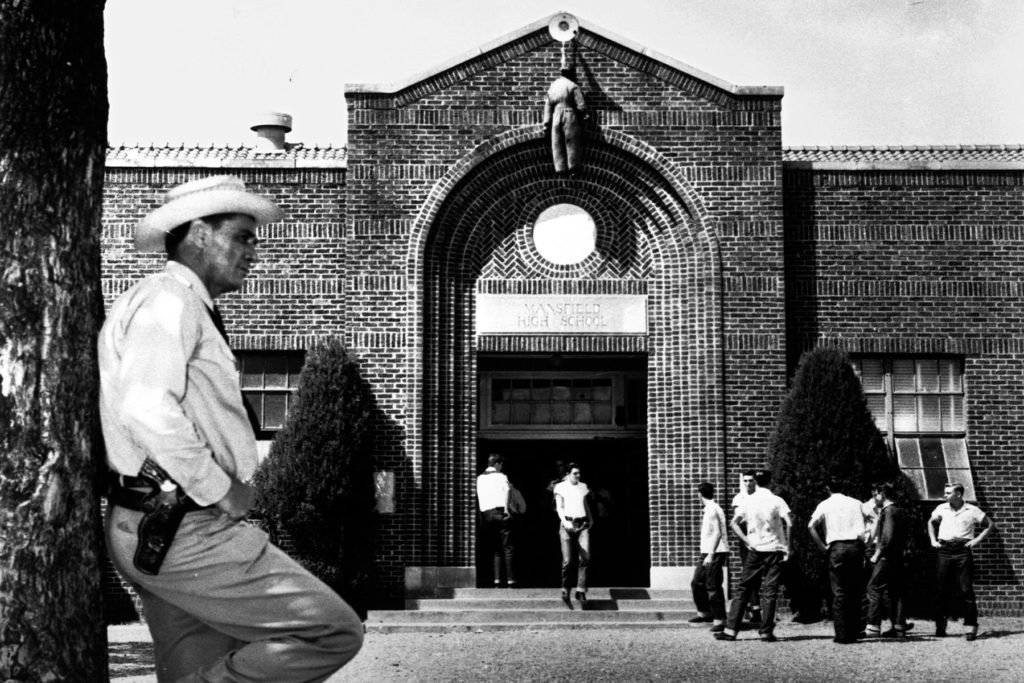
Ranger EJ Banks in front of Mansfield Highschool


When asked about it later, he explained his actions as follows: “They were just ‘salt of the earth’ citizens. They were concerned because they were convinced that someone was trying to interfere with their way of life.”

Banks and the Rangers dispatched to Mansfield were successful. As Swanson notes about the high school integration effort, "Blacks were so intimidated that none attempted to enroll at Mansfield." When two young Black people, aged 17 and 18, attempted to enroll at the local junior college, they were met by an angry mob--one that a Life Magazine photographer described as among the meanest he'd ever seen.

The Rangers, including Banks, stood with the mob. They made no attempt to disperse the mob but, instead, threatened to arrest the two young Black people, who then retreated. Afterwards, the White Citizens Council treated Banks to a chicken dinner.

So what does all of this tell us? What I know specifically about Banks' career overall is limited to what I just shared. But I assume that he did many good things in the course of a career in law enforcement. I assume he apprehended violent criminals and helped to prevent acts of violence. I assume he protected innocent people from harm and gave a helping hand to people in trouble. Maybe he helped a lost child find her parents. Maybe he stood his ground in the face of dire threats to his life in order to keep other people alive. Maybe he saw people broken down on the side of the highway and stopped to help.

But when I use the word "people," I wonder who these people are. Because here's the thing: in Mansfield, Texas, a mob comprised of one segment of the population threatened violence against another. They hoisted up one of the most terrible, terrifying symbolic images one can imagine: a lynched body, a symbol of hanging someone until dead. A Black body, of course, not a White one. The symbol probably did not instill terror in Whites. But it surely did to the Black citizens of Mansfield. It said to them, loudly and forcefully, "We will murder you if you exercise your newly-acknowledged legal right to attend this school."

Jay Banks called the people who delivered this message "the salt of the earth." He defended them on the grounds that "someone" was trying to "interfere with their way of life."

And he acted to protect their way of life from the "someone" who threatened it.

He saw that as his job. He did not protest it or resist it. He saw it as his job: to serve and protect the White community and its way of life from the threat posed by Blacks, by the prospect of Black equality, and by those outsiders (whatever their color) who worked for equality and justice.

I keep returning to this portrayal of violence-threatening mobs as "the salt of the earth," because it communicates a vision of what law enforcement is about, a vision that's bound up with white supremacy. Mobs that gather and threaten violence in order to thwart people from doing what the highest law in the land says they have a legal right to do? THAT is the very definition of lawlessness. A commitment to law enforcement that was impartial with respect to race would balk at defending such a mob.

In order to do what Jay Banks did in Mansfield, he had to have an understanding of his role, of his purpose, that was not impartial with respect to race. He had to believe that it was his mission to protect and serve White people--and a big part of what he was supposed to protect them against was the threat posed by Blacks. Not just Black violence, but Black presumption--the presumption of equality and dignity and respect that trying to enroll in a junior college represents.

This means that Jay Banks did not merely see his role as being about protecting and serving White citizens but about protecting and serving their White privilege. He stood with the White citizens of Mansfield to face down that threat to their privilege posed by integration.

Now let me pause here and say something important: I'm not claiming here that Jay Banks was some kind of moral monster who helped to fire up the racist sentiments in Mansfield. Far from it. In seeing things the way that he did, and in seeing his role as a law enforcement officer as he did, he was probably pretty normal.

It was probably how he was raised to see things. It had to be, for him to look at mobs threatening Black children with lynching and call then the salt of the earth. The people who did this were his people, people like him who were raised to think as he did about race in America. And he saw his job as a Texas Ranger not to be the egalitarian administration of justice or the unbiased enforcement of the law but the protection of these White citizens and their privilege, even against threats that came from the law itself--from the highest law of the land, the Constitution of the United States of America and the rulings of the Supreme Court.

The way that an officer of the law carries out an assignment like this tells us how that officer of the law sees his role and his purpose in society. And what we see on display here is a racialized vision of law enforcement. It is about protecting and serving White citizens and their privilege. It is about protecting them from the threats posed by Black citizens (although I doubt he'd call them citizens), whether that threat came in the form of theft or promised violence, or whether it came from the attempt to assert equality and dignity.

The fact that this way of seeing things was commonplace at the time may well serve to soften the force of our moral repudiation. Today, people know better and have no excuse for thinking in a such a way--but maybe in Jay Banks' day, they didn't know better. Or perhaps they were just beginning to encounter the insights that could help them to know better. In terms of assessing the moral blameworthiness of people in the past, it can lead us into trouble if we simply apply our contemporary standards and values without qualification. While I believe injustice is injustice no matter what the era, understandable cultural blindness can partly excuse people for failing to be just, even if such blindness can never make injustice anything other than wrong.

But in taking down a statue of someone from the past, the issue at hand is not how we should morally assess the overall moral praiseworthiness or blameworthiness of the person represented in the statue. The question is what values we want to symbolically affirm today with the public symbols we choose to display.

The fact is that precisely because Jay Banks was a man of his time rather than a man ahead of his time, he represents something far bigger than himself: he represents a vision of law enforcement that has for generations led to the marginalization and violation of Black Americans. It is precisely this vision of law enforcement whose legacy we have to cast off if we want to move into a future in which fewer George Floyds are murdered by police officers. It is precisely this vision of law enforcement that has no place in any system of law enforcement today. Not that it did back then, either, but we have the clarity of vision today to stand against that vision and to lift up in its place one that is truly egalitarian and just.

To do that, we need to clearly repudiate racist visions of law enforcement. This is what the historic moment we are in calls for: unambiguous repudiation of the vision of law enforcement that sees the mission of police to be the protection of White Americans and White privilege against the threats posed by people of color and their demands for equal dignity and respect.

In other words, this moment in history calls us to unambiguously repudiate the vision of law enforcement that Jay Banks represents--the one so clearly on display during his defining moments in Mansfield, Texas. He was perhaps no more guilty than anyone else in his day for affirming and acting on such a racist vision. Still, he was an uncritical agent of that racist vision and its evils. And that means he represents this vision. And there is no way to unambiguously repudiate that vision while, at the same time, leaving intact a symbol in a public space that lifts up someone whose career represents it.

At the same time, a public act of taking down such a symbol is a public message with its own symbolic meaning: "We are turning away from this racist conceptions of policing; we are choosing not to honor it."

Of course, there are difficulties here because public symbols are complex. This is especially true of the public symbols that are tied to the legacy of human lives, such as statues and the names of famous people attached to building or streets or town squares. No human being symbolizes just one thing. And neither does Jay Banks. And there are surely things in Jay Banks' life that we want to lift up today.

If we look at the lives of those officers of the law who, in earlier generations, saw their mission through racist lenses and went out to serve and protect White citizens while keep Black ones down--if we are honest and fair as we examine their stories, we will find them standing for things we want to honor: their courage in facing danger for the sake of the helpless, for example. But surely we can find people in our history who exemplify these virtues without the limitations that racism imposes on their expression. It's probably true that, at some point, Jay Banks went out of his way to help a child. But my guess is it was a white child, and that he wouldn't have shown the same compassion for a black child. But surely there are law officers in the state of Texas who have shown compassion without racist constraints. So let's honor those officer.

If we want to honor the virtues of law enforcement without also honoring the racist history of policing in America, let's find those prophetic officers who stood for racial equality when it wasn't popular to do so, the ones who were asked to enforce inequality and said no. Let's find the officers who took a stand for racial justice. Let's find Black officers who had the courage to take up a calling in law enforcement despite a hostile environment, who blazed a trail paved with moral courage and helped to challenge racist assumptions.

Let's find those officers who represent the values we want our law enforcement agencies today to embody. Let's commission statues of them.

Maybe the people of Dallas want to lift up what is best in the history of the Texas Rangers. So let's find someone who can symbolize that--someone who saw the mission of the Rangers as demanding opposition to racist oppression rather than someone who happily went along with a Governor's order to enforce racial oppression. Surely in the storied ranks of the Texas Rangers it is possible find such a person, right?

So find that person, make a statue, and erect it where Jay Banks' statue used to stand. One statue, one symbolic gesture that affirms our community's opposition to racist law enforcement and the respect we hold for those officers of the law who truly embody a commitment to equality under the law, to even-handed administration of legal justice, to fairness and dignity, to the idea of serving and protecting everyone in the community regardless of such markers as race or ethnicity, creed or sexuality.

Our symbols matter. Even one symbolic change can, like a Texas Ranger wading into a riot alone, make a big difference in who feels included in the community, who feels marginalized, who sees law enforcement as an ally in the quest to live a good life, and who sees law enforcement as a threat.

In this historic moment, let us make the kinds of symbolic changes that reflect the values of equality and justice and human dignity that can help us move towards a more inclusive and harmonious nation.

Wednesday, May 27, 2020

I Can't Breathe

"I can't breathe."

There are people out there these days who are protesting rules that require wearing masks during this pandemic. They think the law is pressing itself into their lives, restricting their freedom. Some complain that it's hard to breathe in those things.

The force of law, restricting their breath.

"I can't breathe."

Eric Garner was put in a choke hold after being detained by police for selling loose cigarettes. We know how it ended: Eric Garner died and the police officer walked free.

The force of the law, restricting his breath.

A year later, in Tulsa, Eric Harris was fleeing the police. He died when a volunteer reserve deputy shot him after he'd already been tackled. It was apparently a mistake: the volunteer meant to pull out his taser but instead pulled out his gun. As Harris was dying, he gasped out, "I'm losing my breath." The deputy responded, "F**k your breath." Perhaps they were the last words he heard before he died.

The force of the law, restricting his breath.

The other day a police officer knelt on the throat of George Floyd, who was suspected of forgery and resisted when the officers tried to arrest him. He gasped for breath, gasped out the words, "I can't breathe." Onlookers became involved, afraid for Floyd's life, asking the officer to relent. The police officer did not relent. Floyd was picked up by an ambulance but he died.

The force of the law, restricting his breath.

Stopping it. Ending it.

An utterly predictable ending in this most recent case. I saw the size of the officer who had his knee on George Floyd's throat. I know that if someone that size had their knee on my throat for thirty seconds or less, I'd almost certainly die. George Floyd looked bigger and stronger than me, so I'd give it a little longer. Still, this was a murderous form of restraint. A deadly form of restraint. Certainly not the only thing the officer could have possibly done under the circumstances with an unarmed man being arrested for a nonviolent crime.

Three black men who couldn't breathe. Three black men who lost their lives. And they are only a few among many.

Most police officers have not ended someone's life by cutting off their air supply, certainly not by kneeling on the suspect's throat. We need to point that out. But it isn't enough to point this out. We also need to ask how many, under identical circumstances, would do the same.

I hope the answer is not many. I think the police officers I know would be critical of what this officer did. We need to point that out. But pointing that out is not enough. Because we also need to ask how many police officers will circle the wagons and defend those in their ranks who cut off someone's breath.

I hope the answer is that far fewer will do so this time than has happened in the past. And if this is right, we need to point that out. But again, pointing that out is not enough. We need to ask other questions, broader questions:

How many in our society will look at what happened and say, "He shouldn't have resisted when the cops came to arrest him. It's his own fault." As if the death penalty is the right punishment--imposed without judge or jury, there on the scene, on the street, caught between a tire and the weight of a man's body concentrated through the knee and applied to the throat. As if that is what resisting arrest deserves.

How many will say, "The man was big and dangerous, and when he resisted they had to subdue him. They had no choice." As if, in a confrontation between an unarmed man outnumbered by armed police trained in various methods of restraint, there was no other possible choice but to kneel on his throat and keep kneeling on it even after he started gasping, even after it was clear that he was struggling to breathe, to live, to live one more moment if not another day. "No alternative. Gotta do it. Big black guy. Dangerous. Gotta put him down like a mad dog." How many say such things? And of those who don't say it, how many think it?

How many in our society, even if they do not think such things, are hesitant to speak against blatant inhumanity, homicidal inhumanity, for fear of alienating those in their circle of friends and family who do think such things?

This is not just about a single person committing a single homicidal act. That police officer who killed George Floyd is clearly responsible for his actions, but the rest of us are responsible for how we respond to those actions. The rest of us are responsible for shaping and reshaping our shared culture and society.

Do we shape it in ways that minimize the gravity of such crimes? Do we shape it in ways that help to form the hot thin soup out of which such crimes evolve?

Do we shape it in ways that result in Black lives being treated as less precious than white lives? Do we shape it in ways that, while virtuously condemning overt in-your-face racism, perpetuate a quiet refusal to consider how implicit biases and unconscious prejudices create a more dangerous world for our Black neighbors?

If so, then our voices are there, helping to shape the words of the officer who said "F**k your breath" to a dying man.

Or are we, instead, gagging along with Eric Garner, Eric Harris, and George Floyd? Are we encouraging the empathy that is required to see the humanity, the image of God, the face of God, in strangers who are dying on the street? Do we feel the everyday racism that our Black neighbors endure as a weight on our own shoulders, even if we aren't ourselves Black and even if we cannot fully inhabit or understand it? Do we endeavor to do so with enough persistence and compassion to at least try to envision what it is like to be Black in America and to see white police officers ending the lives of unarmed Black men only to be acquitted time and time again, and to see white vigilantes gunning down Black joggers and not be charged until there is a public outcry?

If so, then how can we not find ourselves vicariously gasping and crying out, "I can't breathe"?

Since I started by talking about face masks, let me return to that now--because I think there some lessons there.

Except in rare cases, a cloth face mask does very little to restrict breathing. People can wear it for hours and suffer no ill effects except for mild discomfort, fogged eyeglasses, and some chafing. These masks help keep asymptomatic carriers of COVID-19 from unwittingly spreading it to others, by trapping the respiratory droplets that spread the disease before they can splash outward into the grocery store or the pharmacy. Any law or policy requiring you to wear such a mask is not intended for your safety. It is intended for the safety of those around you. But the policy only works if everyone does their part.

There are two lessons to draw from this. The first is this. Except in rare cases where medical conditions make mask-wearing harmful, those who complain that they can't breathe when they wear a mask are operating from a position of privilege. They are operating from a space of unfettered breathing, from a social space in which they are used to filling their lungs and breathing out across their world without a care. The restriction is nothing compared to the knee at George Floyd's throat. So if you think the mask is the law demanding too much, then so is the knee. If the mask calls for protests and rallies and hours of your time fighting in the name of human breath free of legal tyranny, than all the more so should the knee demand the same. Perhaps something even more dramatic, more sustained, than quietly taking a knee during the National Anthem at a football game.

And here is the second lesson: the mask requirement is about collective responsibility. It is a small thing, but if all of us collectively do it the outcome could be dramatic: people alive who would otherwise be dead; small businesses able to stay afloat which would die if another surge in the pandemic created the need for more sheltering in place. All of us do this little thing, and the burden of the pandemic will be eased from the shoulders of the minority who fall into the highest risk categories. We all do our little part, a tiny inconvenience, and people live who otherwise would have died--like my mother who is in her 80s, or my mother-in-law who is in her 70s and has diabetes.

This is about collective action: everyone seeing themselves as part of the solution rather than treating it as someone else's problem. That is what the masks represent. And that is what is required to change our society enough that our Black neighbors can breathe easier.

The problem of racism is in part a problem of overt racist people acting out their hate in the world. If and when police officers are identified as such overt racists, they should be fired. And when their acts rise to the level of crimes, they should be punished.

But the problem of racism is also a problem of hidden systemic forces and widespread patterns of thinking and acting that are most unconscious and, individually, probably not very harmful. Let's call this the problem of systemic and implicit racism. With respect to this problem, it is a mistake to single out the police as some special locus of systemic and implicit racism. That's just a trick some people play--people who aren't police officers, often white liberals--to avoid responsibility. The problem of systemic and implicit racism is everywhere, including in the system of higher education of which I am a part.

What we need is collective action and collective responsibility. What we need is a willingness to take action from our place of privilege, despite the chafing and the fogging of our glasses, so that someone lives who otherwise would have died.

In the case of systemic and implicit racism, the steps are less obvious and more complicated than simply putting on a mask before stepping into Walmart. It will be harder work. And just as there are those who refuse to wear a mask, there are those who refuse to do this harder work. But hopefully enough of us hear the anguished cry, "I can't breathe," deep in our bones. Deep enough so it aches. Deep enough so it stirs us to act.

The cynic will say, "I'm not holding my breath." But I am not a cynic. I am a person of faith, and I believe that every breath is a gift. As long we can breathe, we have the power to carry into our world the very breath of God. Let us use it well.

Thursday, July 5, 2018

Anti-White vs Anti-White-Supremacy

Here's something I find quite interesting. The last blog post I wrote, "White Innocence: A Confession," was one I worked on especially hard because of how important I took the topic to be. In that post, I took care to explain myself as clearly as I could manage. At no point in writing it did I feel bad about being white, nor did I at any point say I felt bad about being white (or say I should feel bad about being white). After all, there is absolutely nothing wrong with having the skin that you have. In fact, the evil that I was focusing on in that blog post was nothing other than the system of White Supremacy, which treats skin color as a measure of worth. My post was a repudiation of that kind of thinking.

And yet the only comment on that blog post comes from someone who describes the post as among "the most cringy anti-white screeds" they've ever read.

What's interesting here is thinking about why a post that says nothing bad about having light-colored skin could inspire someone to label it as "anti-white."

Just to be clear, my wife and children and parents and other beloved relatives are all pink-skinned. All of my extended family is descended from (or still lives in) the very pale country of Norway--and I love them all and think there is absolutely nothing wrong with them having the skin color (and hair and eyes) that they have. Nor do I have anything against a Nordic heritage or Scandinavian culture, which I love. As I wrote my "White Innocence" piece, the very notion that I might be seen as in some way denigrating these things was so far removed from my consciousness that it never even occurred to me to mention this.

In that post, I never say there is anything wrong with pale skin. I never say there is anything wrong with the art and music and literature and philosophy that is the rich cultural legacy of Europe. I never say that having Scandinavian or Germanic or British or French heritage (etc.) is bad in any way. Nothing in the post attacks any of these things, either directly or indirectly.   

What the blog post does attack, and rather unrelentingly, is White Supremacy, which I see as something of an infection in Western societies, interfering with our ability to live up to the highest ideals of our cultural heritage--you know, those ideals of liberty and equality and justice. My confession in that earlier post is that I could do far more than I do to fight against racism--especially that "structural" and "implicit" kind that is essentially invisible to those who are advantaged by it and is most clearly seen and felt by those who are disadvantaged (meaning that those of us who are advantaged will really be able to see that it's there only by listening with compassion and empathy to those who are disadvantaged, namely people of color).

That it is so easy for some people to experience an unrelenting attack on White Supremacy (paired with a confession from a white person about their unintended complicity) as anti-white tells us something. Our culture's racial categories have nothing to do with biology or anything "real" apart from culture--which is the reason why we ought not to judge anyone by the color of their skin, since that tells us nothing. These categories were, rather, created to justify systems of oppression and domination: such things as the slave trade and the institution of slavery.

They were invented hundreds of years ago to create categories of people who were dubbed "other" and hence could be exploited without the exploiters having to feel bad about it. "Whiteness," as originally conceived, was not a name for pink skin but a name for those taken to be superior, those to whom equal respect and full moral consideration is owed. In other words, "whiteness" as a category was just a name for the judgment, embedded in White Supremacy, that the physical trait of light skin is a mark of human superiority. To attack White Supremacist ideology does involve attacking "whiteness" in this sense. It does involve attacking the idea that there is a class of persons marked by their pale skin who are superior to other persons because of that pale skin.

So what does it mean when someone calls a blog post anti-white when that blog post says not a single thing bad about having pale skin--or about having European heritage, or about the art and music and literature and philosophy that emerged out of Europe, or anything like that--but the post strongly attacks White Supremacy? I think it tells us how easy it is for some people to confuse "anti-White-Supremacy" with "anti-white."

But how does such a confusion happen? And does it only happen to people who are proudly and overtly racist? In other words, is it always a deliberate conflation of the two?

I don't think its always deliberate. I'm sure that overt White Supremacists will quite consciously identify whiteness with the White Supremacist understanding of it, and so label an attack on White Supremacy as anti-white. But others might do so too, precisely because White Supremacy is an infection that can come in more subtle forms. Implicit racial bias--bias that people don't mean to have, bias hat goes against their own overt beliefs--is one of the harms caused by the disease of White Supremacy. But another may be linked to our unconscious sense of self.

While white people don't generally define themselves explicitly as white--since being white is treated as the norm, the standard that does not even need to be named and so isn't even noticed. But that doesn't mean that being white hasn't created some implicit sense of self, an unstated sense of belonging that exists because White Supremacy has staked out whiteness as the mark of chosen-ness. According to White Supremacy, those who aren't white are "other": they don't quite belong; they aren't owed all the privileges of society. But those who fit White Supremacy's category of whiteness do belong. And that sense of belonging can become real even if a person disavows White Supremacy.

I think it is clear that many have a sense of identity that has been shaped, consciously or unconsciously, by experiencing oneself as a member of the chosen group. The sense of belonging that comes from such an identity, even if not explicitly and consciously tied to White Supremacist ideas, will feel threatened in the face of a clear and sustained challenge to White Supremacy.

The solution, I think, is to nurture resources for belonging and identity that aren't premised on hierarchy and marginalization. We need to drive home the idea that belonging does not require the existence of a class of people who are deliberately excluded. We can embrace a heritage without denigrating other heritages. We can affirm and uplift who we are without needing to beat down those who are different.

The idea that affirming who we are depends on diminishing others is an illusion. But if you are in the grip of that illusion, you won't be able to affirm who you are apart from some ideology that diminishes others. And so an attack on that ideology will seem to you to be the same as saying you have no right to affirm yourself.

This is a tragic cost of oppressive ideologies infecting people's thought-processes. But it doesn't need to be that way. We can  and we must nurture conceptions of identity and community that defy the in-group/out-group structure. We can and we must remind each other that we can say yes to ourselves and to our distinct heritage without saying yes to an ideology which privileges "our" group over others.

It is possible to say no, emphatically and remorseless, to such ideology while still affirming ourselves.

Thursday, May 3, 2018

White Innocence: A Confession

Here is an unsurprising fact about me: I am imperfect.

I won't give you a comprehensive list of my imperfections, but I do want to talk about one that I have in common with other people like me: white men who have stable careers and comfortable incomes.

I like to enjoy the privileged life I have without being pressured to reflect on all those people in the world who don't enjoy the same advantages, without being called to think about all the ways I could (but don't) use my privilege to make things better for them.

To put the point in less precise but more common terms: I just want to enjoy my life without feeling guilty about it. 

I want to be "blessed." You know what I mean: I want to look at my beautiful home and my beautiful family and my fulfilling job and say, "I'm blessed." And then just be thankful for that.

I don't want to consider the possibility that systemic injustices routinely bestow people like me with blessings while others labor and suffer and strive and still can't hope for the comforts I enjoy. I certainly don't want to make substantial sacrifices to my comfort and advantages for the sake of those who suffer, or challenge the status quo in ways that might make my life less comfortable.

I want to sit back and enjoy my blessings while still being innocent--or at least without being called out for my lack of innocence.

Take a specific example. I am in a position to indulge my kids' passions. I can pay for expensive extracurricular activities--gymnastics and dance and music lessons--that cultivate their talents, develop life skills, and enrich their lives. And why am I in a position to do that? Some of it's luck. Some of it's hard work. But a lot of it is because my parents were able to do that for me.

My parents could afford to pay for the expensive extracurricular activities that enriched my life--in my case violin lessons with the best and most expensive private violin teachers in town. So much of what I know about how to focus and succeed at things can be traced back to what I learned as I was guided through the difficult task of mastering the technical challenges of one new piece of music after another.

Of course I took advantage of these opportunities. And then I went on to use the personal resources I cultivated to earn a PhD, get a tenure track job, secure tenure and eventually promotion to full professor. But first I had to have the opportunities. And there are others who likely would have done even more with them than I did, who would have had even more drive and determination and commitment than me, if only they'd had the chance.

Let me be clear about something: I am not to blame for growing up in a world where those opportunities are unequally distributed. I didn't make that world. And it's hardly blameworthy that I used those opportunities to cultivate my talents and develop my character (it would've been worse had I squandered them). But here I am now, the beneficiary of privileges that most people don't have. It's the choices I make now, about how to use my advantages, that I can be properly praised and blamed for.

And the hard truth is this: I could be doing more, a lot more, to make those kinds of opportunities available to more people in the world. And so, as much as I wish I could be innocent, I'm not.

Some of the advantages I've had in life are tied to my race. They are tied to being white in a society that was created by white European settlers on the backs of black slaves, human beings kidnapped and born of those who were kidnapped and sold like cattle at auction; a society created at the expense of indigenous peoples who were systematically pushed into smaller and narrower reservations, driven along a deadly Trail of Tears into the Indian Territory that is now no longer Indian Territory but the State of Oklahoma, where I live.

All of that is history. But history casts a long shadow. History shapes the present moment. It forms the contours of our society, both for good and ill. The racial categories of whiteness and blackness were invented in the centuries-long era of forced enslavement. Our very concepts of black and white, understood as distinct "races," were invented to justify treating some people as animals to be owned and bought and sold and used.

Let me say that again in a slightly different way: the racial category, "black," was invented in order to justify treating some people (those with brown skin) as things to be used by other people (those with pink skin). The racial categories we have were created as an integral part of an ideological system called white supremacy.

I would be naive to think that the oppressive ideas that helped to shape our racial categories, oppressive ideas that survived the end of slavery and were refashioned into the more subtle oppression of Jim Crow, somehow died for good when I was a kid.

I see people as black and white. As much as I might wish I'd been raised in a world where nobody saw each other in this way, these categories exist. And I am very good at instinctively putting people into these categories. I'd be naive to think that, when I do place them in one racial category or another, my perceptions of them are in no way shaped by what these categories were invented to do, the oppressive meanings they were originally created to have.

History doesn't work that way. Culture doesn't work that way. And my black friends and neighbors, when they tell me of their experiences today, confirm that it doesn't work that way.

This becomes apparent to anyone who listens deeply to people of color, who hears or reads their stories with empathy and compassion. Doing that means looking beyond the comfortable space I inhabit--a space that has always been and continues to be overwhelming white.

When I do, I see that, simply by virtue of my skin, I enjoy advantages over my black peers.

No woman has ever clutched her purse more tightly when I walked onto the elevator. I have never been immediately followed by a security guard when I enter a store. In fact, I can't remember even noticing a security guard in any store I've ever entered, because I can afford to ignore them.

I certainly haven't found myself carrying the cumulative psychological weight of these sorts of suspicious and fearful gestures happening over and over again over the course of a single day (and then experiencing it again the next day, and the next). I've never experienced health problems caused by the long-term stress of carrying that weight.

I routinely go to meet people at coffee shops and wait for them at a table before ordering--and I have never thought twice about it, let alone had the police called on me because of it (or because I asked for plastic silverware at the Waffle House and then asked to contact the manager when I was told I'd be charged).

I have never felt the surge of bone-deep fear that every black friend I know feels when being pulled over by the police.

I have never picked up a book called "How to Draw Faces" only to find that every single face in the book is of a dominant race not my own.

When I was a kid and decided to dress for Halloween as a superhero or legendary wizard or other character out of my Geek Pantheon, they were virtually all white and so I had loads and loads of choices--and when I donned the costume no ever said, "Oh, look! I white Superman. How cute."

Sure, my hair was blond as a kid, not black like Superman's, but no one seemed to notice that. If you're the default race, not only is your race unremarkable but so, too, are those other little details.

I have never been one of only two white men in a room only to learn later that the choices and actions of the other white man, who looked nothing like me, have been attributed to me (or my choices to them).

I've never been slapped with the N-word.

I've never doubted that I would be treated as an individual, assessed on my own merits, and judged by my own failings and accomplishments. In certain rare situations growing up, I found myself called to my best behavior because I represented my school or my church youth group. I was never called to represent my race. I was never assumed to be a representative of my who race, with all the weight that carries.

Every day I make choices with the complete assurance that people will see me as a harmless, decent, well-meaning person who'll be treated with deference, politeness, and respect. This assurance is so routinely confirmed by experience that on those rare occasions when someone seems afraid of me or hostile to me, I am utterly shocked.

I don't have the experience of being an outsider in my society. Almost everywhere I go, I belong. And that feeling is rarely if ever challenged by the ways that people respond to me. And so I am relaxed and at home in my world.

And most of the time, I simply enjoy these facts about my life--without thinking about or wrestling with or doing anything about the fact that for so many people of color, none of these things are true.

This is why I am so grateful for an open letter that George Yancy, a fellow philosophy professor, wrote a few years ago. "Dear White America," the letter begins. And then, with sensitivity and a real effort to avoid being misunderstood, Yancy invites white Americans to really see and experience their privilege--to really see and experience the ways in which even the most well-meaning white people unintentionally participate in a system that disadvantages black Americans.

To capture the spirit of what he wants to express, he begins with a confession. He confesses that he is sexist. And he explains what he means by that. He makes it clear that he is not labeling himself as a male chauvinist who deliberately uses and abuses women. No, when he calls himself sexist he means something different: that he is part of a system that advantages men in a systematic way, and that he hasn't done enough to escape its influence or oppose its harmful effects. Yancy puts it as follows:
This doesn’t mean that I intentionally hate women or that I desire to oppress them. It means that despite my best intentions, I perpetuate sexism every day of my life. Please don’t take this as a confession for which I’m seeking forgiveness. Confessions can be easy, especially when we know that forgiveness is immediately forthcoming. 
As a sexist, I have failed women. I have failed to speak out when I should have. I have failed to engage critically and extensively their pain and suffering in my writing. I have failed to transcend the rigidity of gender roles in my own life...I have been complicit with, and have allowed myself to be seduced by, a country that makes billions of dollars from sexually objectifying women, from pornography, commercials, video games, to Hollywood movies. I am not innocent.
When he calls himself sexist, he means that even though he thinks sexism is wrong, even though he wishes he were not influenced by sexist tropes and patterns in our culture, he remains a participant in social patterns of thinking and behaving that make women's lives worse than they could or should be. He is not innocent.

This is unsurprising. It is virtually impossible for someone in a sexist society to avoid altogether the effects of socialization, to avoid some level of complicity or seduction. But the purpose of recognizing this fact is not to inspire guilt but rather to motivate honesty and vulnerability. To see ourselves truthfully so that we can pursue that unattainable goal that Jesus talked about: Be perfect, as God is perfect.

When Jesus said that, it wasn't to make us comfortable. It was to make us uncomfortable. It was to remind us that the labor of becoming the best we can be is never-ending, and that although there is forgiveness for our failures such forgiveness is not a reason to stop striving, to stop repenting, to stop reflecting on our inadequacies and recommitting ourselves each day to being better than we were before. Success may be beyond us, and our salvation (thank God) doesn't depend on success, but the practice of confession and repentance and re-commitment to the good remains a lifelong calling.

This is what he asks of his white readers. When he calls himself sexist, he mean that he lives and breathes in a society that is shaped by social patterns and structures that invite men to objectify women in ways large and small--and despite his efforts to live against that tide, he falls short. This is what he means when he calls himself sexist.

But then he turns to the issue of racism. And he says these words:
This letter is not asking you to feel bad about yourself, to wallow in guilt. That is too easy. I’m asking for you to tarry, to linger, with the ways in which you perpetuate a racist society, the ways in which you are racist. 
When I first read those words, it was clear what he was saying. He was speaking to me. He was inviting me to confront not just the fact that blacks are systematically disadvantaged in our society but the fact that I am not innocent. He was inviting me to tarry, to linger, with this unsettling question: where do I fall short in my efforts to repudiate these ongoing injustices? When am I silent about racist jokes for the sake of getting along or not making waves? When am I more concerned about my own comfort or the comfort of my white colleague than I am about racial injustice? Where must I make confession, repentance, and a re-commitment to the good?

And to make that invitation, he used that word: racist.

Being a white man in America, I could've warned him about what that would do. But then again, being a black man in America, I'm sure he knew.

No matter how carefully he led up to the use of that word--RACIST--by invoking the analogy of sexism and offering his own confession about being sexist...

No matter how precise he was in specifying what he meant by that word--that he was referring to ways in which white Americans are "perpetuating a racist society," often unconsciously and absent any ugly intentions...

No matter how clear it is that nobody can live in a society and be entirely free from its socializing influence, and hence that the issue isn't about feeling guilty but about becoming self-aware and finding ways to do better...

No matter how obvious it was that he wasn't telling white Americans that all of them consciously hate black people or use the N-word or tell racist jokes or delight in social-media images of Obama being lynched...

No matter how cautiously he approached the use of that word, I could've warned him what it would mean to invite his white readers "to tarry, to linger, with...the ways in which you are racist."

I'm a white man in 21st Century America. One thing I know something about is how this class of people feels, in general, about being invited to wear the label "racist."

I'll quickly confess to being a bit sexist, a bit lazy, a bit too selfish. But racist?

White men like me have got all kinds of defense mechanisms to protect our innocence. Some are more subtle than others.

There's one strategy I knew would be quickly invoked to silence Yancy: the strategy of self-righteous deflection. It looks like this:

"Are you calling me racist? You don't KNOW me! You're calling all your white readers racist just because they're white! THAT'S what's racist! Slapping a negative label onto people based solely on their race is racism! Yancy's a racist! Racist Yancy!"

Yancy becomes the racist, and so we don't need to tarry with the question of how we contribute to the problem of anti-black racist systems in America. Because the one who's asking us to do it made the unforgivable sin of asking that question by using the term "racist."

This defensive strategy piggybacks on a more widespread one: a refusal to accept or even understand the sense of "racism" that Yancy tries so carefully to explain. Clearly, Yancy means by "racist" the propensity to consciously or unconsciously contribute to a system that disadvantages blacks and other races while advantaging whites. But if white Americans use the term in that way, it forces us to do the very thing that Yancy wants white Americans to do: to reflect on how, consciously or unconsciously, we are part of a systemic problem that continues to cause suffering.

We prefer to adopt a different meaning, one more narrow than Yancy's, more narrow than the generally accepted sociological understanding, more narrow than the one the black community generally has in mind. We prefer to reserve the term "racist" exclusively for individuals who harbor explicitly racist beliefs, who endorse white supremacist doctrines, who invoke the N-word, who wear white sheets on weekend cross-burning outings, who actively and intentionally discriminate against people of color.

If we do that, then--at least for those of us who aren't active with our local chapter of the KKK--racism is someone else's problem. It's not our problem. We preserve our innocence.

Of course, Yancy is very careful to specify, clearly and unambiguously, that when he invites his white neighbors to reflect on the ways that they are racist, he doesn't mean this sense of the word, the sense of "racist" that only applies to klansmen and neo-Nazis and their secret admirers. Yancy couldn't have been more clear that what he's inviting his white neighbors to do is reflect on how their lifestyles and choices play into the social structures and cultural patterns that continue to disadvantage blacks over whites in this country.

But such care and precision does no good if it threatens our innocence--a fact that is made blazingly apparent by the kinds of vitriolic responses to his letter that Yancy received. In fact, the urge to protect white innocence is so insanely strong that threats to it can, it seems, inspire in some people frothing displays of the opposite: N-word-spewing death threats in the name of rejecting Yancy's invitation to reflect on how we might be racist.

It would almost be laughable if it weren't so true and so devastating in its human toll. Yancy discusses that truth and that toll in a new essay, "The Ugly Truth of Being a Black Professor in America." It is adapted from Yancy's new book, Backlash: What Happens When We Talk Honestly About Racism in America.

What he describes is horrific beyond anything I could conceive.

The reason it is beyond what I could conceive is precisely because I routinely underestimate the force and power of racism in that overt, rabid, hate-spewing sense--not the broad sense Yancy was so careful to specify, but in that ugly sense that most of us can safely distance ourselves from. The kind most white people aren't guilty of--but also the kind that most of us can therefore pretend does not exist.

This is another piece of my confession: I live in a bubble-world where most of the time the racism that exists looks at worst like what Yancy was talking about: the unintended complicity of well-meaning people in a system that was forged long ago and continues to cast an ugly shadow.

But my black neighbors do not live in that world. They do not live in a world where that is the only kind of racism they face. They live in a world where overt, rabid, hate-spewing racism can rear up at any moment, especially as a backlash response to the kind of thing that Yancy did in his open letter: earnest efforts to invite the kind of soul-searching that is required to dismantle racist structures and systems.

Apparently, if you're black, the surest way to inspire overt racists to come out of the woodwork, displaying their racism in unfettered verbal abuse, is to accuse them of being racist. Their raging denials are like the abusive husband who, in response to his wife calling him abusive, beats her to unconsciousness while shouting, "How dare you call me abusive!"

My black neighbors and colleagues and friends do not live in my world. My world is one where racism--whether in its raging, spewing form or in terms of hidden structures and implicit biases--affect other people. That is not the world of my black neighbors. They do not live in a world where it is optional for them whether they face these things or not.

They have no choice but to face them, to live with them. What they have a choice about is whether to speak out or endure in silence. And when they choose to speak, even if they do so in the most carefully worded way they can, they make themselves the targets of a hate that transcends what I can tarry with, what I can linger with.

To imagine myself the target of what Yancy describes in his recent essay and book--at least to do so for more than a moment--is too much for me. And so I retreat. I pretend that sort of thing is safely in the past and that what we need to tackle now is something less horrifying: implicit bias.

And then, when I step back to that level of structural and implicit racism, I exempt myself in a different way.

This is the final part of my confession. When I first read Yancy's letter, I knew that these words were meant for me:
If you are white, and you are reading this letter, I ask that you don’t run to seek shelter from your own racism. Don’t hide from your responsibility. Rather, begin, right now, to practice being vulnerable. Being neither a “good” white person nor a liberal white person will get you off the proverbial hook. I consider myself to be a decent human being. Yet, I’m sexist. Take another deep breath. I ask that you try to be “un-sutured.”
You see, I'm always taking myself off the hook. My defense mechanisms are more subtle than the ones I've discussed above, such as defining racism narrowly enough to exclude myself, but they are just as real.

A few years ago I took Harvard University's online implicit bias test, which aims to determine the extent to which you unconsciously harbor racial prejudices (as well as other implicit associations and biases). The test, in my case, showed that I harbored no discernible implicit bias against blacks.

But here's the thing, my confession: I exulted in this result. 

I used this result to tell myself that I was not complicit. That I was not part of the problem. That I could rest on my laurels and enjoy my blessings and never need to confess, to repent, to re-commit to the good. Not only is overt racism a problem that only other people have, but so is implicit bias. Hah!

And so I put on my cloak of white innocence. And I've never taken the test again. Because I'm afraid that the comforting result was just a one-time fluke.

It is so easy to pretend that Yancy's letter does not apply to me. It is so easy to say that it applies mainly to those who responded to it with outrage, those who were so defensive in their reactions that they proved their racism in the frothing way that they rejected the racist label.

It's so easy to pretend that Yancy's letter doesn't ask anything of me, since I have already taken it to heart (even though Yancy's invitation is not a one-off thing but an ongoing part of a lifelong effort to be perfect in the ways we know we are not).

But Yancy's letter does apply to me. I know it does when I linger on his closing words:  "If you have young children, before you fall off to sleep tonight, I want you to hold your child. Touch your child’s face. Smell your child’s hair. Count the fingers on your child’s hand. See the miracle that is your child. And then, with as much vision as you can muster, I want you to imagine that your child is black."

Yancy's letter applies to me because every time I hear about another black child gunned down or read another page of Angie Thomas's extraordinary novel, The Hate U Give, I find myself confronting a terrible species of gratitude.

I find myself grateful that my children are white.

Tuesday, September 5, 2017

Explaining "White Privilege"

Last night I posted a lengthy comment on a Facebook discussion thread sparked by the following meme:

Image may contain: 2 people, meme and text

Since my comment was appreciated and shared by a number of people (and was posted on Robin Parry's blog--thanks, Robin!), I figured it should go here as well. So here it is:

Here's how I explain the concept of white privilege in my classes: "Privilege" names an advantage that is possessed by virtue of systemic or structural features of a society, usually an advantage experienced because one happens to belong to a specific group. In this respect, it is the flip-side of oppression, which names a systemic group harm.

Those who experience privilege did not choose to be born into the class that society advantages through systemic forces, and they did not create those forces that advantage them. Furthermore, they have limited power as individuals to change society, and so are unlikely on their own to be able to divest themselves of their privilege. This means that having privilege is not something anyone should feel guilty about. You can't help it. While there are some advantages you can cast off, you can't remove the social forces that give people in your class a systemic advantage. So acknowledging privilege is not about feeling guilty or about casting blame. It is first and foremost about recognizing an inequity in the social structure, and then about making a commitment to working for change as one's life situation allows, and recognizing that having a particular kind of privilege may allow one to work for greater equity—work for a society in which one no longer experiences this privilege—in ways that those who lack this privilege can't.

Now we can talk about "all-things-considered privilege" and "specific privilege" Someone might have privilege in one respect but be oppressed in others, and end up being oppressed all-things-considered. It might sound strange to say that a black slave in the ante-bellum South experienced male privilege, but in saying this one is not saying that he was privileged. One is saying that although he was oppressed, horribly oppressed, the system did not make him a target for systemic sexual abuse by virtue of his gender in the way that it made female slaves a target. While he might still be raped by his owner, the cultural forces in play don't make him uniquely vulnerable to being raped in the way that female slaves were systemically vulnerable.

Likewise, to say that a person has white privilege is not to say that the person is privileged all-things-considered. The person may not enjoy much privilege at all, having been dealt a lousy hand with respect to an array of other social factors. In other words, it is perfectly possible for a person to truthfully say, "I'm not privileged!"—for that claim to be true about their overall condition in social life—and for it still to be true that the person is the beneficiary of white privilege.

The thesis that there exists white privilege is the thesis that there are various social forces in play (such as culturally ingrained unconscious biases and preferences, demographic facts about who is in the majority and who holds the majority of leadership positions, historical facts about who has held positions of power, implicit cultural conceptions of what is "normal," facts about which stories and films and works of art happen to be most prevalent and beloved, not to mention facts about past or present legal and economic structures that impact opportunities) that give persons who are socially recognized as "white" an advantage in one respect over those who are not (although, again, a white person may experience economic disadvantages and class disadvantages and disadvantages relating to sex and gender, etc., etc., and so not be privileged all-things-considered).

All of this is definitional. The question now is whether white privilege, so defined, exists. Well, here's one tiny thing that I noticed the other day. My kids dug out an old "How to Draw Faces" book that we'd gotten from relatives at some point. It was a few decades old. I leafed through it. Every face in the book was white. EVERY SINGLE ONE. The book was not called, "How to Draw White Faces." It was called, "How to Draw Faces." But there were nothing but faces that we'd classify as white. Of course, this book was a few decades old. Books you buy today will almost certainly exhibit more diversity. But these artifacts of history still litter our landscape—artifacts in which "face" is treated as equivalent to "white face." And the existence of these artifacts (but no comparable or comparably widespread artifacts treating "face" as equivalent to "black face") means that white kids will come across these artifacts and never have the experience that a little black kid will have: "Why aren't faces like mine represented?"

Of course, this is a small thing. But there are lots and lots of small things like that. There is the fact that 44 out of 45 US Presidents are white. There is the little fact that the majority of US Senators and Representatives are white. There is the fact that most CEOs are white. These are just demographic facts and historical facts, and I'm certainly not responsible for them and should not, as a white man, feel guilty about these facts being what they are. But they do mean that as I was growing up, I was inundated with role-models of leaders who were "like me." There was no need to seek them out, no need to set aside a special Black History Month to call attention to them. So, there is a set of realities about our society and its history that gives me an advantage, however small, over persons of color (and over women).

And these advantages hold even if we deny that there exist any implicit racial biases (unconscious, socially-ingrained biases favoring white persons over black ones). But the research shows that such bias does exist—all over the place in society. For example, there was a study in which college professors in graduate programs were contacted out of the blue with e-mails from individuals claiming a desire to study under them. The researchers varied the letters only in terms of whether the name was a common "white" name or a "black"-sounding name, Hispanic name, etc. They then tracked how likely the professor was to respond to the unsolicited email. Guess what? They responded less frequently to the emails with the non-"white" names.

And that is just one study among very many studies that all point in the very same direction over and over and over again. None of this means that a white person, by virtue of being white, is going to get white privilege checks in the mail. It doesn't mean they will experience all-things-considered privilege. And it certainly does not mean that the typical white guy minding his business and treating others with respect and decency is guilty of anything. It just means he has a kind of advantage that people of color do not have, because of a complex array of historical facts, demographic realities, legacy effects of segregation and red lining and other marginalizing practices from previous generations, self-concept affirming cultural artifacts, and persistent but unconscious culturally-ingrained biases.

Thursday, May 18, 2017

Hypothetical Verdicts: Crutcher, Shelby, and Blame

Last night a jury in Tulsa reached a verdict in a high-profile case in which a police officer, Betty Shelby, shot and killed an unarmed black man, Terence Crutcher. When she shot him, Crutcher was neither doing what she ordered him to do nor posing a clear threat (he was walking away from her with his arms raised, apparently putting those arms on the side of his car). Like so many other cases like it, the jury came back with a "not guilty" verdict.

I want to begin by saying​ something about this case that I think ought to be uncontroversial. What happened in this case is that a man with a drug problem who in fact posed no threat encountered, as part of a routine traffic stop, an officer who set out that day to serve and protect, not to kill people. And yet the officer shot the man, killing him. When that happens, something has gone terribly wrong.

What went wrong was not an "act of God." Crutcher did not die from an illness or a natural disaster. He was shot. And yet he did nothing that deserved death. He was under the influence of hallucinogenic drugs, and he wasn't perfectly obedient to the officers commands. But these are not the sorts of things that warrant death. And so something has gone terribly wrong.

That is the uncontroversial thing I want to l say. But now come the difficult questions. Suppose we accept the jury's judgment that the officer was not responsible for what went so terribly wrong. Who is, then? Is it appropriate to blame the man who died--blame him because in his confused state he wasn't absolutely and perfectly obedient, because he went to put his hands on his car in a move that trained officers (but not the man) have learned bad guys might use to grab for a gun? Is that the choice the jury was given? Blame the white woman in the police uniform, the one sitting in front of them looking earnest and just like them, a good citizen who means well; or blame the drug-using black man who is gone, who is nowhere in sight because he is dead, dead by a bullet lodged in his lung, a bullet propelled there by the twitch of that earnest woman's trigger finger?

Perhaps the jury had too few options. Perhaps when it comes to assessing responsibility for something that has gone so terribly wrong, juries are forced into a false dilemma.The jury was not given the option to  deliver, for example, the following hypothetical verdict: "We cannot convict you because the fault is wider than you and deeper than you. You were just there at that moment with the legacy of our cultural conditioning and our collective fears; you were there, and the systems and practices and norms of our society came together in you, pulling the trigger and making a man die, a man who posed no threat. But it could have been any one of us, and we would have done the same."

There was no option for saying that. Should there be?

Shelby and Crutcher were not alone in that moment. I don't just mean that other officers present and the helicopter whirring overhead. Social forces came together in that moment--including, perhaps, the white majority's collective fear of black men, a fear that we feed and perpetuate in all kinds of subtle ways. We feed it and perpetuate it in the unconscious minds of children who grow up wanting to serve and protect. And then one day an officer is afraid that she won't make it home alive--even though as a matter of fact the man was moving slowly away from her with his arms in the air.

Are we quicker to jump to threat scenarios when it's a black man than when it's, say, a white woman? To Shelby, it seemed like a vivid possibility that Crutcher, drugged and disoriented, might lunge through the car window to grab a gun, spin towards Shelby, and fire with deadly aim. It was so vivid, so live as a threat that she shot and killed this man whose hands were in the air, who had no gun, no gun at all. Would it have struck her as such a vivid possibility, such a plausible source of fear-- something demanding such immediate, fatal, and irrevocable action--if Crutcher had been a white woman? Also, would empathy and fellow human feeling have been potent in that case, acting to curb fatal mistakes by making them seem more dire?

I'm not talking here about overt racism. I'm not talking about deliberately discounting black lives because they are black. What I'm talking about are unconscious, implicit biases formed in us through social conditioning, biases we don't even know we have and which shape our perceptions in moments of crisis when there isn't time to make more steady, considered judgments.

Did the jury find her not guilty in part because they share the same fears, the same unconscious presuppositions that shape how they envision unfolding events? Did they identify with her and her perspective because they were subject to the same social conditioning? Was it especially easy for them, because of our shared culture, to understand why that unarmed man who was not engaged in hostile or aggressive action could appear to the officer in that moment as a deadly threat?

If this were a freakish case, an unheard-of anomaly in the American landscape, then we might accept the verdict, say "Whatever it was that went wrong, the jury looked at the evidence and decided it wasn't the officer's fault," and then move on with our lives. But we don't have that luxury, because this is not some unheard-of anomaly in American life.

If we accept the verdict, that means we must look beyond the officer to determine what went wrong, to discern what brokenness in our society needs to be fixed so that tragedies like this don't keep happening.

A guilty verdict would have said many things. Among them, it would have said to my black friends watching the trial with trepidation and a thread of hope that this time, in this case, a black life mattered. But a guilty verdict might also have said, "We've found the culprit, the source of the problem. It was this particular woman. The rest of us are off the hook." If we accept the verdict and we accept that black lives really do matter as much as white lives, then we need to ask why this sort of thing keeps happening and what we can do to fix it.

Maybe, in our current world, "not guilty" means "No one's to blame! We're off the hook!" while "guilty" means "That one person is to blame! The rest of us are off the hook!" Maybe there is no way, with the verdicts on offer, for any verdict to ever move us to ask what has gone so horribly wrong and what we can do, what we must do, to change things.

And so we return to my hypothetical verdict, a different kind of "not guilty" verdict: "Not guilty by virtue of the fact that we, society, are collectively to blame for the forces that came together in that tragic moment; not guilty because any one of us, conditioned as we have been conditioned and socialized as we have been socialized, might have done the same thing in that moment. Not guilty because we are all guilty, not guilty in a way that demands collective responsibility. Not guilty in a way that does not erase guilt but demand accountability."

And maybe that "not guilty"verdict needs to be paired with a different kind of guilty verdict: "Guilty by virtue of being an agent of something deeper than the individual, of social wrongs that found expression in this person at this moment but are not isolating to the individual; guilty in a way that does not let others off the hook but recognizes the deep roots of tragic wrongs and demands collective responsibility and broader accountability."

In our individualistic culture, we don't like those kinds of verdicts. Such verdicts would be a call to action, a call to social change. Easier to treat not-guilty verdicts as exonerating not only the individuals but also ourselves, and guilty-verdicts as heaping all the guilt on the bad guys so that the rest of us can feel cleansed.

Wednesday, September 2, 2015

Tone-Policing and Nonviolent Communication

I recently finished reading this essay, where Maisha Z Johnson uses the recent public clash between Miley Cyrus and Nicki Minaj as an occasion to talk about tone policing and the way that it's used to discount or silence black women's voices. As I was reading it, I was reminded of my study of nonviolent communication strategies. There are, I think, useful lessons to be found in thinking about tone policing in light of those strategies.

Tone Policing

The basic concern of tone policing is this: a member of an oppressed or socially marginalized group speaks candidly about their experience with oppression, speaking out against it, perhaps loudly, perhaps with discernible anger. Someone else (often a member of the privileged group) responds by complaining about the tone of the message. Johnson offers, as examples, the following kinds of responses:

"You're being too harsh"
"You're overreacting"
"You're making your cause look bad"
"I'm on your side"
"This is counterproductive"

"I'm on your side" is a bit different from the others on this list--a point I'll come back to later. But what all of these responses have in common is that they shift the topic away from the substance of what the oppressed person is talking about and towards something else: either the tone with which it is delivered (too harsh, hostile, or extreme); or the strategic failures of the speaker (counterproductive or alienating to actual and potential allies).

Strictly speaking, only the former is tone-policing. But the latter is sufficiently bound up with the former that it makes sense to treat them together. In both cases, the person offering the response distracts from the original speaker's message by complaining that how it was delivered will distract from its message.

It doesn't take much to see the problem here: If we really care about not distracting attention from someone's message, we won't respond in a way that distracts attention from their message. And that's true even if the way we distract from the message is by complaining about how the tone will distract from the message. Got that?

Nonviolent Communication

In its simplest terms, nonviolent communication is about finding ways to communicate with one another that encourage mutual understanding, reduce defensiveness, and help promote cooperative conflict resolution where everyone's needs and feelings are taken into account.

On one level, tone policing sounds as if it's about offering helpful advice with respect to these very things: "Hey, you! The way you're saying that isn't likely to encourage mutual understanding, may increase defensiveness, and may interfere with your goal of promoting cooperative conflict resolution!"

But even if that's true, talking about nonviolent communication isn't the same as engaging in it. There's a place for the former--including a place for pointing out to someone how they can be better at nonviolent communication. You might do it in a workshop about nonviolent communication strategies (or in a blog post about them). But if someone in a heartfelt moment expresses their frustration and anger about something, and I respond by saying, "You're a bad nonviolent communicator!", then I'm talking about nonviolent communication while failing to actually practice it.

When I actually seek to practice nonviolent communication, the focus is not on policing what other people say and how they say it. Rather, nonviolent communication is the effort to communicate in ways that move away from the language of judgment and accusation and towards the language of self-disclosure. And I do this both in terms of how I speak, and in terms of how I listen. The basic strategic tool for doing this is something called the "I-statement."

I-Statements

An I-statement offers a way to address my problems or concerns without making accusations (it can also be used to address things I'm grateful for, but that's another topic). The basic technique is to point out a situation or behavior that bothers or upsets me--in purely descriptive terms that don't make judgments--and then share how this situation or behavior makes me feel, and why.

An I-statement is about self-disclosure all the way down. When I share the reasons why I'm angry (or afraid, or sad) about your behavior, I do so in terms of my own needs, interests, significant desires, and core values (what I'll just call "needs" for short). I share with you something about myself that explains my emotional response.

Sometimes I may need to talk about my beliefs or perceptions as well--although there are dangers in this. It may be best to wait to talk about my beliefs for a time when emotions are less raw, a time when feelings and needs are in less urgent need of attention. But to fully explain my feelings and promote genuine understanding, sharing perceptions at some point is often crucial. If so, I should do it honestly and without judgment or accusation. It's one thing to say, "You're seeing racism that isn't there." It's something else to say, "It looks to me like you see the playing field as less fair with respect to race than I do." When we do share our perceptions or beliefs, we need to do so with humility, recognizing that our perceptions may be imperfect.

An I-statement usually culminates in a request. Not a demand or an ultimatum, but a request. The request is for something that would help me to meet my needs and resolve my emotional distress. When I deliver an I-statement, I understand that there may be more than one way to meet my needs, and that the request I'm making may be just the start of a conversation. After all, the specific way of meeting my needs that I've identified might not satisfy the needs of the other person. I need to be prepared for that, and ready to explore alternative ways that we can both get our needs met.

But if we're going to work together on finding ways to meet all our needs, it's not enough that you know what my needs are. I need to know what your needs are. This may require more than just talking in I-statements. A special kind of listening may also be needed.

Listening for Hidden I-Statements

In conflict situations, we're so used to talking in the language of judgment and accusation ("you-statements") that it's unlikely that when I share an I-statement, the other person will respond in kind. But as nonviolent communication guru Marshall Rosenberg has noted, "you-statements" can be seen as nothing but tragically failed attempts to share our feelings and needs. When I launch into a you-statement tirade, it's because I'm angry (my feeling). And I'm angry because I'm being thwarted in getting things that are really important to me (my needs). And I want things to change in a way that will resolve those feelings and meet my needs (my request).

In short, I can choose not only to express myself in I-statements but to listen for the hidden I-statements in what others say.

Of course, I might get it wrong. So, it's important that I check in: "Here's what I'm hearing. Is that right?" The trick is to try to identify the feelings, needs, perceptions, and requests of the other person, and then make sure I've got it right. If I don't, they'll correct me--maybe in more you-statement forms, but hopeful in a way that will deepen my understanding of them even as I invite them through my I-statements to a deeper understanding of me.

This kind of reflective listening--listening that's attuned to the self-disclosure behind the actual words--can be magical. When people feel heard, anger fades. When people feel understood, a cooperative spirit grows. Conflicts become shared problems that people work collaboratively to resolve, rather than a reason for animosity.

Tone-Policing Revisited

Let's return to the five tone-policing responses that Maisha Johnson talks about in her essay. It should be clear that all but one of them are clear-cut you-statements. They amount to telling the other person what is wrong with them. The exception is "I'm on your side," which I'll talk about on its own.

Tone-policing you-statements are a self-protection strategy. Someone has just said something angry, something full of feeling and deeply expressive of unmet human needs. And maybe their outrage encompasses me, and so I feel an indictment. Maybe the judgment is explicit, maybe not. But either way, my focus becomes immediately on that. I feel defensive. Maybe I agree in general terms with the judgment they're making, but I don't think it applies to me. And so I completely ignore their rich self-disclosure. Instead of listening for the feelings and needs and perceptions that lie at the heart of what they say, I launch into self-protection. I point the finger at them to deflect the perceived attack on me.

In short, I'm more concerned about avoiding blame than I am about listening. Or--as the case may be--I care more about whether you adhere to some standards of nonviolent communication than I care about what nonviolent communication is supposed to facilitate, which is deeper mutual understanding.

All of the tone-policing responses could be changed into I-statements, although in cases like this it may be far more important to listen to what others are trying to say to us--and to check to make sure that we've understood them--than it is to launch into our own self-disclosure. This is especially true in cases where the speaker is a member of a marginalized minority whose voice has been traditionally silenced, and we are members of a privileged group used to being heard. In such cases, there is reason to prioritize nurturing the voice that has been historically silenced over having our own say. There will always be time for us to speak.

But suppose I'm just too worked up to listen. Maybe I realize I'm being defensive, but that realization doesn't help. Maybe I'm even self-aware enough to know that my privileged position in society is part of the reason I'm getting so defensive. And it may well be true that I'd be less defensive, better able to listen, if the other party said things in a different way.

In that case, I might say something like the following. "I'm feeling frustrated, because I want to understand and digest what you're telling me but I'm feeling really defensive. Could you put your point another way?"

This is, in effect, an effort to unpack the hidden I-statement in the typical tone-policing you-statements. While such an I-statement might not be nearly as helpful a response as a listening one, if I'm not able to listen I don't do anyone a favor by pretending to. And this I-statement is a clear improvement over typical tone-policing responses in two ways: (1) it honestly reveals the speaker's issue rather than trying to cast blame, and (2) instead of silencing the other person by shifting away from the substance of their message, it is an invitation for the other person to continue sharing that message.

The response, "You are being counterproductive by taking that tone," changes the topic and invites everyone to ignore what the person is saying in favor of condemning its mode of delivery.

The I-statement response does not.

But what about "I'm on your side"? The problem here is a bit different. In many cases, "I'm on your side," is a comforting reassurance. But much hinges on context. When Johnson brings it up as an example of tone-policing, she has in mind Taylor Swift's response to Nicki Minaj's complaints about racism in the music industry. Johnson's worry is that, in that context, "I'm on your side" is a defensive response with an implicit judgment, namely, "You're wrongly attacking your allies." Even if the former is not in itself a you-statement, the latter is.

There may be an important difference in perspectives here that needs to be addressed. One person may voice a complaint that includes me as part of the problem causing them pain. By contrast, I see myself as their ally, trying to help them fix the problem. But when perceptions diverge like this, the solution is not to silence the opposing perspective with a forceful counter-assertion. The solution is to dig more deeply into the experiences that lie behind each perspective.

Imagine if "I'm on your side" were replaced with the following kind of I-statement: "I'm upset, because I want to be on your side in this, and I worry now that you don't see me as the kind of ally that I want to be. Could you tell me more about the kind of ally you need?"

This is not a rejection of the other person's perspective, but a request to understand that perspective more deeply. Instead of silencing or delegitimizing the other's message, it's an invitation to expand on it.

In short, tone-policing generally takes the form of you-statements. If that's true, one way we can avoid tone-policing is by committing ourselves to practicing nonviolent communication techniques in the kinds of situations where tone-policing so often rears its head.

Shouldn't we condemn those who say, "You're Tone Policing"?

I can already hear a critic say, "Accusations of tone-policing aren't good nonviolent communication. Anyone who labels someone else as guilty of tone-policing is violating the very principles that nonviolent communication tries to teach."

But here's the thing: Nonviolent communication strategies are intended to be used to guide our communication efforts, not as a template for judging the communication efforts of others. The moment I do the latter, I've abandoned nonviolent communication.

Yes, "You're tone-policing!" is a you-statement. But when I point this out, I'm talking about nonviolent communication instead of doing it. I'm mentioning its categories instead of using its strategies.

If I were using those strategies, I would never criticize or condemn those making the tone-policing charge. Instead, I'd do one of two things: (1) I might try to understand the feelings and needs and requests that underlie the tone-policing charge and then try to honestly express them, checking to see if I'm right (and then listening to see what I've missed or got wrong); (2) I might formulate an I-statement about how I feel about the tone-policing charge and why, in terms of my needs.

I think I've attempted to do the former in this post. It doesn't make much sense for me to do the latter, since I haven't been accused of tone-policing. But if I ever am, I hope I don't respond by saying, "You're overreacting! I'm on your side!"

Friday, August 21, 2015

#BlackLivesMatter, Abortion, and the Death Penalty

As the #BlackLivesMatter movement has taken off--largely fueled by a series of controversial cases involving police shootings of black civilians--I've been trying to get into the skin of those who are bothered by the movement.

Some are people I know. Some have been my students. And as I start another semester, in which I'll be teaching my students to think about such moral controversies as abortion and the death penalty, it occurs to me that abortion and the death penalty might offer some useful touchstones for thinking clearly about the #BlackLivesMatter movement.

As I see it, this is a movement that begins by identifying a social pattern--one in which black lives are given less weight, less importance, than white lives. And in the face of this pattern, the movement lifts up those devalued lives and says, "No. These lives matter, too."

I can see why such a movement would raise the hackles of overt racists, that is, those who really believe that black lives don't matter as much as white lives. But not everyone who is bothered by this movement is overtly racist. I'm talking about those who bristle or shift uncomfortably when they hear, "Black lives matter!" And they respond, "Shouldn't we say instead that all lives matter?"

One explanation for their discomfort is that they fail to see why it's so important to single out black lives, to say of those lives that they matter, as opposed to offering the more generic, "All lives matter."

Here, a simple analogy might be helpful. Some (many?) of those who respond suspiciously to the #BlackLivesMatter movement are strongly pro-life. They think that the lives of fetuses are being devalued by social policies that permit abortion-on-demand. In the face of this concern, they are ready and willing to say things like the following: "Fetal lives matter." (Well, okay, they don't usually put it in precisely those terms, but that's the clear message.)

Now imagine that you're pro-life, and you say something like this, and another person in the room responds with, "Well, all lives matter." Doesn't that response kind of miss the point? It isn't all lives that are being threatened by abortion-on-demand. The point of singling out the lives of fetuses is not to say that fetal lives are more valuable than other lives (although some critics of the pro-life movement argue that it sometimes looks that way). The point is to lift up those lives that you see as being devalued and say, "No. These lives matter, too."

In this context, "All lives matter" seems to be a way to deny that there is a special threat to fetal lives. "Of course all lives matter," the pro-life advocate is likely to answer. "But infants and toddlers and children and adults who have already left the womb aren't having their lives deliberately terminated in nearly the numbers that abortion statistics tell us is going on with the unborn."

Those who identify as pro-life see a society where fetal lives are systematically devalued. In response, they explicitly affirm those lives, lifting them up in an attempt to counteract the social forces that push them down.

As such, anyone who is pro-life has a ready model for understanding what is going on with the #BlackLivesMatter movement, and a clear basis for understanding why the "All lives matter" rejoinder is problematic: If you think there is a real pattern in our society in which fetal lives are systematically devalued, you're going to want to lift up those devalued lives--and the "All lives matter" response will seem like a way to whitewash the problem you're concerned about.

Likewise, if you think there is a real pattern in our society in which black lives are systematically devalued, you're going to want to life up those devalued lives--and the "All lives matter" response will seem like a way to whitewash the problem you're concerned about.

But this leads to another issue. Maybe some critics of the #BlackLivesMatter movement are neither racist nor confused about the implications of the "All lives matter" rejoinder. Instead, maybe they just don't see a pattern in which black lives, as black, are systematically devalued. Maybe they think the problem is overblown, and that the #BlackLivesMatter movement is responding out of proportion to the reality of the situation.

Here's where the death penalty comes in--because some of the best evidence that our society devalues black lives in a systematic way comes from how the death penalty is imposed.

When studying death penalty statistics in preparation for teaching my classes, what I found most staggering wasn't the fact that blacks are more likely to be sentenced to death than whites. They are, and that may certainly speak to the devaluing of black lives. But there is another death penalty statistic that, to my mind, more unambiguously highlights the social problem that #BlackLivesMatter stands against.

The statistic has to do with the race of murder victims. By an overwhelming margin, since the death penalty was reinstituted in the 1970's in America, the majority of convicts put to death were executed for killing white people. To be precise, in 77% of executions since 1977, the victims were white. The victims were black in only 15% of the cases.

Now this wouldn't be a shocking statistic if roughly 77% of murder victims in that time period were white and 15% black. But in fact, the evidence indicates that the number of white and black victims in that time period was roughly equal--this despite the fact that the black population remains a minority one in the US. The fact is that if you are black in the US you are far more likely to be murdered than if you're white. And if you are murdered, your killer is far less likely to receive the most serious sentence available in those states that impose the death penalty.

Other studies support this conclusion. A University of Maryland study a few years ago found that prosecutors are more likely to seek the death penalty in cases where the victim is white. A Yale Law School study showed a similar propensity for death penalty decisions to be influenced by the victim's race.

I'm not pointing this out because I think killers of black victims should be put to death at a higher rate than they are. I'm opposed to the death penalty. But the death penalty is the ultimate punishment, reserved in this country for murders that outrage us the most. The point here is that our country tends to be more outraged by the killing of white people than by the killing of black ones.

This isn't because prosecutors and juries are overtly racist. It isn't because they consciously believe that white lives matter more. It's because, all else being equal, on a gut level they are more outraged, more indignant, more horrified when the victim is white. They probably don't even notice this themselves. The whiteness of the victim doesn't leap out at them as a special reason to be horrified. They may consciously strive for impartiality and achieve it most of he time. But the judicial process is filled with judgment calls, gut-level decision-making where no mechanistic rules or objective measures can be applied. Unconscious prejudices, however small and minor, can creep in at every stage--and the cumulative effect of lots of small nudges by unconscious bias can be great.

And that is what the #BlackLivesMatter movement is about. It's about counteracting this unconscious bias by consciously affirming black lives. It's about calling attention to the fact that we live in a culture where, when we hear about a tragedy, our sense of its severity is influenced by the victim's race. And then inviting us to work towards changing that.