Tuesday, August 3, 2021

The Straw Man Fallacy, the Principle of Charity, and Deflection Tactics: The Case of Florida Governor DeSantis

Earlier today, Florida Gov. Ron DeSantis lashed out at a reporter who asked him if mask mandates might have helped seven children in Florida who are currently in intensive care with COVID.

DeSantis responded with the following words: "You're blaming the kids, saying they weren't wearing masks so they're in the ICU. With all due respect, I find that deplorable to blame the victim who ends up being hospitalized."

With all due respect, Gov. DeSantis, I doubt very highly that the reporter was blaming the kids who are in the ICU for their illness. A far more charitable reading of the question is that the reporter was blaming you.

Actually, since DeSantis is unlikely to ever read this blog post, let me stop talking to him directly. The point I want to make here is that there are strategies for engaging in public discourse about controversial topics that are likely to advance mutual understanding and help make progress in reaching wiser collective decision. And then there are strategies that have the opposite effect. DeSantis's response to the reporter falls into the latter category. Often, such deliberate muddying of the water is meant to deflect attention when someone faces a challenge they are ill-equipped to answer directly--and that is almost certainly what is happening in this case.

Let's go a bit deeper, in order to see why. The reporter asked a question. Let me paraphrase it as follows: 

Seven children are severely ill with COVID. The state of Florida does not have masking mandates--in part because Gov. DeSantis is an ardent opponent of such mandates. Would some or all of those seriously ill children have been spared if there had been state-wide mask mandates of the sort DeSantis opposes?

These are not the reporter's precise words, but I think they capture the substance. So what is the reporter really saying here? Philosophers advocate using what they call "the Principle of Charity" in interpreting what others say: if what someone says can be taken in different ways, opt for the interpretation that makes the most sense. Partly this is about choosing the interpretation that is the best fit with their actual words and (since we sometimes fumble for the words or don't quite say what we obviously mean) with their likely intentions to the extent that we can discern them. Partly, also, it is about assuming the best about others when that is possible: if there is a way of understanding what someone says that is plausible and morally decent, then don't choose an interpretation that is wildly implausible or that attributes to them views or aims that are indecent.

The Straw Man Fallacy might be seen as the polar opposite of the Principle of Charity. The Straw Man Fallacy involves attributing to someone a view or position that is at best a distortion of what they have said and at worst foists on them an easily-refuted or outrageous view they would never endorse but which bears enough superficial resemblance to what they actually said that you can get away with making the false attribution. In short, it's about attacking someone for some implausible or indecent view they don't hold and then acting as if you have successfully refuted what they said. 

Rather than a means of trying to engage with the substance of another's words, the Straw Man Fallacy is often a deflection tactic. Sometimes, the aim is to turn the conversation away from the actual ideas someone raised because you aren't sure you can refute them and you want to give the appearance of having won the debate--and since the distortion is easy to refute, you can create that appearance by attacking it. At other times, you use a Straw Man to deflect because the actual ideas the other person has expressed have merit...and if that is noticed it could be bad news for you.

It is no surprise at all that politicians routinely commit the Straw Man Fallacy and ignore the Principle of Charity. But am I right that DeSantis's response to the reporter is a case of this?

Consider. The reporter asked a question. It would be entirely reasonable to treat it not as a veiled act of casting blame or criticism, but as simply a question: Would a different policy have had better results for pediatric health in Florida than the policy DeSantis has been championing? Usually, there is no violation of the principle of charity when you treat something formulated as question as if it were an honest question. Had DeSantis engaged with this question, he might have given his reasons for thinking either that (a) a different policy wouldn't have had better results or (b) even though it might have had better public health outcomes, other considerations (perhaps the freedom of individuals to avoid the inconvenience of a bit of cloth on their faces) is more important that the survival of the state's children. 

Of course, if he tried to make either case (a) or (b) he'd be forced to engage with strong arguments to the contrary. Of the two, he comes out better if he defends (a)--but in that case, he'd invite experts around the country to marshal arguments and evidence that strongly challenge the truth of (a).

Another interpretation of the reporter's question falls within the scope of plausibility and might be seen as allowed by the principle of charity, namely the interpretation I posited above: the reporter's question was a veiled criticism of the governor. The reporter was, in the form of a question, really saying that those critically ill children would have been less likely to have ended up in the ICU if DeSantis had championed a different public policy response to the COVID crisis in his state, perhaps one that included a mask mandate in indoor public spaces.

Had DeSantis interpreted the reporter's question in this way, if he didn't want to accept blame for making an unwise public health choice he could either (again) defend the wisdom of his favored public policy by defending (a) or (b)--or to concede that a mask mandate would have had better outcomes for the state but maintain that he can't reasonably be held blameworthy for choosing an alternative course, perhaps because of unavoidable ignorance or something to that effect. In states where mask mandates were lifted before the delta variant surge, I could imagine a public leader offering such a response: "We sincerely believed that vaccinations had brought the virus sufficiently under control that masking was no longer doing enough good to justify the intrusion into personal choice and public convenience." 

But DeSantis's broader policy choices and leadership decisions could render such a move implausible, forcing him to defend (a) or (b). And if he didn't think he had a sufficiently compelling case for either (a) or (b), he might therefore have chosen to deflect with a Straw Man--not because that serves the truth or the public good, but because that serves his own ego and political prospects.

Is that what he did? The answer depends on how plausible it is to take the reporter as, in effect, saying, "The children who are in the ICU are to blame for their own condition, because they failed to wear masks." Is this a plausible reading of the reporter's question about whether a mask mandate would have spared those kids? Or, if not that, is it an implication of what the reporter was asking, even if he may not have noticed that implication?

Clearly it is neither. Here are some things to keep in mind, things that DeSantis surely knows:

1. Children in public spaces are more protected by the widespread mask-wearing of those around them than they are by their own mask-wearing. Such widespread mask-wearing is more likely to happen when there is a mask mandate. Hence, a widespread mask mandate could reduce the incidence of pediatric COVID independent of the mask-wearing habits of the children themselves. 

2. Since younger children, being immature and lacking adult self-control, will predictably fall short in diligent mask-wearing, it falls on the broader society to protect those kids from their understandable failures through adult diligence. In other words, a society that knows kids will be safer if either the kids wear masks diligently or the adult population wears masks diligently, and which knows that kids being kids will fall short in wearing masks diligently, has reason to buckle down and diligently wear masks for the safety of those kids. So, a mask-mandate could help protect children from their own immaturity by driving home with the force of law the importance of adult diligence in protecting children through adult mask-wearing. And the evidence shows that, in fact, mask-wearing among adults is more diligent and widespread when there are legal mandates. So, again, a mandate could reduce risk to children regardless of what the children do--and, in fact, may be wise precisely because we cannot expect young children to diligently wear masks. 

3. Kids cannot be expected to wear masks at home, and so they are vulnerable to being infected by family members who bring the virus home. But mask mandates reduce the rate of virus spread within a community, such that it is less likely that a family member will bring the virus home, exposing the child, in a community with a mask mandate than in a community without one. Again, for this reason a mask mandate protects children regardless of the mask-wearing habits of the children themselves.

In short, a mask mandate is the sort of thing that can reasonably be expected to protect children from the spread of COVID, reducing their risk of getting it and being hospitalized, regardless of whether the children themselves consistently wear masks. Not only has DeSantis surely been presented with this information, but so has the reporter. It is, after all, widely disseminated public knowledge, at least among those of us who have been following the research on masking and COVID. 

As such, it is almost certainly this information that motivated the reporter's question. If the reporter were making an accusation (not merely asking a question) it is therefore highly unreasonable to suppose that the reporter were accusing the sick *children* of failing to mask up. It is much, much more plausible to treat the reporting as accusing state leaders (and DeSantis specifically) of failing to make a public policy decision pertaining to mask use that would have predictably reduced the risk to those children.

DeSantis surely knew that the reporter was not blaming children for being sick. He surely knew that there is a difference between talking about masking policies and individual mask use. The reporter specifically referenced the former. And when you are focusing on policies, it is primarily political leaders who are responsible for whether those policies are implemented or not--not sick kids who might have not gotten sick had the policies been different. 

So, DeSantis was guilty of committing the Straw Man Fallacy and ignoring the principle of charity. And if you ask me, he probably did it on purpose as a deflection tactic, because he was not ready to defend himself against the charge that he'd made and was continuing to make a bad public health policy decision at a time of unprecedented risk to public health. 

There are likely many who see those children in Florida ICU's are a vivid symbol of DeSantis's blundering of this public health crisis. He likely knows this. So when the reporter called attention to this symbol of public health incompetence, out of fear of the political ramifications he accuses the reporter of blaming innocent children for their own illness--even though that is not what the reporter did. 

I sure hope that most people see through this move and continue to push for substantive discussion of public policy questions, and continue to ask whether state leaders who have been resisting mask mandates should rethink their positions as the delta variant surges in states like Florida (and my own state of Oklahoma). Let's demand actual engagement with these questions and not fall for Straw Man deflections.


Monday, July 26, 2021

Socialism, Capitalism, and Talking Past One Another

I've been seeing a lot social media posts recently about socialism. Often, they take the following form: "How can anyone today seriously think socialism is a good idea? Are they too young to remember the Soviet Union and its collapse? And too out-of-touch to have followed the news about Venezuela?" 

The problem, more often than not, is that the advocates of socialism and the critics of socialism are talking about different things--using the  term "socialism" in different ways. They are talking past each other. And it seems to me quite possible that if they understood what the other was saying, they might actually agree with each other. Or at least be able to have a productive dialogue about their real points of disagreement.

I also think that there are forces at work in our society that are committed to stopping such mutual understanding and dialogue from happening, because they benefit from polarization--whether it comes from miscommunication or from substantive dissent.

So this is a short post aimed at, hopefully, countering some of those forces of polarization by clarifying concepts. 

Strictly speaking, "capitalism" refers to a system in which the means of production are privately owned and the goods produced are made available in free markets to those who can afford to buy them. "Socialism" refers to a system in which the means of production are publicly owned and the goods produced are distributed to the public in accord with existing laws (created in whatever way the political system creates laws).

Most actual economies are a mix of these things. In the US most goods and services are privately produced and sold at market. But K-12 education, fire and police departments, the military, infrastructure such as roads, etc., follow a socialist model.

In such countries, it is perhaps better to speak of certain areas of the economy being capitalist or socialist than to speak of the country as socialist or capitalist. So we can say that in the US, the beer industry is capitalist and the military is socialist. But we usually don't. We usually talk about countries being socialist or capitalist.

So when is a country "socialist"? Here we see a diversity of uses.

Countries like the former USSR, which attempted to follow Marx's communist philosophy but got stuck in dictatorship, have been called "socialist".

Democratic countries like Norway with mixed economies are sometimes called "socialist" when their mix has more areas of public ownership than in the US.

The Nazis, during their rise to power, were competing with Marxist-communist groups for the support of disaffected working class Germans and so put "socialist" in the name of their party and adopted a few token socialist proposals as a rhetorical ploy to win support. Because of this self-labeling, some people want to call Nazi Germany socialist.

But the USSR, Norway, and Nazi Germany are all very different from each other. If someone says they'd like to see the US become like Norway (at least in certain ways), it would be a mistake to take this to mean they want the US to become like the USSR or Nazi Germany.

And if someone is talking about socialism in the sense of a country like Norway (as many younger generation Americans do), it would be a mistake to interpret them as talking about socialism in the sense of a country like the USSR (which is the sense that may older generation Americans appear to have).

Many of the criticisms that are right on target when one is talking about the USSR will miss the mark if one is talking about Norway. And so we can easily get a situation where one person is advocating socialism in the sense of "a country like Norway, with more socialized elements than the US but also with privately-owned businesses, free markets, representative democracy, etc." And someone else, hearing the term "socialism," imagines the USSR, with a command system and five-year plans and a dictatorial regime. The ensuing argument goes nowhere because the parties to the dispute are talking about different things.

Put simply, the term "socialism" has come to be used in different ways. Make sure, therefore, that when this term comes up in conversations about public policy, everyone is clear about how the term is being used. There are those who will try to prevent such clarity and mutual understanding because it serves their interests for people to be (metaphorically or literally) shouting uselessly at each other rather than having productive conversations.

For what it's worth, my own view is that the real disagreement in our society--and as such the real conversation we should be having--is about what mix of capitalist and socialist elements is the optimal one at this particular time and place (and I do believe that the optimal mix changes from time to time and place to place based on social and environmental conditions). The US is a mixed economy, like Norway. The Norwegian mix is probably not the best mix for the US today--but is there a mix that is better than the mix we have now? That is the conversation we need to be having, and it is a conversation that is derailed by those who encourage us not to understand what other people mean.

Resist them by asking clarifying questions. Here's one to try: "When you use the term 'socialism,' what do you mean?"

Sunday, October 4, 2020

If I Cannot Love (Insert Your Preferred Villain Here), I Cannot Love Anybody: A Reflection on Christian Love

The other day on Facebook, I posted a lengthy reflection on what it means to pray for healing, given my commitment to Christian love, and inspired by the recent COVID diagnosis of President Trump. I stressed that prayer for healing should encompass all brokenness: physical and psychological, moral and social. We should always pray for more healing rather than less. When our society is riddled with all the problems we see, I am convinced that the solution is more love, not less.

But on reflection, it seems to me that these ideas, absent a deeper context, can lead to misunderstanding. So here, I want to offer some deeper thoughts about what Christian love calls for in relation to those we might think are not good people, those we think might pose a threat to others. Because even as I pray for Donald Trump's full recovery, I believe that for the good of this country, his presidency must end.

At the height of the Nazi ascendancy, pastor and activist A.J. Muste said, “If I can’t love Hitler, I can’t love anybody.” He was making a point about the logic of Christian love, sometimes called “agape”: it is the kind of love that does not wait on worth, but extends to each person, even the enemy. If your love excludes the enemy, then it isn’t this kind of love. It isn’t agape. 

That doesn’t mean your love for your family or friends isn’t real and beautiful. It doesn’t mean you’re a villain on the order of Hitler. It just means that this particular difficult kind of love that Jesus called his followers to display is not the kind of love you are cultivating in your life. Or, if you are trying to cultivate it, then it has eluded you.

It eludes all of us. It has to be and always is an ongoing struggle. To be committed to living by this sort of love is not to actually live by it, but to constantly try anew.

A couple decades after Muste, Martin Luther King, Jr., made very similar points when he led a movement that targeted racism, not racists, and when he insisted that an unwavering and relentless opposition to racial injustice should be paired with love for the agents of injustice.

But it is very important to know, not just the scope of this kind of love, but its character. What does loving Hitler look like?

It doesn’t mean being “nice.” It doesn't mean not trying to stop them from committing crimes against humanity. It doesn't mean enabling abuse or remaining silent in the face of injustice.

Years ago, I wrote my dissertation on the Christian Love Ethic and its relationship to violence. One of the points I made was that agape looks very different when it is directed towards the robbery victim lying in a gutter along the Jericho road than it looks when directed towards the elites who are abusing the poor or those who watch it happen in silence because they don’t want to risk their comfort. At its heart, agape is a love that desires that the brokenness within each person be healed and that seeks, in the most fitting way, to promote such healing.

For the racist, the most egregious brokenness is their racism. For the compulsive liar, it is their profound disconnection from truth. These are afflictions of the soul, wounds that separate the afflicted from the true and the good while also causing untold damage to others. My love for the liar and my love for the liar’s victims demands that I stand against the lies and pray for a transformation that will restore to the liar the love of truth that is essential for human welfare.

Let me be clear. Agape is not the sort of love that calls an abuse victim to remain with their abuser. Because agape is a love that extends to everyone, it extends to the victim of abuse. It extends to yourself. And so agape calls abuse victims to protect themselves from toxic relationships. By virtue of the love they are called to have for themselves, they are called to escape the kind of relationship that enables abuse. But this love also extends to all the future potential victims of the abuser. And so it can mean denouncing the abuse (if that is safe). It can mean warning the world about the threat that the abuser poses.

And because it extends to the abuser—and because the brokenness Christians call sin is the worst kind of brokenness of all, a brokenness that separates the sinner from the most fundamental truths in a way that leaves them adrift, that leaves them furiously chasing after dominance and control of others as a surrogate for the deeper peace and joy that is possible when one lives in tune with reality—because the abuser's sin is so crushingly destructive of the sinner, love for the sinner calls for interventions that shake them out of the illusion that the path they are on is anything but evil.

This can and often does mean punishment. This was one of the most interesting conclusions I reached in my study of Christian love and violence: the infliction of punishment on someone who has committed egregious wrongs may be the most loving thing we can do for them. Of course, our systems of punishment are themselves broken and need to be healed. The privileged often escape punishment while the marginalized are punished, not for serious wrongs, but for desperate acts pursued to meet their basic needs or escape their pain. But for those who are mired in viciousness, who have lost their capacity to empathize with others, who are so selfish or so trapped by ideologies of hate that they have become severed from the true and the good, the most loving thing we can do for them may be to punish them.

When I began doing weekend conflict resolution workshops in prisons, and I found myself forming bonds of human connection to murderers and rapist and even child molesters, I never thought they shouldn’t be there. They were exactly where they belonged, both for their own sakes and for the sakes of their victims. But for their sakes, they also needed a healing from afflictions they didn’t understand. They needed a grace they didn’t know how to ask for. Some were so closed off from the true and the good that they thought they weren’t broken—and the most powerful breakthrough of an intense weekend workshop came when they found themselves face to face with the depths of their own brokenness and began to weep for all those they’d hurt, all those who had hurt and abused them, all those ways they’d been hiding from the truth about themselves, and all those ways they had dealt with wounds inflicted on them when they were innocent by simply inflicting comparable wounds on the innocent around them.

This kind of brokenness—moral brokenness—is the most damaging kind of brokenness of all. Especially when its victim lives within layers of delusion that hide the truth of their brokenness from themselves. And so love calls us above all to care about healing such brokenness where we find it. But the most serious kind of brokenness is not necessarily the most urgent. Sometimes, to even begin to focus on moral brokenness, other kinds of brokenness must be addressed first.

This is why we are called to love the poor and the sick by offering food and healing without thought to their character, without exploring what other forms of brokenness might lurk beneath the surface. The Good Samaritan, coming upon the robbery victim lying in a gutter, didn’t first grill the robbery victim to find out if he was a racist or an abuser before helping bring him to safety and care. The Good Samaritan just helped.

When it comes to those who are physically wounded, sick with a deadly illnesses, starving, or homeless, their desperate human need cries out in such a way that if we walk on or place conditions on our aid, it means we don’t love them with the agape kind of love. If Martin Luther King, Jr., found one of the most vile racist sheriffs of his day lying in a gutter, bleeding, King would get that man to a hospital and pray for his health. He would also continue to oppose and fight to overthrow everything that this sheriff was fighting to defend.

Even as we punish those who commit egregious wrong, we must feed them a healthy diet, provide adequate shelter and health care, and pursue their deeper psychological and moral needs. In so doing, we show (or at least strive to show) that the punishment we inflict is not about hatred of them, not about petty vengeance, but about repudiating and hopefully transforming the moral brokenness that harms both them and all those they victimize.

Sometimes, when our bitterest enemies fall sick or become destitute, we are not in a position to drive them to the hospital or give them a bowl of stew. When we cannot do these things directly, we do it by praying for those needs, an act that displays our commitment to those needs in the face of our own impotence. For me, this is what prayer is about, first and foremost: a way to commit myself to my neighbor’s welfare even when there is nothing else that I can do. It is a way to orient my will towards their health, their safety, their general welfare, their moral development, despite my limits.

One reason we might not be able to provide help ourselves is because we lack the skills or the resources But a different reason is because, in doing so, we might put ourselves within the reach of someone who would exploit that closeness in order to hurt us. This is why I would not encourage an abused wife who has escaped the hell she was in to return to her abusive husband if he fell deeply sick and needed a caretaker. Such an act would expose her, someone she is called to love, to renewed abuse. 

Sometimes, the reason we can’t help someone is because we know that if we try, they will take advantage of our good will to attack us, to dominate or bully or abuse us. Our love for ourselves demands that we remain at a distance. And so we express our love by opposing their abusiveness, condemning their actions, perhaps insisting they be punished, and praying for their health.

(Some use this as an excuse, for example, to not provide help for refugees. But there is a difference between refusing to take in someone you know to be a terrorist and refusing to take in innocent victims of terrorism and violence out of a fear, unsupported by concrete evidence, that they *might* be terrorists in disguise or might be prone towards terrorism—simply because of their ethnicity or religion. This is prejudice, not self-protection. We create more terrorist threats to our safety when we turn away those in need out of prejudice than when we offer them safety, a home, and a way to live with dignity.)

In this moment, I am thinking about what this ethic means for how I should respond to Donald Trump’s COVID diagnosis. What is clear to me is this: I am called to pray for his health. In this moment, that has an urgency that I cannot ignore. I am called to pray that he gets the care he needs to recover fully from this disease that has the power to kill. But his illness does not change my belief that his administration poses a credible danger to the health of this country, that his character is such that his occupying the office of the presidency is doing harm, serious harm, to the country I love.

And so even as I pray for his full recovery, I will vote against him, and I will call out in appropriate ways and in appropriate places the offenses he has committed—the bullying, the refusal to condemn white supremacists, the chronic indifference to truth, the self-serving exploitation of people’s fears and the deliberate stoking of divisiveness and polarization at a time when these problems have become so serious that our country urgently needs a leader who at least tries to do the opposite. As I pray for his healing I will pray for the kind of breakthrough in grace I occasionally saw with some of the prisoners I worked with: a coming to grips with the depths of his own brokenness.

I am called to love everyone. And this means I am called to see and respond to all the brokenness in the world to the best of my ability. I am called to cry out for bodily healing if Trump’s body is broken, and to cry out for moral healing if his character is broken, and to cry out for social healing if his brokenness exacerbates the brokenness of my country. To oppose what I think is dangerous in his character, in his policies, does not preclude me from praying for his health and the health of his family and those around him. In fact, it all springs from the same source. I am called to love in a way that seeks the end to brokenness wherever I find it.

This is the ethic I try to live by. I am no better at it than others who try to live by it. I fail, and then I try again. I will not tell you that this is the ethic you must live by, but I will say that I have found it to have an astonishing potential to heal forms of brokenness that looked to be so fixed, so permanent, that there was no possibility at all of any change. It doesn’t always work. But the more that this sort of love spreads within a community, the more immersive it becomes, the more powerful it is.

Saturday, June 6, 2020

One Statue, One Symbolic Gesture: The Case of the Texas Ranger Statue at Love Field

The other day, airport officials at Dallas Love Field removed a 12' brass sculpture that has greeted travelers for decades.

The sculpture is of a law enforcement officer, a Texas Ranger. The sculpture's caption reads, "One Riot, One Ranger"--a reference to the apocryphal story that when a single Texas Ranger appeared in response to a riot there was someone who asked if he was really alone and the ranger replied, "You only have one riot, don't you?"

The model for the sculpture was a Texas Ranger by the name of Jay Banks. The impetus for the removal of the statue comes from a recently published excerpt, in D Magazine, from a forthcoming book, Cult of Glory, by Doug Swanson (a Pulitzer Prize finalist and, for a year, a John S. Knight Fellow in Journalism at Stanford University). But while that publication called attention to some uncomfortable truths about Jay Banks, current national events almost certainly played a big role in the swiftness of the decision to remove the statue. What Swanson's excerpt reveals is that Banks commanded Rangers who carried out a deeply troubling assignment: they blocked the integration of a public high school and a junior college in Mansfield, Texas.

The move to take down the statue is predictably controversial, peppered with cries of political correctness run amok. One person I know on social media bemoaned the fact that, because Banks did one thing people don't like, we are tearing down a tribute to someone who spent a career serving and protecting the public.

But just as one Texas Ranger can, purportedly, quell a riot, so too can one act by a law officer have far-reaching and career-defining implications.

A favorite quote of mine, from A.J. Muste, is this: "If you can't love Hitler, you can't love anybody." Muste is here make a very challenging but also a quasi-logical claim about the nature of Christian love, the distinct kind of love that does not wait on worth but extends unconditionally to all. His point was that if I can't love Hitler, then my love has conditions; and if my love has conditions, it isn't this unconditional Christian kind of love. And that means that this ONE instance tells us something about all of my acts of love: none of them are Christian love in the full sense.

Likewise, one police action by an individual officer can, at least in certain cases, reveal to us something career-defining, something about who that officer is and what values and commitments shape the nature of his police work. It can tell us, among other things, whom he sees himself as serving in his vocation--and whom he does not serve.

And that, in turn, can tell us a lot about what his name and likeness mean, symbolically, when lifted up--or taken down--by a community. A career-defining moment may not only tell who this officer is, but the values of the community that chooses to honor that officer. If a community hoists up a statue to that officer, what is the community saying about itself, about its members, about its values? If they leave it up when they learn something troubling, what does that say? And if the same community takes the statue down, what does that say?

The decisions about erecting monuments, keeping them up, and taking them down are decisions about what a community wants to say about itself to its citizens and to wider world. One statue can thus mean a lot, and what we do with that statue can both express and shape the values of a community. It can help determine whether Black Lives Matter, really matter on an equal footing with White lives, to a community and its criminal justice system.

With this in mind, let's look at the story about Jay Banks that Swanson shares in the published excerpt from his forthcoming book.

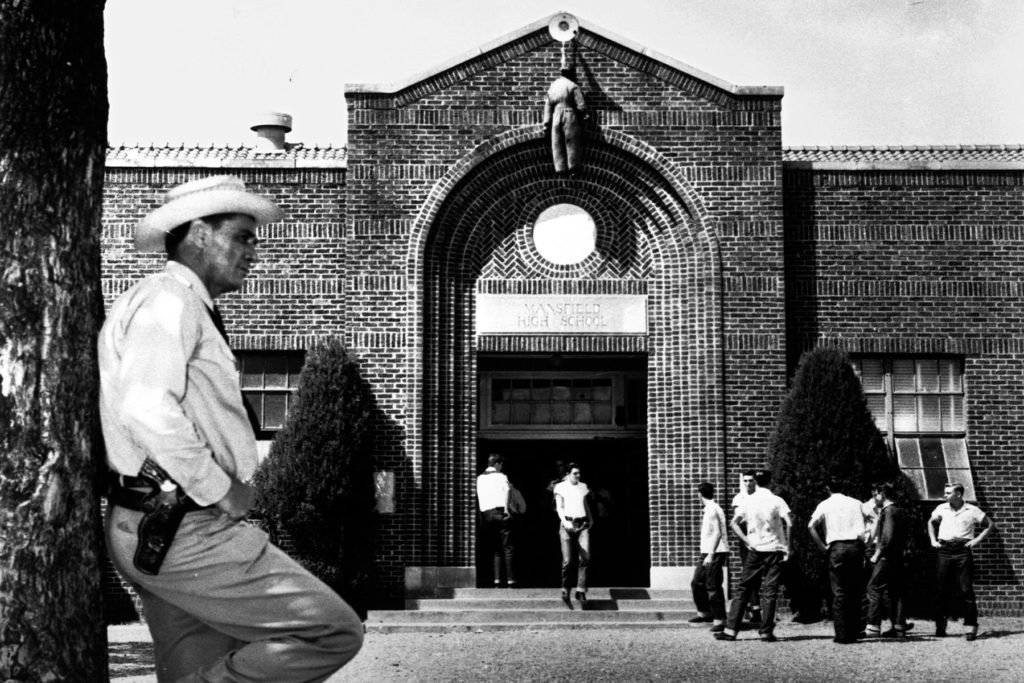
I want to review the story that Swanson tells in my own words, since I want to highlight certain features of it that are important for drawing moral conclusions. In 1956, in keeping with the Brown v Board of Education Supreme Court Decision, the NAACP tried to integrate the high school in Mansfield, Texas. White citizens responded with outrage, threats of violence, and an effigy of a lynched black man strung up at the entrance to the school. The governor responded by sending in the Rangers--not to quell the angry white supremacist crowds and help the black children go to school, but to help the angry white supremacists keep integration from happening.

Let me say that another way: these Rangers were not sent to enforce the law of the land but to help the white citizens of Mansfield to continue segregationist policies in violation of the highest laws of the land.

Jay Banks was the Ranger in command. And he did as ordered. It was his mission to enforce unconstitutional segregationist policies, and he carried it out.

We could imagine a brave officer of the law refusing such a mission on the grounds that his job was to enforce the law, not help citizens violate it. We could imagine some Texas Ranger taking a principled stand for justice in that moment in history, bucking the white supremacist values that were so widespread and instead speaking a prophetic moral message of racial equality. It would make a great story. But Jay Banks was not the hero in such a story. He made no such courageous stand.

Nor did he did make any attempt to disperse the violence-threatening mob of white citizens who were gathered to defy US law and enforce white supremacist principles.

Nor did he make any attempt to take down the sinister effigy of a lynched Black man--a symbol used to terrorize the Black population of Mansfield just as lynchings and the threat of lynchings have been used for generations to terrorize Black people. He let that stay up.

Here's a picture of Jay Banks, leaning against a tree in front of the school, the dangling effigy in place:

Ranger EJ Banks in front of Mansfield Highschool


When asked about it later, he explained his actions as follows: “They were just ‘salt of the earth’ citizens. They were concerned because they were convinced that someone was trying to interfere with their way of life.”

Banks and the Rangers dispatched to Mansfield were successful. As Swanson notes about the high school integration effort, "Blacks were so intimidated that none attempted to enroll at Mansfield." When two young Black people, aged 17 and 18, attempted to enroll at the local junior college, they were met by an angry mob--one that a Life Magazine photographer described as among the meanest he'd ever seen.

The Rangers, including Banks, stood with the mob. They made no attempt to disperse the mob but, instead, threatened to arrest the two young Black people, who then retreated. Afterwards, the White Citizens Council treated Banks to a chicken dinner.

So what does all of this tell us? What I know specifically about Banks' career overall is limited to what I just shared. But I assume that he did many good things in the course of a career in law enforcement. I assume he apprehended violent criminals and helped to prevent acts of violence. I assume he protected innocent people from harm and gave a helping hand to people in trouble. Maybe he helped a lost child find her parents. Maybe he stood his ground in the face of dire threats to his life in order to keep other people alive. Maybe he saw people broken down on the side of the highway and stopped to help.

But when I use the word "people," I wonder who these people are. Because here's the thing: in Mansfield, Texas, a mob comprised of one segment of the population threatened violence against another. They hoisted up one of the most terrible, terrifying symbolic images one can imagine: a lynched body, a symbol of hanging someone until dead. A Black body, of course, not a White one. The symbol probably did not instill terror in Whites. But it surely did to the Black citizens of Mansfield. It said to them, loudly and forcefully, "We will murder you if you exercise your newly-acknowledged legal right to attend this school."

Jay Banks called the people who delivered this message "the salt of the earth." He defended them on the grounds that "someone" was trying to "interfere with their way of life."

And he acted to protect their way of life from the "someone" who threatened it.

He saw that as his job. He did not protest it or resist it. He saw it as his job: to serve and protect the White community and its way of life from the threat posed by Blacks, by the prospect of Black equality, and by those outsiders (whatever their color) who worked for equality and justice.

I keep returning to this portrayal of violence-threatening mobs as "the salt of the earth," because it communicates a vision of what law enforcement is about, a vision that's bound up with white supremacy. Mobs that gather and threaten violence in order to thwart people from doing what the highest law in the land says they have a legal right to do? THAT is the very definition of lawlessness. A commitment to law enforcement that was impartial with respect to race would balk at defending such a mob.

In order to do what Jay Banks did in Mansfield, he had to have an understanding of his role, of his purpose, that was not impartial with respect to race. He had to believe that it was his mission to protect and serve White people--and a big part of what he was supposed to protect them against was the threat posed by Blacks. Not just Black violence, but Black presumption--the presumption of equality and dignity and respect that trying to enroll in a junior college represents.

This means that Jay Banks did not merely see his role as being about protecting and serving White citizens but about protecting and serving their White privilege. He stood with the White citizens of Mansfield to face down that threat to their privilege posed by integration.

Now let me pause here and say something important: I'm not claiming here that Jay Banks was some kind of moral monster who helped to fire up the racist sentiments in Mansfield. Far from it. In seeing things the way that he did, and in seeing his role as a law enforcement officer as he did, he was probably pretty normal.

It was probably how he was raised to see things. It had to be, for him to look at mobs threatening Black children with lynching and call then the salt of the earth. The people who did this were his people, people like him who were raised to think as he did about race in America. And he saw his job as a Texas Ranger not to be the egalitarian administration of justice or the unbiased enforcement of the law but the protection of these White citizens and their privilege, even against threats that came from the law itself--from the highest law of the land, the Constitution of the United States of America and the rulings of the Supreme Court.

The way that an officer of the law carries out an assignment like this tells us how that officer of the law sees his role and his purpose in society. And what we see on display here is a racialized vision of law enforcement. It is about protecting and serving White citizens and their privilege. It is about protecting them from the threats posed by Black citizens (although I doubt he'd call them citizens), whether that threat came in the form of theft or promised violence, or whether it came from the attempt to assert equality and dignity.

The fact that this way of seeing things was commonplace at the time may well serve to soften the force of our moral repudiation. Today, people know better and have no excuse for thinking in a such a way--but maybe in Jay Banks' day, they didn't know better. Or perhaps they were just beginning to encounter the insights that could help them to know better. In terms of assessing the moral blameworthiness of people in the past, it can lead us into trouble if we simply apply our contemporary standards and values without qualification. While I believe injustice is injustice no matter what the era, understandable cultural blindness can partly excuse people for failing to be just, even if such blindness can never make injustice anything other than wrong.

But in taking down a statue of someone from the past, the issue at hand is not how we should morally assess the overall moral praiseworthiness or blameworthiness of the person represented in the statue. The question is what values we want to symbolically affirm today with the public symbols we choose to display.

The fact is that precisely because Jay Banks was a man of his time rather than a man ahead of his time, he represents something far bigger than himself: he represents a vision of law enforcement that has for generations led to the marginalization and violation of Black Americans. It is precisely this vision of law enforcement whose legacy we have to cast off if we want to move into a future in which fewer George Floyds are murdered by police officers. It is precisely this vision of law enforcement that has no place in any system of law enforcement today. Not that it did back then, either, but we have the clarity of vision today to stand against that vision and to lift up in its place one that is truly egalitarian and just.

To do that, we need to clearly repudiate racist visions of law enforcement. This is what the historic moment we are in calls for: unambiguous repudiation of the vision of law enforcement that sees the mission of police to be the protection of White Americans and White privilege against the threats posed by people of color and their demands for equal dignity and respect.

In other words, this moment in history calls us to unambiguously repudiate the vision of law enforcement that Jay Banks represents--the one so clearly on display during his defining moments in Mansfield, Texas. He was perhaps no more guilty than anyone else in his day for affirming and acting on such a racist vision. Still, he was an uncritical agent of that racist vision and its evils. And that means he represents this vision. And there is no way to unambiguously repudiate that vision while, at the same time, leaving intact a symbol in a public space that lifts up someone whose career represents it.

At the same time, a public act of taking down such a symbol is a public message with its own symbolic meaning: "We are turning away from this racist conceptions of policing; we are choosing not to honor it."

Of course, there are difficulties here because public symbols are complex. This is especially true of the public symbols that are tied to the legacy of human lives, such as statues and the names of famous people attached to building or streets or town squares. No human being symbolizes just one thing. And neither does Jay Banks. And there are surely things in Jay Banks' life that we want to lift up today.

If we look at the lives of those officers of the law who, in earlier generations, saw their mission through racist lenses and went out to serve and protect White citizens while keep Black ones down--if we are honest and fair as we examine their stories, we will find them standing for things we want to honor: their courage in facing danger for the sake of the helpless, for example. But surely we can find people in our history who exemplify these virtues without the limitations that racism imposes on their expression. It's probably true that, at some point, Jay Banks went out of his way to help a child. But my guess is it was a white child, and that he wouldn't have shown the same compassion for a black child. But surely there are law officers in the state of Texas who have shown compassion without racist constraints. So let's honor those officer.

If we want to honor the virtues of law enforcement without also honoring the racist history of policing in America, let's find those prophetic officers who stood for racial equality when it wasn't popular to do so, the ones who were asked to enforce inequality and said no. Let's find the officers who took a stand for racial justice. Let's find Black officers who had the courage to take up a calling in law enforcement despite a hostile environment, who blazed a trail paved with moral courage and helped to challenge racist assumptions.

Let's find those officers who represent the values we want our law enforcement agencies today to embody. Let's commission statues of them.

Maybe the people of Dallas want to lift up what is best in the history of the Texas Rangers. So let's find someone who can symbolize that--someone who saw the mission of the Rangers as demanding opposition to racist oppression rather than someone who happily went along with a Governor's order to enforce racial oppression. Surely in the storied ranks of the Texas Rangers it is possible find such a person, right?

So find that person, make a statue, and erect it where Jay Banks' statue used to stand. One statue, one symbolic gesture that affirms our community's opposition to racist law enforcement and the respect we hold for those officers of the law who truly embody a commitment to equality under the law, to even-handed administration of legal justice, to fairness and dignity, to the idea of serving and protecting everyone in the community regardless of such markers as race or ethnicity, creed or sexuality.

Our symbols matter. Even one symbolic change can, like a Texas Ranger wading into a riot alone, make a big difference in who feels included in the community, who feels marginalized, who sees law enforcement as an ally in the quest to live a good life, and who sees law enforcement as a threat.

In this historic moment, let us make the kinds of symbolic changes that reflect the values of equality and justice and human dignity that can help us move towards a more inclusive and harmonious nation.

Wednesday, May 27, 2020

I Can't Breathe

"I can't breathe."

There are people out there these days who are protesting rules that require wearing masks during this pandemic. They think the law is pressing itself into their lives, restricting their freedom. Some complain that it's hard to breathe in those things.

The force of law, restricting their breath.

"I can't breathe."

Eric Garner was put in a choke hold after being detained by police for selling loose cigarettes. We know how it ended: Eric Garner died and the police officer walked free.

The force of the law, restricting his breath.

A year later, in Tulsa, Eric Harris was fleeing the police. He died when a volunteer reserve deputy shot him after he'd already been tackled. It was apparently a mistake: the volunteer meant to pull out his taser but instead pulled out his gun. As Harris was dying, he gasped out, "I'm losing my breath." The deputy responded, "F**k your breath." Perhaps they were the last words he heard before he died.

The force of the law, restricting his breath.

The other day a police officer knelt on the throat of George Floyd, who was suspected of forgery and resisted when the officers tried to arrest him. He gasped for breath, gasped out the words, "I can't breathe." Onlookers became involved, afraid for Floyd's life, asking the officer to relent. The police officer did not relent. Floyd was picked up by an ambulance but he died.

The force of the law, restricting his breath.

Stopping it. Ending it.

An utterly predictable ending in this most recent case. I saw the size of the officer who had his knee on George Floyd's throat. I know that if someone that size had their knee on my throat for thirty seconds or less, I'd almost certainly die. George Floyd looked bigger and stronger than me, so I'd give it a little longer. Still, this was a murderous form of restraint. A deadly form of restraint. Certainly not the only thing the officer could have possibly done under the circumstances with an unarmed man being arrested for a nonviolent crime.

Three black men who couldn't breathe. Three black men who lost their lives. And they are only a few among many.

Most police officers have not ended someone's life by cutting off their air supply, certainly not by kneeling on the suspect's throat. We need to point that out. But it isn't enough to point this out. We also need to ask how many, under identical circumstances, would do the same.

I hope the answer is not many. I think the police officers I know would be critical of what this officer did. We need to point that out. But pointing that out is not enough. Because we also need to ask how many police officers will circle the wagons and defend those in their ranks who cut off someone's breath.

I hope the answer is that far fewer will do so this time than has happened in the past. And if this is right, we need to point that out. But again, pointing that out is not enough. We need to ask other questions, broader questions:

How many in our society will look at what happened and say, "He shouldn't have resisted when the cops came to arrest him. It's his own fault." As if the death penalty is the right punishment--imposed without judge or jury, there on the scene, on the street, caught between a tire and the weight of a man's body concentrated through the knee and applied to the throat. As if that is what resisting arrest deserves.

How many will say, "The man was big and dangerous, and when he resisted they had to subdue him. They had no choice." As if, in a confrontation between an unarmed man outnumbered by armed police trained in various methods of restraint, there was no other possible choice but to kneel on his throat and keep kneeling on it even after he started gasping, even after it was clear that he was struggling to breathe, to live, to live one more moment if not another day. "No alternative. Gotta do it. Big black guy. Dangerous. Gotta put him down like a mad dog." How many say such things? And of those who don't say it, how many think it?

How many in our society, even if they do not think such things, are hesitant to speak against blatant inhumanity, homicidal inhumanity, for fear of alienating those in their circle of friends and family who do think such things?

This is not just about a single person committing a single homicidal act. That police officer who killed George Floyd is clearly responsible for his actions, but the rest of us are responsible for how we respond to those actions. The rest of us are responsible for shaping and reshaping our shared culture and society.

Do we shape it in ways that minimize the gravity of such crimes? Do we shape it in ways that help to form the hot thin soup out of which such crimes evolve?

Do we shape it in ways that result in Black lives being treated as less precious than white lives? Do we shape it in ways that, while virtuously condemning overt in-your-face racism, perpetuate a quiet refusal to consider how implicit biases and unconscious prejudices create a more dangerous world for our Black neighbors?

If so, then our voices are there, helping to shape the words of the officer who said "F**k your breath" to a dying man.

Or are we, instead, gagging along with Eric Garner, Eric Harris, and George Floyd? Are we encouraging the empathy that is required to see the humanity, the image of God, the face of God, in strangers who are dying on the street? Do we feel the everyday racism that our Black neighbors endure as a weight on our own shoulders, even if we aren't ourselves Black and even if we cannot fully inhabit or understand it? Do we endeavor to do so with enough persistence and compassion to at least try to envision what it is like to be Black in America and to see white police officers ending the lives of unarmed Black men only to be acquitted time and time again, and to see white vigilantes gunning down Black joggers and not be charged until there is a public outcry?

If so, then how can we not find ourselves vicariously gasping and crying out, "I can't breathe"?

Since I started by talking about face masks, let me return to that now--because I think there some lessons there.

Except in rare cases, a cloth face mask does very little to restrict breathing. People can wear it for hours and suffer no ill effects except for mild discomfort, fogged eyeglasses, and some chafing. These masks help keep asymptomatic carriers of COVID-19 from unwittingly spreading it to others, by trapping the respiratory droplets that spread the disease before they can splash outward into the grocery store or the pharmacy. Any law or policy requiring you to wear such a mask is not intended for your safety. It is intended for the safety of those around you. But the policy only works if everyone does their part.

There are two lessons to draw from this. The first is this. Except in rare cases where medical conditions make mask-wearing harmful, those who complain that they can't breathe when they wear a mask are operating from a position of privilege. They are operating from a space of unfettered breathing, from a social space in which they are used to filling their lungs and breathing out across their world without a care. The restriction is nothing compared to the knee at George Floyd's throat. So if you think the mask is the law demanding too much, then so is the knee. If the mask calls for protests and rallies and hours of your time fighting in the name of human breath free of legal tyranny, than all the more so should the knee demand the same. Perhaps something even more dramatic, more sustained, than quietly taking a knee during the National Anthem at a football game.

And here is the second lesson: the mask requirement is about collective responsibility. It is a small thing, but if all of us collectively do it the outcome could be dramatic: people alive who would otherwise be dead; small businesses able to stay afloat which would die if another surge in the pandemic created the need for more sheltering in place. All of us do this little thing, and the burden of the pandemic will be eased from the shoulders of the minority who fall into the highest risk categories. We all do our little part, a tiny inconvenience, and people live who otherwise would have died--like my mother who is in her 80s, or my mother-in-law who is in her 70s and has diabetes.

This is about collective action: everyone seeing themselves as part of the solution rather than treating it as someone else's problem. That is what the masks represent. And that is what is required to change our society enough that our Black neighbors can breathe easier.

The problem of racism is in part a problem of overt racist people acting out their hate in the world. If and when police officers are identified as such overt racists, they should be fired. And when their acts rise to the level of crimes, they should be punished.

But the problem of racism is also a problem of hidden systemic forces and widespread patterns of thinking and acting that are most unconscious and, individually, probably not very harmful. Let's call this the problem of systemic and implicit racism. With respect to this problem, it is a mistake to single out the police as some special locus of systemic and implicit racism. That's just a trick some people play--people who aren't police officers, often white liberals--to avoid responsibility. The problem of systemic and implicit racism is everywhere, including in the system of higher education of which I am a part.

What we need is collective action and collective responsibility. What we need is a willingness to take action from our place of privilege, despite the chafing and the fogging of our glasses, so that someone lives who otherwise would have died.

In the case of systemic and implicit racism, the steps are less obvious and more complicated than simply putting on a mask before stepping into Walmart. It will be harder work. And just as there are those who refuse to wear a mask, there are those who refuse to do this harder work. But hopefully enough of us hear the anguished cry, "I can't breathe," deep in our bones. Deep enough so it aches. Deep enough so it stirs us to act.

The cynic will say, "I'm not holding my breath." But I am not a cynic. I am a person of faith, and I believe that every breath is a gift. As long we can breathe, we have the power to carry into our world the very breath of God. Let us use it well.

Wednesday, January 8, 2020

Iran, Jesus' Third Way, and the Notion of a Christian Nation

Iran did exactly what they said they'd do. Notice that the US threat of strong reprisals should they do this did not deter them. And when they say that should we strike back they will feel compelled to strike again, that will not deter us. In a dynamic like this, each side from its own perspective sees each escalating act by the other as a new wrong that demands a violent response: an eye taken that demands an eye be taken, a tooth knocked out that demands the knocking out of a tooth. We never reach a point where things are "even" because each side has their own moral perspective from which the other side's act of getting even is seen as a new affront that demands that we get even. That's the engine that drives escalation to all-out war.

And the entire pattern of thinking and relating that creates this engine makes the world a far worse place than it would be if we could only cultivate a "third way" of response--an alternative both to "taking it" and to "striking back in kind."

This kind of third way was what Jesus was attempting to describe in the Sermon on the Mount. As theologian Walter Wink noted, turning the other cheek was not for Jesus a call to simply endure abuse but a call for a creative third way of response that neither strikes back in kind nor meekly submits. It matters, for understanding Jesus, that he specified that if someone strikes your right cheek you turn the left cheek to them. This matters because a blow to the right cheek was the kind of back-handed blow a master would use to strike a slave. A blow to the left cheek was a blow that one struck against a perceived equal. Turning the other cheek was thus an example of a creative way to assert one's equal dignity in the face of a demeaning attack, without striking back in kind. (Wink offers a similar analysis of walking the second mile and giving all of one's clothes to the one who demands your outer garment.)

Jesus did not here offer a specific solution to be used in every conflict but rather a way of thinking about conflict, a way of approaching conflict, distinct from the eye-for-eye approach that serves as an engine of escalation. This different approach, this third way, demands thought and planning and imagination. It cannot be carried out by rote but by bringing thoughtful people to the table who understand the enemy and how our actions will affect them. Massive symbolic gestures that startle and disarm, responses that make continuing to strike culturally costly or shameful, responses where the only face-saving move is not to escalate. Responses that aren't in the script, that leave everyone momentarily stunned.

Imagine if we as a nation devoted a fraction of what we devote to the military towards the cultivation of our capacity to launch such creative third-way responses. Imagine if we were as committed to developing and implementing such responses as we are to developing and implementing effective military ones. To imagine such a thing is to imagine a nation that as a matter of national policy takes seriously Jesus' strategy for responding to violence and injustice. To imagine such a thing is, in a real sense, to imagine a Christian nation.

In this sense, the world has never seen a truly Christian nation. Perhaps we never will.

Thursday, July 4, 2019

America's Values: A Fourth of July Meditation

"We hold these truths to be self-evident, that all men are created equal, that they are endowed by their Creator with certain unalienable Rights, that among these are Life, Liberty and the pursuit of Happiness."

These are America's founding values, which we celebrate today. As we understand them now, they do not apply only to men. They affirm that all people have an equal moral worth and have a claim on equal basic rights, and that this moral standing is derived not from any government or law but is an original endowment.

While Jefferson invoked the language of "Nature's God" to describe the Creator of this original endowment--a reference to his Enlightenment Deist philosophy--I understand this Creator in Judeo-Christian terms. Others have different understandings. Jefferson and other founders later affirmed their commitment to this freedom of religion in various ways

But what I want to meditate on here is the idea that equality and basic moral rights precede any government or nation-state. This basic moral standing, enjoyed by all human beings without exception, determines when a law is legitimate and when a government has exceeded its authority. Our country was founded on the idea that the equal right to life, liberty and the pursuit of happiness isn't something we have because we belong to a society that grants this to us. On the contrary, our society is obligated to honor and protect it because we already have it.

We were born with it. We possess it because we are human.

Not because of our race or gender or political party. Not because we are Americans. We have the right to life, liberty, and the pursuit of happiness because we are human.

That means that we distort or even betray our country's founding values if we hold that they only apply to Americans.

To be an American is to believe that all people everywhere were created equal.

To be an American is to believe that all people everywhere have the inalienable right to life, to liberty, to the pursuit of happiness.

And it is to believe that if any government--including our own--makes laws or pursues policies that violate these rights toward any person, American or otherwise, that government has acted wrongly.

This is why Americans have never been able to get uniformly behind isolationist policies. If these values at the heart of America are about all people and not just Americans, then we should care about what happens to people elsewhere in the world. That doesn't mean we should always intervene. It certainly doesn't mean we must always try to impose our will coercively on other people. But it does mean we have to pay attention to the plight of those outside our borders, care about that plight, and take that into account when making decisions.

This is why Americans have never been able to get uniformly behind the idea that being an American is about blood or birth. By blood and birth, all human beings have the same inalienable rights, whether they were born in Nebraska or Nicaragua or Norway or Nigeria. Being an American is most fundamentally about allegiance to this ideal and commitment to civic participation in a society committed to it. For all its history, despite forces of opposition born from the human tribal impulse, America has continued to welcome new Americans into this noble experiment, this effort to build a country based on values opposed to tribalism.

What all of this means for our immigration policies today is a difficult question that I don't want to try to answer here. Our values must contend with an array of realities, including resource limits, when it comes time to decide specific policies. But some general principles are clear. We must care about those beyond our borders. We must care about those who are not American citizens. And with respect to migrants at our borders, any policy that fails to honor their equal human right to life, liberty, and the pursuit of happiness is in violation of our founding values.

All human beings are created equal, not just Americans. All have the inalienable right to life, liberty, and the pursuit of happiness, not just Americans.

To think otherwise is un-American.

Tuesday, April 30, 2019

It's About the Hate: Targeting Religious Worshipers

Christians targeted during worship by violent extremists in Sri Lanka.

Muslims targeted during worship by violent extremists in New Zealand.

Jews targeted during worship by violent extremists in the United States, in Pittsburgh this fall and today in San Diego.

In all cases the root evil is an us/them ideology of hate. The in-groups and out-groups that the ideology latches onto may be different, but that's ultimately incidental. What matters is the hate.

The agents of hate aren't made that way by some feature of the wider faith tradition, ethnicity, etc., with which they identify. Hate always has a cover story, but the hate comes first. If the hate springs from someone who wears Christianity as a label, you can be sure that the ugliest verses in the Bible are lifted up and the call to love explained away. If the hate springs from someone who wears Islam as a label, you can be sure that the ugliest verses of the Koran are lifted up and the calls for decency and respect across differences explained away.

Hate isn't motivated by anything about its target, but it needs a target. And it needs vindication, some "purpose" that the agents of hate can give themselves over to, so that they can see themselves as foot soldiers in a cause greater than themselves. They want to indulge in the most evil of human impulses, but want to do it with a clean conscience. They want to glory in violence and death while experiencing pureness of heart.

And so they make a class of people into monsters, and they conceive themselves to be noble warriors fighting for a chosen group--a group destined for greatness or happiness by virtue of their intrinsic worth, but kept down by the very existence of the monsters.

And so they tell themselves that every death and defeat of those they consider the Children of Darkness is a gain for the Children of Light. They indulge evil in the name of good, declaring themselves heroes, laboring to build some imagined Utopia out of the corpses of the innocent.

In my first book, Is God a Delusion?, I distinguish between religion and religionism. The former offers a way of thinking about the world and a way of living life, something around which communities can form. Religionism is about using religious differences in the same manner that racism uses racial distinctions and nationalism uses nationalities: as a way to divide the world and set us against them. It is about hate above all else.

In fact, it is hard to disentangle this species of hate from others. Is anti-Semitism about religion or ethnicity? Is Islamophobia targeting people because of their faith tradition or because of middle-eastern origins? The answer is that, for the person infected by an ideology of hate, it doesn't matter. Because the point is to have a group to hate, someone that is worthy of hate regardless of who they are and what they do or what kind of life they lead. Automatic, easy hate, hate that can latch on without needing to investigate the actual character or life of the person being hated.

Whether it's religion or ethnicity or race doesn't much matter, and typically an ideology of hate uses more than one thing. Ideologies of hate are vague and ecclectic in who they target, precisely because what matters is to be able to hate someone.

This is why Jews become afraid when Islamophobia is nurtured, why African Americans feel less safe in church when a Mosque has been recently targeted. Because it's about hate. And hate breeds hate.

Such ideological hate, described beautifully by Sartre in his short book, Anti-Semite and Jew, is a demon. It possesses human beings. It is a demon that thrives and spread best under a distinctive set of conditions: when empathy is restricted to people like ourselves, when building walls matters more than building bridges, when communities become insular and polarized, when fear displaces hope, and when security for "us" matters more than compassion.

Christianity is just one faith tradition that urges us to love. All over the world, in different ways and with different words, that call can be heard.

And yet, all over the world, people find ways to put limits on the scope of that call. The more we do the latter--the more we justify limits on love and the less we aspire to love every single other person (even when we fail, as we inevitably do)--the easier it becomes for ideologies of hate to take root.

And here's the thing: we can't control others' commitment to loving widely. We can only choose in our own case, and invite others to follow our example. And as hateful rhetoric becomes louder--as it finds its way into more prominent places--love has to become louder, too.

When hate spreads, we must look for ways to amplify the voice of extravagant love.

Monday, April 22, 2019

Death's Persistent Sting: Meditation for an Easter Monday

"O death, where is thy sting?"

I woke up Easter morning to the news of terror in Sri Lanka: hundreds dead, many hundreds more injured, in a series of coordinated bombing attacks on hotels and Christian churches. I blinked back horror...and then I got up, dressed for Easter services, and went on with my day.

I felt the sting, but it was a small one: a remote horror, the death of people I do not know on the far side of the world. It felt insufficient, this little sting, as if my compassion were too weak to reach across the miles.

Where is your sting, death? It is here, here in the news of hundreds killed. But it is too small.

"O death, where is the sting?"

For Easter services I put on the cream-colored silk jacket that I inherited from him after his death. It is the jacket he's wearing in one of my favorite pictures of him, the picture that was the centerpiece at his memorial service and that depicts him as I most remember him.

It was his favorite jacket for special occasions. In the last decade or more of his life, if the occasion called for dressing up, this jacket was what he'd put on. And I'd joke: "That jacket is mine when you die."

I rarely wear it, because I want it to last. And when I do take it out I see my father and feel afresh his absence. Sometimes it feels like a kind of treason that it doesn't hurt more.

Where is your sting, death? It is here in this pale silk and the memories it evokes.

"O death, where is thy sting?"

I have friends who are staring down the inevitability of death in a way that most of us do not. Confronted with a terminal diagnosis, the truth of human mortality intrudes on their living and in dark moments threatens to paralyze them, to steal away what life they have left--a kind of death before death that they must continually fight against: "You will not take this, too, o death. This day is yet mine to live."

The rest of us know this struggle in a weakened form: the anxiety over strange symptoms or impending storms or trips where so much could go wrong. We hide from it as best we can, but sometimes the inevitability of death rears before us and for a few heartbeats we can't escape it, the sense of a consuming dark. The only question is when: today, tomorrow, thirty years from now?

Where is your sting, death? Here, here in the universal dread.

There are some for whom the dread has faded in the face of something worse: the monotony of lonely hours. Death has taken too many beloved companions, and it's creeping harbinger has stolen away the skills and powers that make living rich and vibrant. And so they sit, reduced to waiting and remembering. Life is something in the past, something gone with the beloved. The fear of death has been replaced by the lonely horror of feeling nothing worth living for.

Where is your sting, death? Here, here in this living death, where death has stung so deep that its victim has come to see death as a welcome escape rather than the architect of the intolerable.

All around us, death stings and stings. And in defiance we lift our voices and say with Paul, "O death, where is the sting?"

We treat it as a rhetorical question.

As if the answer were that it's sting is gone.

As if we didn't feel its sting every day in different ways.

As if the muting of the sting were born of our faith, our capacity to grasp the deeper truths that assure us that death is weaker than life, when in truth it is born of sin, of our failure to care enough.

And yet we lift our voices in defiance and triumph, an exercise in holy pretense. We cry it into existence, this self who has no fear of death--that has lost its fear not because of despair, not because of insufficient compassion, but because we have seized upon a joy more powerful than death.

The joy eludes us. Death keeps stinging us. And yet in heroic, sacred, audacious hope, we keep reaching for that world where death has lost its victory and joy will have no end.


"O death, where is thy sting? O grave, where is thy victory?" 1 Corinthians 15:55

Thursday, April 11, 2019

Buttigieg vs Pence and the Politics of Misconstrual and Deflection

Rising star Pete Buttigieg, the gay Indiana mayor who's running for the Democratic presidential nomination, has recently spoken publicly about former Indiana Governor and current Vice President, Mike Pence--most recently in reference to Pence's well-known anti-LGBT commitments, which Pence (like many Evangelical Christians) roots in his religious beliefs.

Earlier today, Pence replied with the following remark: "He's said some things that are critical of my Christian faith and about me personally. And he knows better. He knows me."

What I struggle with here is what Pence is actually referring to. There are two possibilities that I'm aware of. The most obvious is the most recent, since it happened just days ago.

Here's what Buttigieg said, at a Victory Fund speech on Sunday: “Speaking only for myself, I can tell you that if me being gay was a choice, it was a choice that was made far, far above my pay grade. And that's the thing I wish the Mike Pences of the world would understand. That if you got a problem with who I am, your problem is not with me. Your quarrel, sir, is with my creator.” (You can check out the video here.)

This is a rhetorically effective way of making a point that many LGBT persons have made about their own experience of themselves: their sexuality (for LGB persons) or gender (for trans persons) is not something they chose for some reason or another. It is something they discovered about themselves. It has the kind of givenness that, for LGBT persons of faith like Buttigieg, immediately invokes the thought of divine intent: "If I was made by God, and if this part of me is sewn into my fibers in a way that seems not only a given but a fixed and unchangeable truth about who I am, then it appears as if this is part of God's original design plan for me."

What this comment doesn't do is say anything derogatory about Mike Pence's faith or character.

As someone who recently wrote a book making a Christian case for same-sex marriage, I am well aware than many Christians think all same-sex relationships are morally wrong. I am also well aware that many of these people are persons of deep faith. I don't question their faith. What I question is the accuracy of the moral conclusions they have reached.

It is possible for people of faith to disagree, and to disagree quite strongly, on which moral teachings fit best with their faith tradition, its Scriptures, and its creeds. Such disagreement does not imply any person attack on someone's faith or character.

And so, if this is what Pence was responding to, his response is a kind of non-sequitur. Worse, it is a deliberate misconstrual of Buttigieg's words to make it sound as if Pence were being attacked as a person rather than having the soundness of his views called into question. 

But maybe this recent comment by Buttigieg wasn't what Pence was responding to at all. A little bit of digging shows that this was not Bettigieg's only mention of his state's former governor from the stump. A month ago, Buttigieg had some more extensive remarks about Pence at a town hall in Austin. According to Politico, here are the key elements of those remarks:
...he previously trusted that Pence “at least he believes in our institutions” and did not consider him to be “personally corrupt.” 
“But then how could he get on board with this presidency?” Buttigieg said. 
Buttigieg said that while his understanding of the Bible was rooted in "protecting the stranger and the prisoner and the poor person," Pence's reading of the Gospel "has a lot more to do with sexuality" and "a certain view of rectitude." 
“But even if you buy into that, how could he allow himself to become the cheerleader of the porn star presidency?” Buttigieg added. 
“Is it that he stopped believing in Scripture when he started believing Donald Trump? I don't know.”
Here, Buttigieg opens with an impression of Pence that he formed before Pence became Vice President, an impression that for Buttigieg has started to crumble--because of Pence's role in the Trump presidency.

That Trump has little respect for (or even understanding of) American institutions and is prone towards kleptocratic corruption may be controversial claims among Trump's fans, but for others it seems beyond self-evident given his record. Buttigieg is clearly among the latter. And for the latter, it is surely deeply perplexing how someone who actually respects US institutions and has a sense of personal moral rectitude could function as the kind of uncritical voice and cheerleader for the Trump administration that Pence appears to be.

The reference to "porn star" presidency, of course, is a glancing way to reference the well-known fact that Trump had adulterous sex with porn stars and paid them off to keep them quiet--something that speaks to how deeply Trump defies basic standards of personal ethics to which conservative Christians like Pence cleave.

And even if Pence's version of Christian ethics focuses more on sexuality than on "protecting the stranger and the prisoner and the poor person," the latter must still be something that Christians like Pence care about if they claim to take Scripture as their guide.

To me and Buttigieg and many others, it looks as if many of Trump's policies are sharply at odds with those values--most notably his policies for dealing with poor refugees who have made a desperate trek to our borders in search of a better life. Even if we must as a nation care about security and the rule of law, the rhetorical and literal harshness of the Trump administration's approach to these desperate human beings defies the heart of what Jesus and the Jewish prophets preached. There are ways of securing our borders and upholding the rule of law that don't involve ripping babies out of their mothers' arms and creating concentration camps for refugees and refusing to consider taking in desperate refugees from war-ravaged Muslim-majority nations.

Of course, the Trump administration is hardly the first to be implicated in policy decisions that Christians ought to have trouble with. Both Democratic and Republican administrations before this one have made choices that, from the standpoint of Christian values, warrant concern or even outrage. And Trump is hardly the first president to fall short in terms of Christian standards of sexual fidelity in marriage (Bill Clinton, anyone?).

But it seems to many people today that the current administration has lifted things to a new level, especially when it comes to issues of immigration. And when one listens to the way Trump talks about his political opponents and the poor refugees who have stumbled and struggled hundreds of miles to seek a better life, there is a difference in tone. If one listens to the rhetoric of Obama and Bush and Clinton and Bush Sr. and Reagan and Carter, one would often hear expressions of compassion even in the face of hard policies justified by the perception of political necessity. One would be hard-pressed to find words that sounded gleefully cruel.

But sometimes, unless I am staggeringly misreading him, Trump appears to take a kind of pleasure in responding to the desperation of refugees with a curt dismissal like, "Our country is full." (And as Wayne Cornelius recently noted in a Chicago Tribune commentary, "The reality is quite different.")

The point is this: such a tone is one I could not imagine Mike Pence ever using. Pence calls himself a devout Christian, and he is right now the second-most-powerful politician in the United States. While the separation of church and state means Pence shouldn't use this power to, say, favor Christian churches over other religious institutions, the separation of church and state does not prevent our political leaders from having a conscience and being informed by that conscience as they make decisions. And Pence's conscience is a Christian one.

And yet, based on the publicly available evidence, Pence has been nothing but a bulwark of uncritical support for Trump and his policies.

Buttigieg's perplexity makes perfect sense to me. What does it look like for a man of deep Christian faith to find himself as vice president to Donald Trump? I guess my answer is the same as Buttigieg's: "I don't know."

But if these remarks are what Pence was responding to when he said, "He's said some things that are critical of my Christian faith and about me personally," then one would really hope for something more in response than, "He knows better. He knows me." Because Buttigieg was asking questions. Buttigieg was asking, "How could you?" To treat such questions, rooted in an apparent dissonance between Pence's outward behavior and his professed faith, as nothing but a personal attack is like...

...well, it's like when devout Christians confront atrocities that bring home the magnitude of evil in the world and feel the dissonance between the pervasiveness of such horror and the message that the world is the creation of a God of love. "How could you, God?" they cry. "How could you allow such things?"

That's not a personal attack. And even if it might be fitting for God to answer such a question from the whirlwind with something like, "You're too small to understand," Mike Pence isn't God. He's just a human being like Pete Buttigieg.

Maybe, just maybe, Pence meant something different by his response than, "How dare you attack my faith and character?" Maybe he meant to say, in some subtle way, that he was doing more to minimize the harms of a Trump presidency than it looks like to the public eye. Maybe he was saying something like, "You know me, Pete. You know my character, and so you know there is a reason why things look the way they do, even though you can't see what it is." Maybe, in other words, his comment was intended as a small bit of reassurance: "It looks bad, but I'm doing what I can."

Or maybe it was just a strategy of deflection: to push aside Buttigieg's questions and the dissonance that gives rise to them. If he pretends that Buttigieg's remarks amount to nothing more than a personal attack, he doesn't need to answer the questions or account for the perceived dissonance. He can just be indignant.

But there are many people for whom Buttigieg's questions seem like real questions that call for more than indignation. I, for one, would like to hear Pence's answers.